

INDIANAPOLIS (Nov. 14, 2009)—The marching band from Center Grove High School in Greenwood, Ind., draws on the music of French composer Camille Saint-Saëns, perhaps best known for his Carnival of the Animals, from which he only allowed one number, “The Swan” for cello and piano, to be published during his lifetime, and the music of Hollywood composer Danny Elfman for their field show in the semi-final and final competition at the Bands of America Grand National Championships at Lucas Oil Stadium.

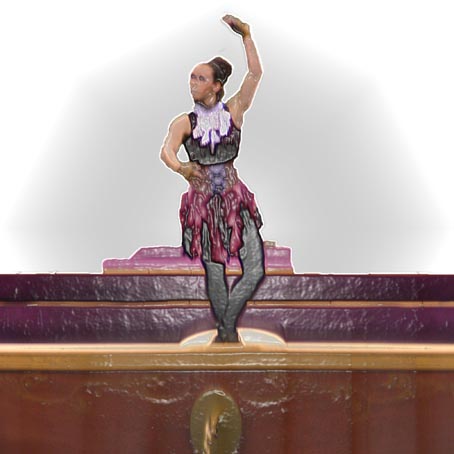
The photo above has been modified for artistic purposes: A tuxedo-clad band member winds up a music box, and then the lid opens. A doll stands up, nearly lifeless in her stare, and turns around in time with the music. Every detail, from her hair to her arm position to her clothes, to the golden lock and the box itself, is picture-perfect.

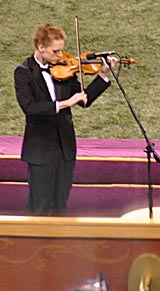
Music here is “Ice Dance” by Danny Elfman, “Danse Macabre” by Camille Saint-Saëns, “Music Ricercata” by George Legeti, and “Dies Irae” by David Reeves and Michael Klesch. Later, that same wind-up person, looking macabre himself, treats us to a rich viola solo. It segues to some saxophone music and comes right back to the viola.
Then, as if the pale-faced violist and the lifeless music-box dancer weren’t dark enough, black curtains stand as a mysterious backdrop over the entire field. Emotionless dancers do their thing in front of those for a while. Another dance involves five band members rolling on the floor, kicking their legs up high, as the drumline moves right through them.
They look good standing still and in motion.
The marching maneuvers themselves are no less intriguing. At one point, a double-curve formation has marchers moving toward each other from two different arcs, as shown by the arrows below. Just try to keep your arc smooth without hitting the other arc head-on!

One thing is clear: a show like this, with the elaborate props and the tight marching formations, takes a fair bit of practice. The band practices after school three nights a week and meets for three and a half hours on another night. Every single one of them.
In addition to time, gorgeous wood boxes that have a wind-up mechanism like this don’t just fall off a truck. According to the band, each member pays $575 to participate in the extracurricular, volunteer activity. The money is used for props, travel expenses, extra instructors, and other band needs like the entry fee for this very competition. This is not uncommon, even in public schools, especially for a national-class band like this one.
I would be remiss not to recognize, formally, the parental support that is evident on the field in an organization like the Trojan Band. Even with that much money coming in from the band fees, the Booster organization states that the fees “only provide a third of the budgeted amount needed for each student. The remaining budget comes from donations and fundraisers throughout the year.”
Band members like to say, “It’s on the field.” And that may be true. What we see, and what we usually report, is this:
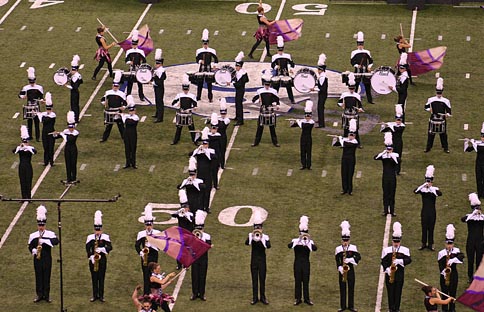
But what you don’t see, what happens off the field, goes into the equation, too. Booster president Jeff Wright, treasurer Larry Baysinger, and parents like them, such as Matt Riggs, who leads the dads during the band’s field set-up, which is timed to the second, make the music-box dancer—and indeed, the whole marching band—possible.
The same story could be told, with different names, different dollar amounts, different payment plans, and so on, for every band here today. Our point in telling it, though, is not so much to encourage or discourage the charging of band fees for students to participate in arts education. Rather, it is to provide yet another piece of evidence that having a marching band, even a championship band, is possible in any school, in any community. It may not be necessary to charge every student $575, but there is a way to make it happen.
Center Grove High School and the community of arts lovers in Greenwood, Ind., found their way, and that has led to the enrichment evident on the field today.
The Trojan Band is directed by Kevin Schuessler, Joe Lapka, and Josh Torres. Drum majors are Michael Tomkiewicz, Kelsey Williams, and Melissa Guerrero. The band was named grand national champion in 1995, and it will happen again.