

INDIANAPOLIS (Nov. 14, 2009)—The year 2009 marks the 200th anniversary of the birth of American writer Edgar Allan Poe, most well-known perhaps for his short story “The Pit and the Pendulum” and for his poem “The Raven.” The marching band from Plymouth-Canton Educational Park in Canton, Mich., pays tribute to Poe in their field show, using music from the second movement (allegro molto) of Dimitri Shostakovich’s “Prelude and Scherzo for Strings.”
Georgetown University scholar Joseph Fruscione said, “There’s something very accessible about Poe, and a lot beneath the surface.”
The band takes the field here in semi-final competition at Lucas Oil Stadium for the Bands of America Grand National Championships, with a show entitled, appropriately enough, “Beneath the Surface.”
However, there’s hardly anyone on the field when we first catch glimpse of the pit (pun intended). That’s because most of them have been trapped, beneath the surface—where else?—of a 9-yard-by-9-yard floor that has been raised up about a yard.


Arms soon start to poke through, though, then whole people, first through the floor and then out the sides. For those of you who know your Poe, it might seem to be a scene from his short story “The Fall of the House of Usher,” which focuses on being buried alive and the state of mental illness.
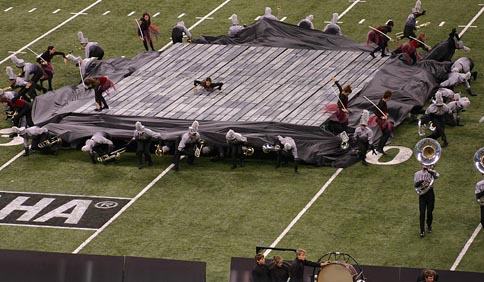
They’ve become mad, I tell you, mad, throwing their bodies into every manner of contortion. Being under that floor could not have been one of those positive, life-changing experiences that the Bands of America organization professes to provide.
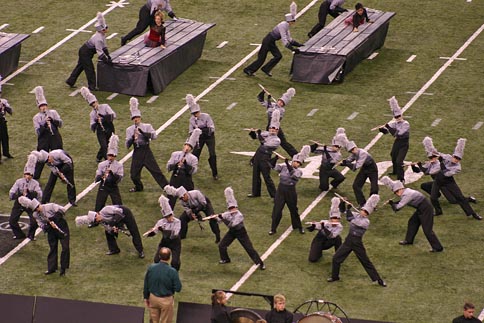
We hear a girl crying, “Stop looking at me,” but the flags have eyes. Some of the eyes are so big, they require two color guard dancers to carry around the field.
The macabre will be no stranger to fans of this literary giant, who died at about age 40, but not before producing a tremendous wealth of literature.
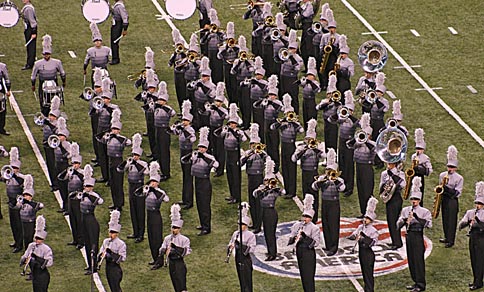
What is perhaps most striking about Poe’s poetry is that it’s marked by an adherence to the beat of a metronome. Most contemporaries were rebelling against that sort of thing, but Poe used it with skill. And it is for this that we speakers of English—and we fans of great music, in all its forms—are truly grateful.
Plymouth-Canton’s band seems to echo our sentiments, ending with chords of stunning beauty after they have shed the chains of the prison under the floor and broken through the proverbial walls that the many secrets we keep from our friends force us to build.
Eventually, they go back into hiding. After all, Poe was a writer of fiction, and what you have seen here has been a diversion, an exploration into what is possible without some of the horrors Poe wrote about, whatever the cause.
But maybe we’re a little wiser for having seen a few scenes from this great writer’s stories told in this way: with music, as language has given us music to express, and by storytellers who are just beginning to figure out the dangers of building walls around—or over—themselves.
The Plymouth-Canton Educational Park marching band is directed by David Ambruster, and drum majors are Caroline Williams, Kayla Ragland, and Kaitlyn Tracy. The band has been named grand national champion three times: consecutively in 1990-1991 and again in 1999.