

INDIANAPOLIS (Nov. 14, 2009)—The Walled Lake Central High School marching band from Walled Lake, Mich., makes great use of movie plots in their semi-final performance at the Bands of America Grand National Championships at the Lucas Oil Stadium.
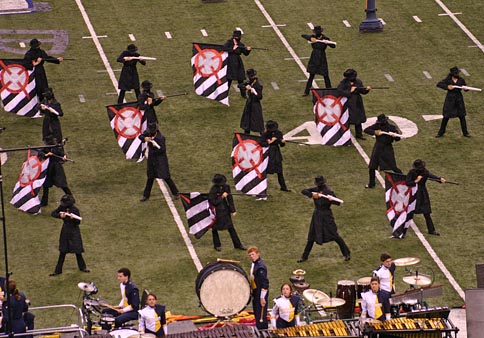

The color guard uses the rifles not only as twirling hardware but as stage prop guns, and it doesn’t stop with the rifles. In one color guard bit, holes are cut into the flags, through which dancers poke their heads. A silhouette of a person is printed on the flag, with the head in the right place. As a person gets shot, she falls to the ground, leaving the flag standing with the silhouette.
Throughout the performance, the narrator says things like “I want them in a bodybag by sundown” and, from the recent film Taken starring Liam Neeson and Maggie Grace, “If you’re looking for ransom, I don’t have money, but what I do have is a very particular set of skills.”
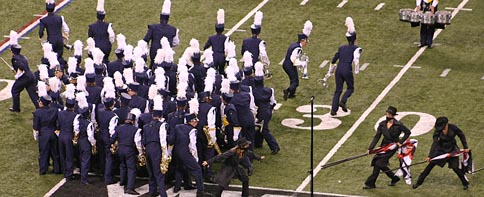
It has been reported that Mr. Neeson was trained in combat and weapons handling by a former Special Air Service soldier in preparation for his role.
What I’m trying to figure out is who came over from the Beijing Olympics to train the band’s gymnasts.
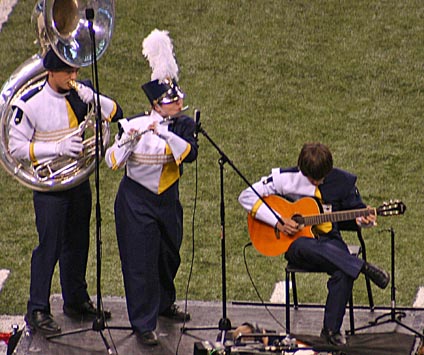
In order to fit the gymnasts into the show, Walled Lake Central uses a trio, including flute, tuba, and acoustic guitar, to cap off one of the show’s middle movements. This leads to an acoustic guitar solo, as the flute and tuba depart.
Spanish dancers take the floor, mainly for the third movement, a tango, in a way that would look familiar to anyone who has seen “Dancing with the Stars.” Then, an all-out tumbling run by two gymnasts from the band, the two Spanish dancers, takes us into the final movement. From what I could see, it would have received a 9 or better from all judges—if this were a gymnastics competition.
But it’s not, is it? It’s a marching band competition. Yes, bands are scored, and the tumbling runs no doubt added to both the visuals score and the general effect points for Walled Lake Central.
“General Effect” is perhaps the least understood component of a marching program, but Walled Lake Central’s show provides a good opportunity to discuss it. As the name implies, the score is higher for bands that are more “effective,” in terms of the artistic and entertainment aspects of their show. Bands that are more entertaining get higher points for general effect than bands that don’t, say, choose appropriate music for their theme, integrate the marching maneuvers with the music or the show’s overall theme, or fill in all the holes.
Many marching band experts have likened the scoring systems to those used in gymnastics. Some systems of marching band scoring even have mandatory penalties. The Bands of America adjudication system, for example, assesses penalties if a band is late, runs over its time limit, and so on, just as gymnasts would have points deducted for taking an extra step after a dismount or something.
The purpose of a competition
The use of an analytical scoring system is rather distant from the artistic ideas marching bands portray, which is perhaps part of the confusion about the meaning of the general effect score. What is entertaining and effective for one judge may not be so entertaining for another. An attempt is made to average out differences of opinion, especially on artistic matters in general effect, but every points-based system for artistic merit will have its flaws.
There are, however, reasons why competition and an analytical scoring model are necessary in order for festivals like this and thousands of others in every state across America to go on. Among these reasons is the need for a tangible goal for students to hold high and directors to show school administrators and/or parents who contribute time and money to school band programs.
Educator Jonathan Kozol, in his book Ordinary Resurrections (New York, Crown, 2000, p. 106), recounts the story of a Hispanic woman whose teachers reduced her goals in school, which caused her parents to lower their expectations for her:
I told [the young woman] of schools I visit in which dozens of black and Hispanic women have been channeled into classes like hairdressing that don’t give the credits they would need to go to four-year colleges but are viewed by educators, and sometimes by students too, as sensible accommodations to diminished possibilities.
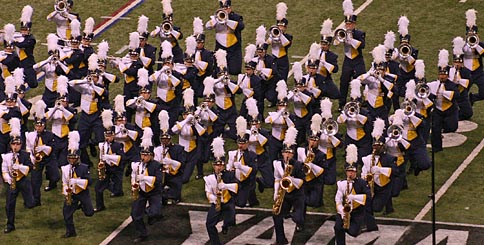
Walled Lake Central shows us, and judges confirm with their scores, that there should not be any “diminished possibilities” when it comes to what high school students can achieve, like the gorgeous trumpet lick I heard executed in unison by at least 10 of the band’s trumpeters. We see, with Walled Lake Central as our proof, students can put together a vast, creative output, one that speaks to us artistically, and practice it until it is good enough to be among the best performed in the nation.
There aren’t all that many issues with Bands of America, but one issue that is brought up by several directors who don’t make the trip to Indianapolis, or to any other Bands of America competition, is that it is a competition in the first place. They often say that “winning” has no meaning.
“Marching Band is a leadership training activity,” fine arts chair Charles Staley, from Neuqua Valley High School in Naperville, Ill., told me. “The musical experience is secondary to the team building marching band promotes. Competitions have their place in a marching band season, but naming a … champion promotes those programs that place too much of an emphasis on marching band. Administrators glom on to … champions and would push music programs to WIN. This would mean more time, money, and energy on the marching band activity. Marching Band should not be the basis for a music program.”
The evidence of money spent on marching programs is never more before us as it is at the Grand National Championships. Bands bring semis to haul their equipment across country. Some need two. Hotels near Lucas Oil Stadium go berserk with band kids, their parents, teachers, and fans. There can be no disputing that.
I can only hope that these blog posts have shown how unimportant the score really is. In talking about what is more important, Jonathan Kozol would probably quote Gwendolyn Brooks: “I shall create!” she once wrote about an adolescent. “If not a note, a hole. If not an overture, a desecration.”
That is, what shines through here—more so in judges’ commentary, recorded and delivered back to the band, than in their scores—more so in the applause of an admiring public than in a trophy in a case back in the band room—is the need students have to be creative, to express themselves.
For Bands of America, they create marching programs on a football field, incorporating music and visuals according to a certain formula that will earn points from judges. The drum corps style of marching, used here, differs from the collegiate style, used mainly in the Big 10 conference, and from the show style, first developed by historically black colleges. Those styles might fare worse here, since show style focuses more on the music than on the artistic meaning of the show, and Big 10 marching doesn’t have the same curvilinear formations on which the drum corps style depends.
But it is not the intention to exclude schools from this competition simply because of the type of marching they do. Rather, the point seems to be more to inspire students to set goals for themselves, this inspiration being spawned by exposing students to the highest level of achievement, whether that be in corps-style marching, show-style marching, or any other endeavor. Those goals need not include a certain general effect score from a certain Bands of America judge or a certain place finish at a Bands of America competition. In fact, they rarely do include these things. However, they need to include some high mark of achievement in the band’s own idiom.
The Viking Band from Walled Lake Central High School is directed by David Rogers and led on the field by drum majors Olivia LaFlamme, Sarah Semroc, and Elizabeth Williams. The field show, featuring the music of Monty Norman, John Powell, Dana Wilson, and Nick Pourcho, is entitled “Spy Games” and has four movements:
- Part 1. Choose Your Weapon
- Part 2. Stealth
- Part 3. Tango
- Part 4. Ambush/Escape