

The Maryland State Department of Education approved on Thursday 21 of the 22 teacher-principal evaluation plans that had been submitted, leaving only Baltimore City Public Schools with a pending approval. Montgomery and Frederick counties have until next year to submit their plan, since those two systems didn’t sign on to the state’s Race to the Top grant application.
“Maryland school systems have developed robust evaluation plans designed to strengthen our state’s outstanding teaching and administrative work force,” said State Superintendent of Schools Lillian Lowery. “This is not easy work, and local superintendents and their bargaining units are to be commended for their efforts. We all share the same overarching goal: building better schools for our students.”
The teacher evaluation component requires that half of a teacher’s assessment be tied in some way to student achievement or growth, with at least 20 percent of that coming from assessments given by the state if those subjects are part of the teacher’s duties. If teachers don’t teach one of the subjects covered by the state’s tests, they are measured in different ways, in some cases by looking at the overall achievement of students at the school, but their rating is still tied to student growth.
Each school district was allowed to develop its own evaluation system within parameters set in the Race to the Top Application. Each district constructed an evaluation model based on its own interests, and each local superintendent and head of the local bargaining unit signed off on the design.

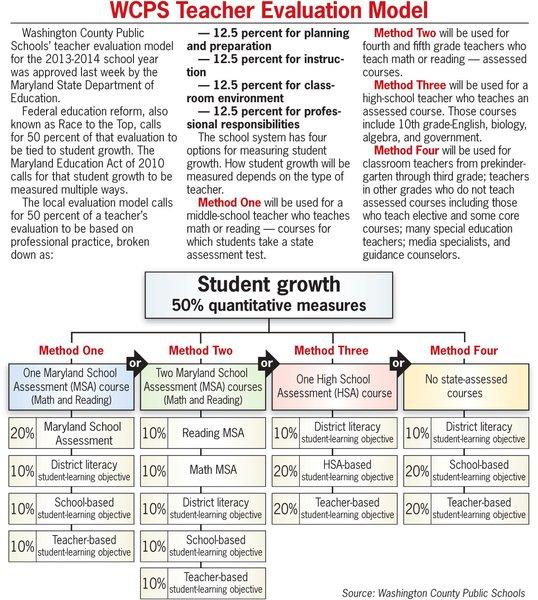
Zooming in on teacher evaluation in Washington County
Washington County will use one of four different methods to obtain the quantitative half of each teacher’s evaluation beginning next year, depending on grade level and whether the teacher taught any students in an assessed subject. The county school system will model the observational half of the teacher evaluations after a labor-intensive framework developed by Charlotte Danielson.
Off the record, many Illinois teachers and principals using evaluation systems modeled after the Danielson framework tell me so much work is required for each teacher so often that it’s not easy for principals or assistant principals to handle any other duties besides teacher evaluation. While the framework gives teachers considerably more feedback than previous evaluation systems, providing and documenting that feedback creates much more work for principals, making shortcuts more tempting.
In Washington County, the Herald-Mail reports, some school board members are feeling a bit of “buyer’s remorse” that they ever accepted the terms of the state’s $250 million Race to the Top application in 2009, not because of the additional work that will be required to produce the evaluations but mainly because of the nature of the evaluation document.
“When I look in here at this evaluation, and I see bullet after bullet after bullet after bullet after bullet of observation material, I think I’m looking at an assault weapon,” the paper quoted board member Wayne D Ridenour as saying during a June 4 work session for the board. “We’re saying this is not a weapon, but it sure as heck looks like one, and it could be one in the wrong hands.”
Others have characterized evaluation systems based on the Danielson framework as opportunities for teacher-principal conversations needed to help teachers get better. But the final score of an evaluation could be tainted by the evaluator’s biases or expectations of what should be happening in classrooms. A score can be appealed, at least in Washington County’s system, but that requires teachers to provide evidence that good instruction is producing student growth at an acceptable level, the Herald-Mail reported. This would usually require the teacher to submit evidence to show the work students are doing.
Other frameworks have been developed that try to address some of the concerns educators have expressed about the Danielson framework, which was first published by the ASCD (an acronym that has become a name, which originally meant “Association for Supervision and Curriculum Development”) in 2007. One framework from Robert J Marzano addresses some of the broad generalities in the Danielson framework. Some independent research suggests the higher degree of specificity in the Marzano framework may lead to more constructive dialog and more positive changes in instruction.
Teacher evaluation plans are ultimately about complying with the law. But in my view, laws should reflect the need to both encourage conversations and allow assistant principals, especially those at large high schools with many teachers, to have those conversations. If they have to spend every minute of a 180-day school year actually doing the evaluations, there’s really very little time left to have the conversations those evaluations are supposed to encourage in the first place. And do principals do anything at schools under the new laws besides evaluate teachers? It’s a question worth asking.