

Full-time workers who haven’t graduated from high school make an average of $457 per week, 42 percent less than those with a high school diploma or equivalency but no college, USA Today reports.
For people who don’t get their high school diploma after completing 12th grade, there are other options for obtaining an equivalency certificate. The laws vary by state, but every state in the country has some path for students to complete the GED.

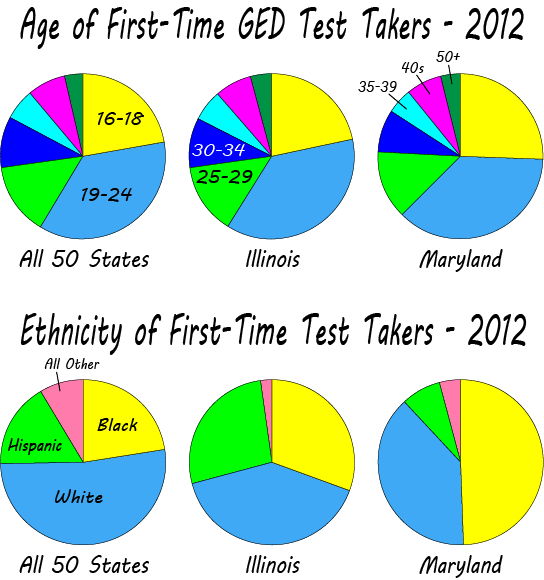
Source: GED Testing Service
But the test is changing once again in order to keep pace with the education provided by high schools across the country. Starting next year, an overhaul of the high school equivalency program will make the test more difficult and will nearly double the cost to test takers in most states.
It’ll be given online and feature five new types of questions designed to measure students’ problem-solving skills. The test will also incorporate new content that comes from the Common Core State Standards, which have been adopted by 45 states and the District of Columbia in mathematics and English/language arts.
“We can’t hold adults to a different standard than we’re holding high school students to,” the paper quoted Randy Trask, president and CEO of GED Testing Service, as saying. “The nation’s high schools are all undergoing a major transformation for college readiness, and the GED has to keep pace with that.”
As far as the cost goes, that also varies by state because some states fully or partially subsidize the cost. In Illinois, first-time test takers in 2012 paid $50 for the testing battery and $10 to $15 per test for retesting, depending on which subtest they took. In Maryland, they paid $45 and $45 for retesting per battery, regardless of the subtest.
Although states may cover some part of the increase, the cost to take the GED is expected to increase by about $50, the USA Today article said.