

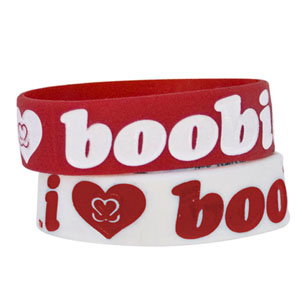
Can you wear “i ♥ boobies” bracelets to school to support breast cancer awareness, prevention, and treatment? If you’re not sure, join the club. The past 12 months have brought that question before courts across this land on more than one occasion.

Earlier this month, the US Circuit Court of Appeals for the Third Circuit, sitting en banc, ruled that the bracelets were free speech because they made a statement that was political or concerned a social issue. The district therefore couldn’t ban them.
I’m thinking, great, and then, just last week, a federal district court in Indiana, which is part of the Seventh Circuit, ruled that a school district could ban the bracelets since they were, in the judgment of school officials, “lewd, vulgar, obscene or plainly offensive.”
The district court relied on the case of Bethel Sch. Dist. No. 403 v. Fraser, 478 U.S. 675 (1986). This case says if a school district makes “an objectively reasonable decision in determining that the bracelet was lewd, vulgar, obscene or plainly offensive,” its ban is constitutional and doesn’t violate the free speech rights of the student, J.A. in this case, who wore the bracelet to school.
J.A. was basing her argument on the Third Circuit’s en banc ruling in B.H. v. Easton Area Sch. Dist., No. 11-2067, 2013 U.S. App. LEXIS 16087 (3d Cir. Aug. 5, 2013), which was, in turn, based on the Supreme Court decision in Morse v. Frederick, 551 U.S. 393 (2007). The Morse case may have established new limits on how far a school could go in restricting student speech when it concerned political or social issues. Since breast cancer awareness is clearly an important social issue, the Third Circuit held, the school must clear a higher threshold in calling the bracelet “lewd, vulgar, obscene or plainly offensive.”
The details of the Indiana case are as follows: A student in the Fort Wayne Community Schools, J.A., started wearing the bracelet to school in December 2011 in support of her mother, a breast cancer survivor. The bracelets are made and sold by the Keep a Breast Foundation, which writes on its website that the phrase “i ♥ boobies” is used to “speak to young people in their own voice.” J.A. wore the bracelet to school for about three months before it was confiscated.
She then filed suit against FWCS, seeking a declaratory judgment and permanent injunction allowing her to wear the bracelet in support of her mom. She said the “bracelet promotes a positive breast cancer awareness message” and “the school’s ban violates the First Amendment’s free speech protections.”
In responding to the suit, FWCS said the ban complied with all the requirements set forth in Fraser, and they had every right to ban the bracelets. The district court relied on the judgment of school officials, who—in the local community and school—know the maturity level of students better than federal judges could ever hope to understand. In other words, it can’t be up to a judge to determine the lewdness or vulgarity of the bracelets; that determination must be made by each local school district with respect to each form of speech it seeks to restrict.
Technically, that’s what it says in the Fraser ruling. The Third Circuit was stepping around that finding a little bit by relying on a concurring opinion entered by Justice Alito.
For these reasons, school officials who “know the age, maturity, and other characteristics of their students” are in a much better position to decide whether speech is vulgar than judges who are “restricted to a cold and distant record.” B.H. ex rel. Hawk v. Easton Area Sch. Dist., No. 11-2067, 2013 U.S. App. LEXIS 16087, at 34 (3d Cir. Aug. 5, 2013). Judges are “outsiders” who do not have the experience and competence to “tell school authorities how to run schools in a way that will preserve an atmosphere conducive to learning.” Nuxoll ex rel. Nuxoll v. Indian Prairie Sch. Dist. No. 204, 523 F.3d 668, 671-672 (7th Cir. 2008); see also Brandt v. Bd. of Educ. of City of Chi., 480 F.3d 460, 467 (7th Cir. 2007) (“[Schools] have an interest of constitutional dignity in being allowed to manage their affairs and shape their destiny free of minute supervision by federal judges.”).
This finding essentially puts the decision as to whether any particular speech is lewd in the hands of the school district and renders the intentions of the person doing the speaking completely irrelevant to the First Amendment. If an objective observer might interpret the speech as “lewd, vulgar, obscene or plainly offensive,” then the school district can restrict such speech, even if the “intent” of the speaker was to promote a good cause.
From a legal standpoint, the district court said that Justice Alito’s concurrence doesn’t control the Morse decision. “The majority’s opinion in Morse did not establish new limits on a school’s ability to regulate student speech commenting on political or social issues,” the district court ruled, and it has the backing of decisions from eight other appellate courts. Since Justice Alito’s concurrence has been rejected, the bracelet’s social commentary doesn’t give it any more constitutional protection than any other speech about “boobies.” And if, in the judgment of local school officials, “i ♥ boobies” is offensive, then that opinion is what matters.
Finally, the court considered the age and maturity of students at the school J.A. attended and found the “evidence in the record reveals a low maturity level.” The school’s record contained several instances of improper conduct that seemed to have been caused by the bracelets, and therefore, one could “reasonably conclude that the bracelet contained sexual innuendo that was vulgar within the context of J.A.’s school.”
Anyway, in answering our initial question, it seems whether or not a student can wear “i ♥ boobies” bracelets to school depends on the age and maturity of other students at the school, at least in Indiana and other states not served by the Third Circuit. The intent of the student doing the speaking doesn’t seem to matter as much as the understanding that reasonable people who hear the speech might take away.