

STandards = STarting point for Teachers, STopping point for Tests
In an article about a story that is tied only tangentially to the Common Core State Standards and their implementation in Maryland, Baltimore Sun reporter Liz Bowie cited a politician who hopes to become governor of Maryland:
Harford County Executive David R. Craig, a Republican candidate for governor, said Monday that he does not support the Common Core because he believes what is taught should be left up to classroom teachers. The former teacher and administrator said he believes the new standards are no better than what was required by the state under No Child Left Behind and that he is opposed to the amount of testing that would be required.
The paragraph features three assertions: The Common Core
- Doesn’t leave what is taught up to classroom teachers
- Is no better than Maryland’s old “State Curriculum”
- Requires a great deal of testing
As Mr Craig spent 34 years as a teacher and principal in Harford County before providing sound management of the resources and finances of Harford County since his election as county executive, his comments can certainly be considered sincere.
All of the remarks, however, miss the big picture about the Common Core. They serve as a canary in the mine for the state’s school leaders, revealing a home-grown version of a misunderstanding by the general public on a natoinal scale of what the Common Core is all about.
It’s about politics
Mr Craig’s first assertion is inaccurate in that the Common Core leaves everything that is taught up to classroom teachers. The first thing the public needs to understand about learning standards, such as those found in the Common Core and adopted by the state of Maryland in 2010, is this:
- Standards are only the “floor,” not the “ceiling,” of education
- Teachers need to take it from there to the highest point each student can achieve
The movement that eventually launched the Common Core was started by governors and state school chiefs from across America. It wasn’t started by teachers. As such, it doesn’t say what methods teachers should use. Rather, it specifies the minimum concepts students need to master.
The Common Core doesn’t say students can’t be taught more than what’s in the standards, only that they must be taught at least what’s in the Common Core. Federal and state government influence ends at the floor, and all the rest, including what students actually learn, comes from classroom teachers. I like to think of it like this: The Core ends at the floor!
Now, individual school districts, which are entire counties in Maryland, may specify a “curriculum,” which includes course descriptions and syllabi, possibly lesson plans and educational programs, and such. That, however, is a completely local decision. Nothing in the Common Core document tells states, districts, schools, or classroom teachers how to teach.
I think if we could clear up this one misunderstanding—that the public sees the standards of learning as something other than the “floor” of education and instruction—we would solve many problems among Common Core skeptics.
States have, for many years, set learning standards for their students, some of which were much higher than others. Some conservative talk radio commentators have advanced the meritorious claim, also asserted by California and Florida, that the Common Core represents an intrusion by the federal government into our states and classrooms. Other politicians, seeing the need for students from their states to compete on a global, or at least nationwide, scale for colleges, jobs, and so on, felt the need to develop at least a minimum set of standards that would work for all players in the global marketplace.
Mr Craig’s point here should be taken more seriously than it has been in the past three years since the standards were adopted. While 10th-Amendment questions may be irrelevant when talking with teachers, they aren’t irrelevant when talking with government officials who have a say in running the schools.
School officials, in the recent past, have shown an unwillingness to address these important concerns from the public, which has annoyed the members of the public even more. Sure, tell people how important the standards themselves are, but it is also important to address the political issues around the Common Core if people should be expected to listen to anything else.
It’s about college and career readiness
The standards are a little different, though probably not much better, than Maryland’s old state curriculum, but the grade level at which some material is introduced is different. This has wreaked havoc with our state tests, but we have to hope school leaders are working those problems out. Besides, testing is a completely different matter from the Common Core implementation.

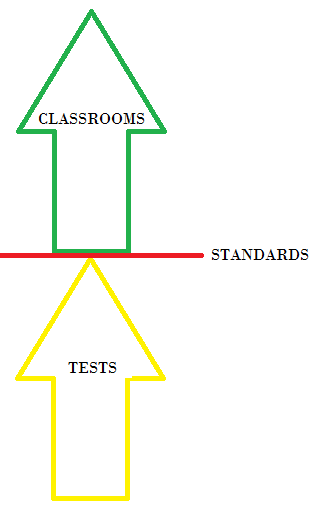
Let me explain. Although the learning standards represent the “floor” of education and instruction, as described above, they represent the “ceiling” of testing. Any question on any test purporting to be aligned to the standards in the Common Core must stop at that standard.
For example, in math, the third-grade standard that has the designation “3.NBT.A.3” (the letters NBT stand for “number and operations in base 10”) says this: “Multiply one-digit whole numbers by multiples of 10 in the range 10–90 (e.g., 9 × 80, 5 × 60) using strategies based on place value and properties of operations.”
What teachers can do: Whatever they want, in whatever way they want, as long as the result is that their students can multiply one-digit numbers by multiples of 10 in the range 10–90. The Common Core doesn’t say they can’t teach their students to multiply two-digit numbers by multiples of 10, just that their students must learn how to multiply one-digit numbers by multiples of 10. What they do beyond that is completely out of the hands of the federal government, the Common Core, or anyone not associated with their classroom.
What tests can and can’t do: Statewide or multistate tests must stop exactly where the standard says. If a test question in third grade requires students to multiply a two-digit number by a multiple of 10, for example, the question would be judged unfair, misaligned, unhelpful to our children’s education, and in poor judgment. If too many bad questions are on a test, the test is invalid.
What teachers can’t do: Teachers aren’t restricted in any way. They can use baseball, dolls, racecars, or any other appropriate device of interest to their third graders, including technology, to teach them how to multiply one-digit numbers by multiples of 10. They can give quizzes, homework assignments, projects, even group projects, or use any other pedagogical method, but they cannot allow their students to reach the end of third grade without knowing how to multiply one-digit numbers by multiples of 10. That would be unfair to those students, and that’s where the government has to step in and protect the interests of our citizens.
I would encourage everyone to discuss with teachers whether multiplying one-digit numbers by multiples of 10 is a topic we want to be teaching our students, but that’s a different story. Please, please, please, talk about the standards themselves with teachers, but don’t haul in an argument about the 10th Amendment, which is irrelevant to what is happening in our classrooms. All school officials really care about, despite all we hear from talk show hosts, is providing the best education we can for our young people.
Constructive dialog about the learning standards in the Common Core is encouraged, while bashing the standards document based on a dislike of the political process used to create the standards has to be left to the realm of politicians, since it has nothing to do with instruction or with testing. As far as they go, the Common Core standards help students prepare for college and the workforce much more than the standards that existed in many states prior to their launch. Give credit where credit is due.
You see, if third graders can’t multiply one-digit numbers by multiples of 10, then those students, when they reach the end of high school, might not be ready for college or a competitive job market, because fourth-grade, fifth-grade, etc., teachers will have had to spend time catching them up. Teachers in future years depend on teachers in prior years to bring students to a certain level so they can go from there.
Teachers can, as the state can, use tests to determine this minimum level of achievement, but teachers can also use tests and quizzes to go much further, if they feel such methods are appropriate. The Common Core doesn’t “require” testing per se. In fact, lots of people are trying to figure out a better way to make this determination that doesn’t produce testing calendars by school districts across America that are honestly some of the most depressing documents I’ve read in my life.
The state is limited to testing at (or below) the level of the standards themselves. The standards in the Common Core, as Mr Craig notes, are not much better than what the state had before, but these standards are shared with other states. Some of those states had some pretty low standards, and we’re all in this together as Americans.
It’s about standardization
Every decision government makes these days seems to be about the bottom line. States are interested in saving money wherever they can, of course, and one way to do that with schools is to eliminate some of the costs associated with developing and maintaining test items that work for only one state. Better to share the expense burden, governors and state school chiefs thought.
In other words, Maryland has the MSA, Illinois has the ISAT, and other states have their own tests, which are aligned to each state’s standards of learning. Each state also pays to have items developed, but it was found that the test items were remarkably similar from one state to another. Why not pool the resources?
This is where standardization comes in. It is a financial benefit to the states, in theory, although the actual tests being created by two big multistate testing consortia may not save a few states all that much money. In fact, Maryland will just about break even when it changes from the MSA to the tests from PARCC, and Illinois will end up spending quite a bit more for the PARCC tests than it currently spends on the ISATs.