

At this moment, close to 100 high school marching bands are in Indianapolis, performing at the Bands of America Grand National Championships, one of the largest spectacles for competitive marching band in the country. And although we can’t predict who the next grand national champion will be, we can make one prediction with reasonable confidence about the more than 10,000 students who will perform at Lucas Oil Stadium this week: the performance anxiety, or stage fright, many of them feel could lead to anxiety-inducing nightmares several years after this weekend’s performance is over, according to a report in the Pacific Standard Magazine.

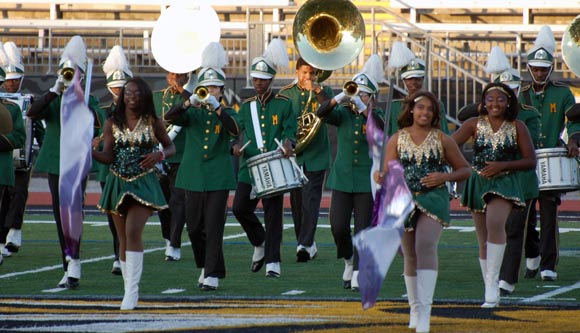
Milford Mill Academy Marching Band at Towson University, Oct 26 (Voxitatis)
One marching band alum from the University of Maryland has the following dream a few times a year, which increases in intensity during the fall: “It’s almost game time. I can’t find my sax. Or my shoes. Or my hat. I know I won’t be able to find a spare in the band room, but I scramble around anyway, praying frantically. The clock is ticking, and I am not finding what I need.”
A former clarinetist for the Willowbrook High School Marching Band in Villa Park, Ill., said she dreams she has missed rehearsal and doesn’t know the music, the magazine reported.
How does the Pacific Standard know about the dreams? The stories come from Ryan Hurd, a researcher, author, and board member for the International Association for the Study of Dreams. He himself dreams about high school marching band, even though he last stepped out onto the gridiron more than 25 years ago. His site, the Dream Studies Portal, has found that recurring dreams are commonly set in the first half of our lives, which would be high school and college.
“Adolescence and young adulthood is an intense period of life—possibly the most intense—and we frame the world and our role within it during these years,” the magazine quoted him as saying.
A 2011 study out of the University of Tennessee, Knoxville, about musicians’ health took a closer look at the condition officially known as musical performance anxiety among marching band members. MPA, also known as stage fright, affects many performing musicians, of course, and it frequently affects these musicians into their adult years, including those in the marching arts—high school and college marching bands, drum and bugle corps, indoor color guard, and percussion ensembles and drum lines.
So, Jacob Levy, associate professor of psychology at the university, studied 780 world-class drum and bugle corps performers. His results showed that among marching band performers, color guard members reported more physical symptoms than brass players, and female performers reported more cognitive symptoms than their male counterparts. That is, female marchers are more likely to experience nightmares about marching band, and color guard members are more likely to show physical signs of anxiety—such as an increase in heart rate, rapid breathing, dry mouth and tight throat, and trembling or sweaty hands—than brass performers. Other differences weren’t reported as being significant, but marching band performers, as a rule, aren’t immune at all to the symptoms of MPA.
This is significant because how much anxiety performers feel has a lot to do with how likely they are to continue their participation in marching band. Performers who experience more anxiety are more likely to abandon the activity than those who experience less anxiety. Dr Levy said performers who are more exposed during a marching band’s performance, such as soloists, color guard members, and trumpeters, report greater levels of anxiety, compared to performers who more or less blend into the ensemble.
But, “anxiety is not all bad,” he said. “It can motivate us to practice and help us focus when performing. The trick is to develop skills to manage one’s anxiety level so it does not become overwhelming.” Ways to manage one’s anxiety include:
- Relax by using breathing exercises, muscle relaxation techniques, etc.
- Increase the pressure during rehearsals—yes, challenge yourself
- Get in some practice time in the venue in which you’ll be performing
Additional tips, from WebMD, include limiting caffeine, seeing the audience as your friend, and “practice, practice, practice.”