


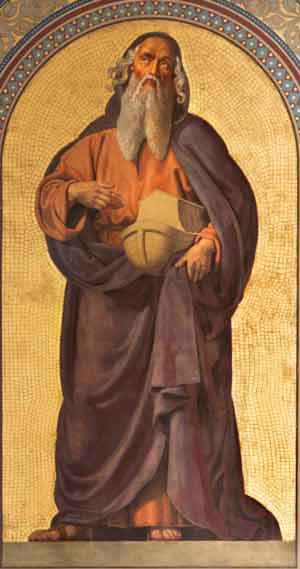
Fresco of Noah in Altlerchenfelder Church, Vienna
In the movie Divergent, the government injects a drug into young adults, allowing them to enter into a trance-like state for a test that can determine what role they are most suitable to play in society.
Blogger Jason Stanford claims the “villain in Divergent is something [kids] can’t run away from and they can’t kill: standardized testing. Kids these days live in a world in which their futures are determined by high-stakes testing, making Divergent a dystopia they can believe in.”
Although I think we still have a few years before kids’ futures “are determined by high-stakes testing”—that is, unless you believe the people who want to sell you an advanced preparation course for the SAT—Mr Stanford’s idea got play on Diane Ravitch’s famous blog, here.
I would like to focus on an equally miniscule part of the movie Noah, starring Russell Crowe, Jennifer Connelly, and Emma Watson, which was released today. As much as Divergent is a statement about the potential evils of standardized testing, which isn’t very much but enough to get mentioned on a blog, I think one scene in Noah is an informed response about standardized testing.
As I’ve pointed out before, teachers can’t do much to stop standardized testing, since it has been written into federal law. Until we change the law, teachers are stuck with the tests.
In the movie, as Jews, Christians, and Muslims would know, Noah is responsible for saving all the species on Earth while God wipes out evil sinners with a giant flood.
When Noah (Mr Crowe) realizes it’s the Creator’s plan that he kill Ila’s (Ms Watson) children, his own grandchildren, he reflects on the matter. He can’t stand that he’s going to have to kill them, but that’s what the Creator has ordered him to do, the law as it has been handed to him. To underscore his dilemma, when his wife, Naameh (Ms Connelly), confronts him about it, he says, “It’s not something I want to do; it’s something I have to do.”
This is what teachers say as they take kids out of class and give them test after test. No teacher wants to do this, but every one of them has to do it. The pronouncement has come from on high.
“But they’re babies,” Naameh cries at him.
Here, Naameh echos the cry of many parents, concerned citizens, including state lawmakers, and even the very teachers who are administering the standardized tests. “They’re kids, and these tests are not helping them learn anything!” they cry.
How little has changed!
Noah doesn’t give in, standing firmly behind the task the Creator has given him, which he truly believes will rescue the human species from its own sinful nature.
School leaders and philanthropists also have good intentions, but they do give the tests anyway, instead of standing up for love, for the lifelong learning of our students, or other good and decent qualities they should be standing behind.
Naameh continues, “If you do this, you will lose Ila, your sons, me, and everyone you ever loved.” That might not be an exact quote, but the basic idea is the same.
Right, so if we go through with bad testing and with over-testing, will we lose another generation of kids? The man who built The Ark seems to think we will, but I won’t give away the ending.
The cast is filled with stars, and the movie, while starting with God and a religious theme, is not exactly the Bible’s tale—although there is a rainbow at the end. We ultimately have to come to terms with what matters, whether that comes from God, our sense of loyalty to the spirit of laws whose letters have drifted away, the fact that people—students and teachers—are drowning, or the face of children whose eyes light up when they learn something new.