

The Obama administration said on June 24 that the vast majority of the 6.5 million students with disabilities in US schools today are not receiving a quality education, and that it will make a “major shift” in the way states are held accountable for demonstrating that those students are making progress, NPR reports.
The shift refers to a change in emphasis. While the old guidelines for students in special education programs focused on compliance with the law—making sure schools file the appropriate paperwork, meet critical timelines for implementing plans to accommodate special ed students, etc.—the new guidelines put 50 percent of the focus on results, mainly those from standardized tests.
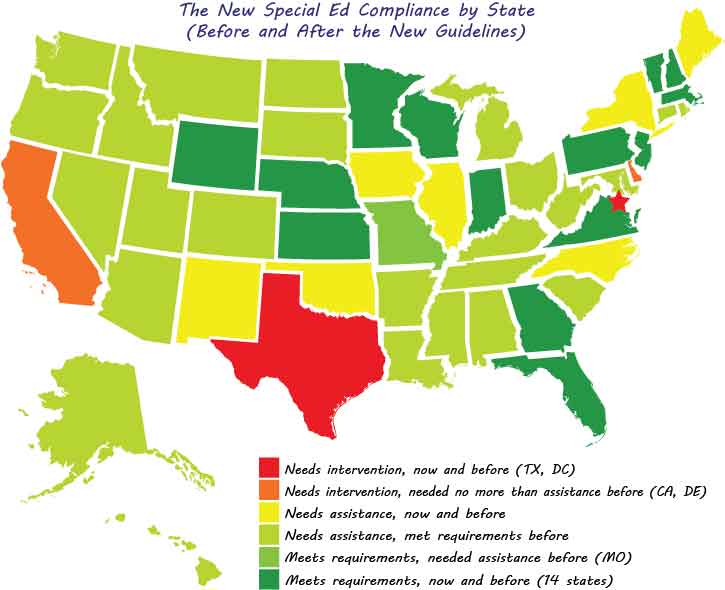
Under the old guidelines, about three-fourths of the states were in compliance; now the number will be much lower, as the federal government plans to compare test scores of students in special education programs with those who are not designated as having special needs under federal law. More than 35 states and territories don’t meet the new requirements, the New York Times reports.

“We know that when students with disabilities are held to high expectations and have access to a robust curriculum, they excel,” NPR quoted US Secretary of Education Arne Duncan as saying.
It sounds to me like Mr Duncan is saying the reason the majority of eighth graders in special ed programs don’t do well on standardized tests at the eighth-grade level is that nobody expects them to perform well on those tests. That is, because we as a society have low expectations for disabled students, we give them tests that are much easier than the ones taken by their mainstream peers and thus enable them to achieve at levels below their potential.
I’m not totally sure Mr Duncan’s hypothesis is correct for most special ed students. Sure, where schools set low expectations for all their students, those expectations probably affect the outcomes, as in turnaround schools under No Child Left Behind that just keep narrowing the curriculum. I’m not convinced that’s what happens with special ed students, although we all must admit that a few of them have been given easier tests to ensure compliance under NCLB.
But some kids just can’t process information as quickly as others, and on the ground, in real schools, sometimes teachers have class sizes of 35 kids, 10 of whom have IEPs and five of whom have limited proficiency in English. In many cases, therefore, I suspect the real problem that needs solving isn’t one of low expectations but of limited resources. But this is just my opinion.
On a conference call with reporters, Mr Duncan was joined by Kevin Huffman, Tennessee’s education commissioner. “In Tennessee, we’ve seen over time that our students with disabilities did not have access to strong assessments,” he was quoted as saying. “So the results were not providing an honest picture of how those students were doing.”
IEPs and special ed in the US
Schools in Maryland, Illinois, and all states provide an individualized education plan, or IEP, for students with a wide range of disabilities, documenting their compliance with the federal Individuals with Disabilities Act, or IDEA. Schools then are supposed to provide special services to students with an IEP according to their special needs. For example, an IEP will be created for blind students ensuring they get enough support to allow them to participate in school.
“It’s not enough for a state to be compliant if students can’t read or do math,” NPR quoted Mr Duncan as saying. “We must have a system that will do more than just measure compliance.”
Not all special needs, of course, hinder a student’s ability to learn math or perform well on a standardized test, given appropriate accommodations and support, such as the printing of braille test booklets for blind students. The thing is, even if we can provide braille books, it still takes a blind student longer to read them than it would take a sighted student. If it takes longer to read the material, blind students may not be able to keep up with the grade level as easily as other students.
Furthermore, IEPs require a great deal of effort on the part of school staff, including teachers, administrators, and psychologists, as well as the cooperation of parents, which is sometimes difficult to arrange. But schools do it, even if they don’t have the funding to deliver all the supports needed to accommodate a student’s IEP, because the needs of the student are paramount.
Helping states comply with the new law
The education department will create a $50 million technical-assistance center for states that need help coming into compliance with the new guidelines. California, Texas, Delaware, and the District of Columbia, which have been identified as needing “intervention,” are first, but several states, including Maryland and Illinois, will fall into the “Needs Assistance” category.
If states don’t comply, they could lose money earmarked for special education programs, which now totals more than $11 billion annually, although the education department is unlikely to withdraw funding from states or schools that don’t meet the new law, the Times noted.
Although advocates for inclusion welcomed the changes, generally, some have said Congress needs to provide additional funding for schools or districts so they can give students the required support they need to keep up in mainstream classes.
A spokesperson for the Illinois State Board of Education said it’s too early to judge the new guidelines, but that hasn’t stopped bloggers from weighing in. Many point out how ridiculous it is to suggest that special ed students aren’t succeeding because we don’t expect them to succeed. Writes Peter Greene:
We don’t need IEPs; we need expectations and demands. We don’t need student support and special education programs; we need more testing. We don’t need consideration for the individual child’s needs; we just need to demand that the child get up to speed, learn things, and most of all, TAKE THE DAMN TESTS.