

A two-week boot camp this summer and extra help on Saturdays during the school year could bring at least a few students at Milford Mill Academy in Baltimore closer to passing the Advanced Placement test in calculus, the Baltimore Sun reports.
Three years ago, no student at the school passed it, and even though schools are sometimes pushing more minority and low-income students into AP classes, the failure rate is substantially higher for those students, sometimes as high as 75 percent, than it is for white or Asian students or those from more affluent schools. About 60 percent of all students nationwide who take the AP calculus test pass it.

Reporter Liz Bowie writes, “No research exists to show that taking the class and failing the exam leaves students better prepared for college.” But that’s because she’s asking the wrong question. Or at least, the question is too vague.
To determine how well students are “prepared” for “college” depends on too many variables for any research to analyze it. For example, how prepared a student is for college depends on what college we’re talking about. A student going to Stanford won’t require the same level of preparedness as one going to the University of Baltimore or Illinois State University.
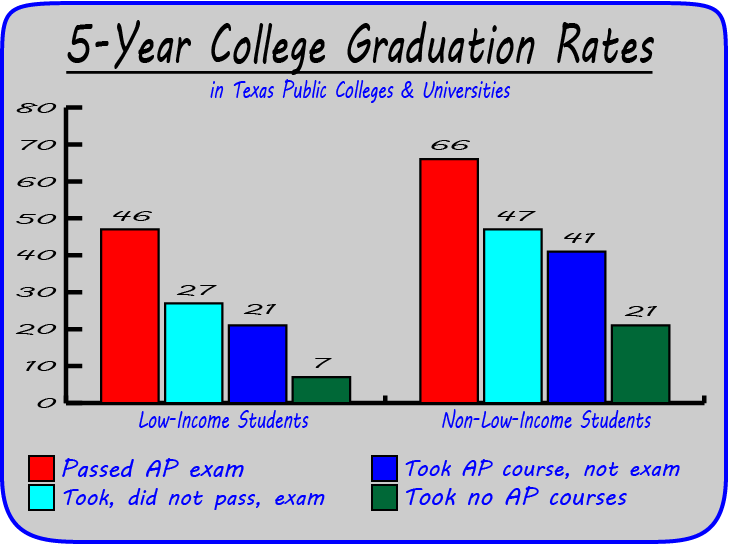
Let’s look instead at an easier question to define, such as how many students actually graduate from college within, say, five years and compare that to their AP status: whether they took an AP class, took the test, passed the test, or took no AP courses or exams.
In the study from 2005 graphed above, researchers Chrys Dougherty, Lynn Mellor, and Shuling Jian looked at public colleges and universities in Texas. Their study showed that low-income students who took and passed at least one academic AP exam had a 39 percentage point higher five-year college graduation rate than low-income students who did not take any AP course or exam.
And, perhaps more relevant to Ms Bowie’s article, those who passed the exam for an academic AP course had about a 20-percent greater chance of graduating from college within five years than those who took the course and then failed the exam, regardless of socioeconomic status. But kids who took a course and failed the test were still about 15 percent more likely to graduate from college within five years than kids who never took an AP course.
Students at Milford Mill, like many others nationwide, are putting in a consistent effort, and they seem aware of gaps in their mathematics knowledge.
“There were some things I should have known that I don’t,” the Sun quoted one student as saying. Some of what the training has covered so far, she said, was just a refresher, but she is also learning new concepts.