

Gov Pat Quinn, Democrat of Chicago, and Bruce Rauner, Republican of Winnetka, met in a debate for the Illinois governor’s race in Peoria on Oct 9. The debate was sponsored by the Illinois League of Women Voters and PBS Peoria (WPTV), from C-SPAN, courtesy of WSIU-TV.
Comments about schools and education were spread throughout the debate, but they mostly were reiterations or recasts of statements made in the sections on education. Repetition has been eliminated in the transcript excerpt below.
Mr Quinn
Right now our state has unemployment at its lowest level in six years. Jobs are up, unemployment is down, and it’s very important that we keep together and work together, invest in education. We’ve been able to increase our investment in education, and that has helped our state grow jobs. I think the best way to go is to stay on this direction, and do the right thing.
Mr Rauner
I’ve been blessed in my career with terrific results, first working for Illinois teachers and police officers, by investing their pension money, then by giving back to our community, donating to our schools, our Red Cross, our veterans’ services. … A small group of Chicago machine politicians got control of our government in Springfield, and they’ve led us down a bad path: high unemployment, crime, low wages, deteriorating schools. … We’ve lost our way as a state. … I’m going to dedicate my work to restoring the prosperity for the families of Illinois and bringing back the American dream for every family here by growing our economy and having the best schools in America.
[Two points here: (1) Many of the best schools in America are already in Illinois. It all comes down to a person’s definition of “best.” (2) I know it’s a favorite phrase of politicians, but Illinois schools absolutely should not aspire to be better than schools in Iowa or Idaho. Rather, they should aspire to be—and governors should express this as a statewide goal—the best they can be for Illinois students. Like the Army slogan. It’s a collaboration, not a competition.]
Mr Rauner
First of all, the politicians in Illinois have said, every time they want to raise taxes, it’s for schools. We put the lottery in Illinois to fund the schools. That money doesn’t end up in our schools. Our current governor raised our income taxes 67 percent, saying that much of it was going to be for education, then he cut half a billion dollars from our school funding.
Politicians use schools as an excuse to raise taxes. I am opposed to putting a further income tax on the families of Illinois. We already have income taxes that are too high. I’d rather like to see our income taxes rolled back to where they were in 2010 and do other tax reforms to generate additional revenue.
And the biggest reform being becoming a pro-growth state, where growth generates the tax revenues. And I strongly a believer that we should increase overall education funding. Other things, wasteful spending, can be cut. Education must be increased in the support, and I’ll make that the top priority for taxpayer dollars as governor.
Mr Quinn
When it comes to education funding, my opponent makes up things. We’ve increased education funding in the classroom by about $500 million. Independent fact-checkers have indicated that. We’ve also paid the teachers’ pension every single year. Prior to my arrival as governor, that didn’t happen. So we’ve paid the pensions, and I’ve increased funding in education.
I think we need to do more. There is a referendum that I signed to put on the ballot, asking whether or not millionaires should pay a little higher income tax. And all that money, by constitutional amendment, would go to the school districts and classrooms of Illinois. I think that’s a good idea.
My opponent, who’s a billionaire, doesn’t want to raise his income tax, but he wants to slash funding for schools all across Illinois. His budget plan would slash our education budget by $4 billion. He would lay off one out of six teachers in Illinois, and cause great harm to everyday people. He wants, with his plan, a million-dollar tax cut for himself and education funding slashed all across Illinois. I don’t go for that, and I think it’s a very good opportunity for the people of Illinois, at the ballot box, to the millionaires and billionaires that they ought to pay more.
Mr Quinn
My thing is we need to increase education investment. We need to fund schools more. One way to do it is the referendum we just talked about. Another way is the budget I proposed earlier this year. It would put more money in classroom education than any other time in Illinois history. It would also put more money into early childhood education, as well as scholarships for students to go to college.
[Moderator: But do you support Sen Manar’s proposal to restructure the school funding formula?] With regard to that particular proposal, I think it needs a lot of oversight and review. It passed one house, the Senate. It’s not passed the House. It really needs more, I think, debate. I do not favor reducing funding in a particular school district to its disadvantage, and so, I think a much better way, what I just proposed, would be increasing funding for all school districts. I think that should be done first and foremost.Mr Rauner
I haven’t studied the detail on Andy Manar’s bill [Voxitatis coverage], and from what I’ve read about it, I probably would not support that particular bill, although I do believe we should come up with a new state education funding formula. We are, I believe, 48th out of the 50 states for state general revenue support for education. That’s not right. We should increase our state support for our schools.
My wife and I believe that education’s the most important thing we do together as a community. There’s nothing more important. When you look at the challenges we face as a state, as a nation—unemployment, low wages, high crime, poverty—the challenges we face—education is maybe not the sole solution, but it’s a major part of the solution. My wife and I have dedicated our lives to improving public education and early childhood education. For decades, we are very active in this issue.
Gov Quinn, on the other hand, he’s been in government for decades. He has been zero on education, completely lacking in any regard in education. Except, he’s increased our income taxes, said it was for schools, and then cut education funding. We need an education governor, and I will lead in that process.
Mr Rauner, on pensions
I personally don’t think that that constitutional language was a mistake at all [the pension protection clause in the Illinois state constitution]. I think pensions are a contractual obligation, and what is agreed to should be paid into and honored by all parties.
I was opposed to the pension changes that Pat Quinn put through last November [Voxitatis coverage], because I believed that they were unconstitutional. I don’t believe that it’s right to change the payments to a retiree after they are already retired, and that’s what Gov Quinn did in that pension reform bill. I don’t think that’s the right thing to do.
What I have argued from day one in this race is I think both the fair thing to do and the constitutional thing to do is to freeze the current pensions where they are today. Don’t change anything from what’s accrued. Pay those benefits as they come due, in the future.
But starting tomorrow, for future work, both for current employees and for future employees, we should create a second pension plan that’s more flexible and more affordable—more of a defined-contributions style plan. Doesn’t save a lot of money in the very short term, saves billions in the long run.
Mr Quinn
I think it’s important to understand here, my opponent wants to privatize pensions in Illinois, a very risky 401(k) plan that has a $100 billion hole. I don’t think that’s the right way to go in Illinois.
I think the provision in our constitution protecting pensions is a good one. We did pass a bipartisan pension reform bill that I signed. It’s now going to be before the courts, the Supreme Court ultimately, and they will make the decision on that regarding our constitution.
I want to go back to one thing that my opponent persists in misstating. We have raised spending for education. Despite all the hard times, we’ve raised our funding for classroom education by almost $500 million, almost half a billion dollars. And, we have paid the pension amounts every single year for teachers and all public employees. Governors before me did not do that. I have done that. I have complied with the law. I’ve invested in our pension systems properly, and that’s why that’s the best way to go to move Illinois forward.
[Moderator: What if the Supreme Court does find the pension law that you signed unconstitutional?] Well, my dad taught me a long time ago, don’t take an aspirin ’til you get a headache. We don’t have a decision in the Supreme Court. I don’t think it’s wise at all to take something that both the legislature and I feel are constitutional provisions before the court acts. If the court acts in a way that is contrary, well, we’ll take the necessary steps, obviously.The bottom line is, we have to deal with liability problems that I inherited. I didn’t create this problem, but I’m solving the problem by putting the proper amount every year into the pensions.
Mr Rauner, on buying the black vote
It’s not a conflict [of interest] at all. The difference is, I’m using my personal money. Pat Quinn has been trying to buy the election using taxpayer money, … in his … programs. He’s been running around the state using taxpayer money, dropping into certain communities to try to get voters’ influence. But that’s politics in Illinois.
My wife and I have been very involved in the African-American community in and around Chicago and other cities, for decades. We are major donors to early childhood education in the black community, charter schools in the black community, teacher training in the black community. I personally donated to fund a full professorship at Morehouse College in Atlanta, Ga., which is dedicated to educating African-American leaders throughout the United States.
My wife and I care deeply about the African-American community here in Illinois and around the US. We’ve been involved for decades. It’s not politics. I have learned about this particular credit union on the campaign trail. Someone brought it up to me, and it sounded like a good program. And I made an investment there. And I’m honored to have done it.
Mr Quinn, in closing
… My opponent … wants to cut our education budget. I don’t think that’s the right way to go for Illinois. I want to have a future for our kids. I want to invest in early childhood education, in K-12, in community colleges, in our four-year universities, and in our scholarships. That’s the right way to go.
[There is confusion over whether Mr Quinn cut education funding, as Mr Rauner says, or increased education funding, as he says about his own term as governor, which began with FY 2010. Whether Mr Rauner or Mr Quinn is correct depends on how you do the accounting and what you count as “education spending.” Reboot Illinois produced an explanation about the claims being made by the campaigns, but since their graphic was too small for me to read, I reproduced it below.]

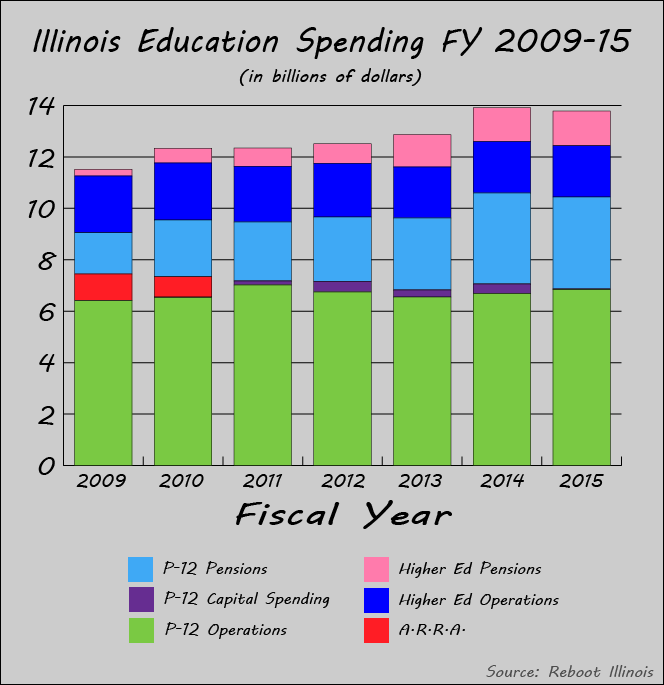
[If you follow the green (P-12 operations) across the graph, you see an increase from $6.4 billion to $6.8 billion, an increase in spending on operations of about $434 million. Adding the funds from the American Recovery and Reinvestment Act, however, which were sent almost directly to school districts but dried up after two years of federal investment, one could say the amount going for P-12 operations decreased by about $605 million (not all the ARRA money, however, was used for operational expenses by school districts). Reboot Illinois explains it in full. “If Rauner becomes governor, K-12 education funding will be 60 percent lower statewide than under Quinn’s plan,” the organization writes on its website.]