


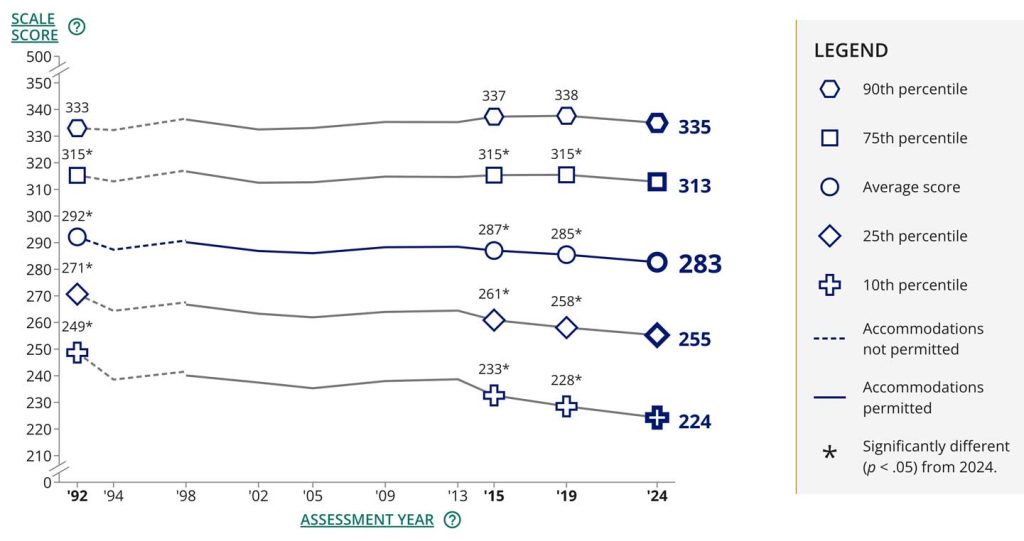
A decade-long slide in high school students’ performance continued into the pandemic era, with 12th-grade reading and math scores in 2024 falling to their lowest levels in more than two decades, federal data show, the Associated Press reports.
Across the entire country, taking into account students of all ability levels, the National Assessment of Educational Progress, known as the Nation’s Report Card, found that 32 percent of seniors scored below Basic in reading. A striking 45 percent similarly failed to meet the Basic benchmark in math. Only 33 percent of those students are currently deemed prepared for college-level mathematics.

For more information, visit the NAEP Web page.
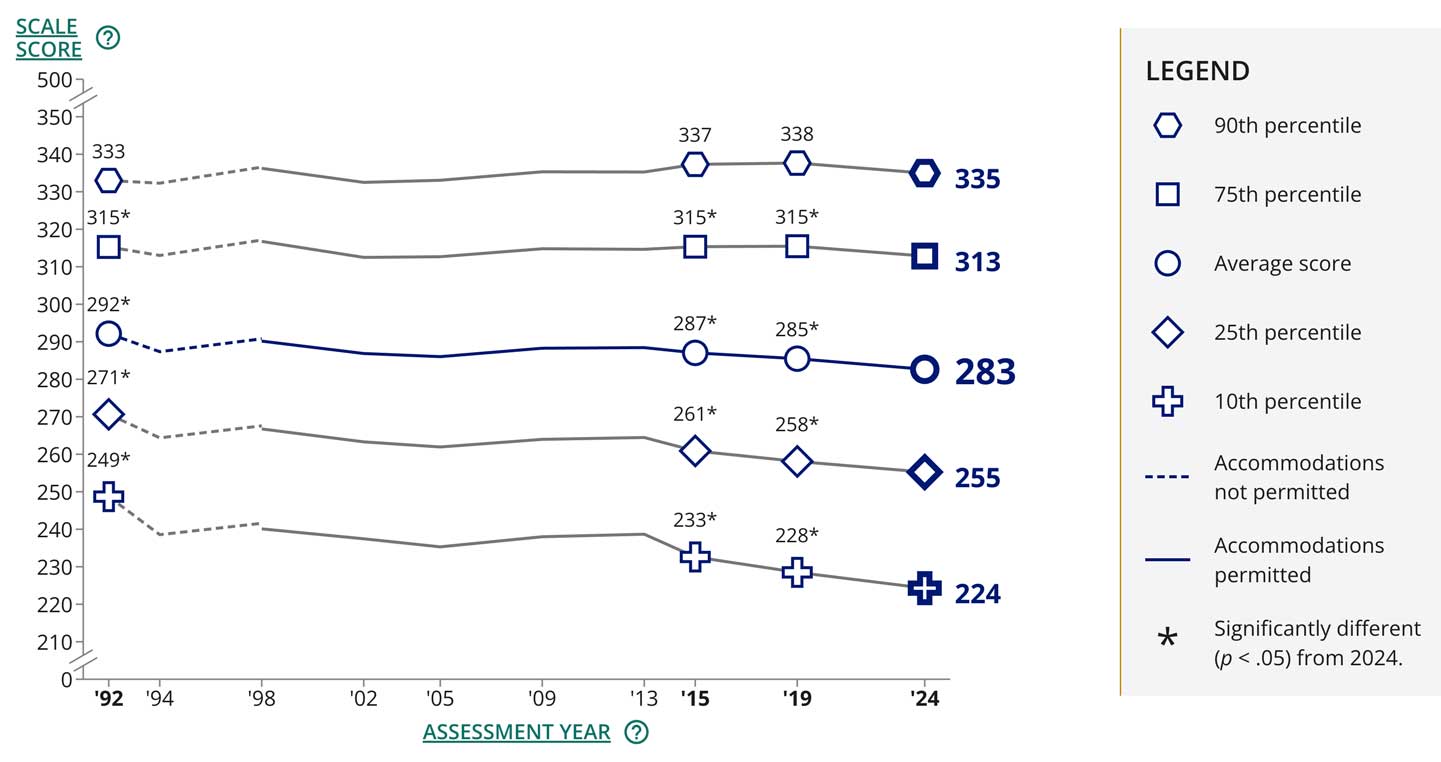
Data showed that, in 12th-grade reading, average scores for high-performing students have remained relatively constant since 1992, while average scores for the lowest-performing students dropped from 249 in 1992 to 224 in 2024, a statistically significant decline and a marked increase in the achievement gap between high and low performers. The gap in math didn’t widen as much, with high performers remaining constant at about 196, while average scores for the lowest-performing students dropped from 105 in 1992 to only 100 in 2024.
These figures reflect not only temporary learning disruptions but also a longer-term academic decline that predated COVID-19, as evident across multiple NAEP releases. Acting Commissioner Matthew Soldner at the National Center for Education Statistics warned that “scores for our lowest-performing students are at historic lows,” calling for “concerted and focused action to accelerate student learning.”
Education Secretary Linda McMahon pointed to the results to uphold her administration’s push for decentralizing education spending, arguing that despite annual billions in K-12 funding, outcomes continue to deteriorate at the high school level. “More high school seniors are performing below the Basic benchmark in math and reading than ever before,” she was quoted as saying.
Meanwhile, House Democrats, led by Representative Bobby Scott of Virginia, pushed back, warning that dismantling the Department of Education would only exacerbate widening achievement gaps and derail recovery efforts.
Experts say the steep falloff in reading and math achievement isn’t solely a result of the pandemic. The decline reflects complex, long-term shifts, including increased screen time, shorter attention spans, and changes in curriculum and classroom reading habits. Carol Jago of UCLA highlighted how shorter texts and excerpt-based instruction may fail to build the endurance that students once developed by reading full books, once a common practice in high school English classes.
Eighth-grade science scores also fell sharply, registering the widest achievement gap between high- and low-performing students in the subject’s history, according to Reuters. While this underscores broader systemic challenges, the high school metrics remain especially concerning, The Wall Street Journal noted: nearly one-third of seniors are below Basic in reading and nearly half fall short in math.
The results point to areas where improvement is urgently needed. Whether that challenge is met through decentralizing education or ensuring — at the federal level — that low-performing students in every state get the resources they need will be a central question for the current administration, and likely for the next one as well.