


Occasionally, we take a study reported in a scientific journal that has passed a peer-review process and, instead of simply reporting the results, turn it into a set of questions that we hope will strengthen students’ skill in writing about science. This is one such article.


Flashy Traits, Strong Numbers — Why Showy Signals Win in Evolution
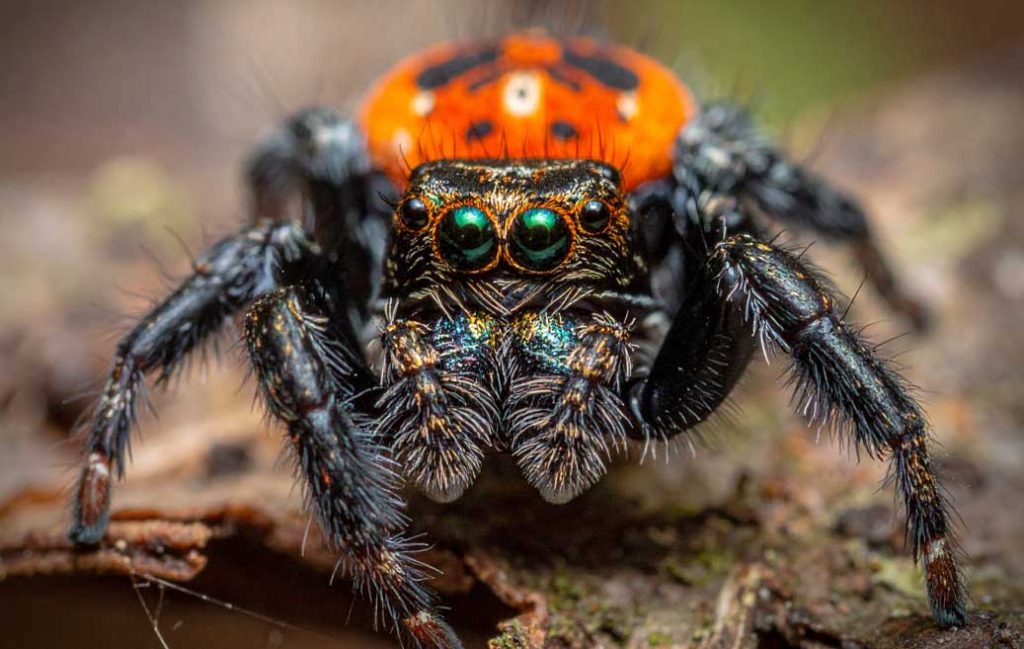
Picture a spider smaller than your pinky nail, standing tall on a leaf and waving its legs like it’s on a disco floor. This is the peacock spider, famous for its bright red, yellow, and blue colors. When a male finds a female, he raises his colorful abdomen, vibrates, and kicks out a hairy leg in an elaborate dance that can last up to an hour. If the female approves, he passes on his genes. If not, he may become her snack.
At first glance, this strategy seems like a terrible idea. Bright colors make you easy to spot, not just for mates but for predators. Spending time dancing burns energy you could use to hunt or escape. Wouldn’t it make more sense to stay camouflaged, get stronger, or fight off rivals?
That’s the evolutionary puzzle.
The Puzzle of Flashy Traits
Across nature, we see costly, showy behaviors and features:
- Peacocks dragging long shimmering tails.
- Birds of paradise sprouting neon feathers.
- Frogs croaking and crickets chirping all night.
- Hammer-headed bats with oversized heads that make booming calls.
Why do so many animals invest in traits that appear to hurt survival?
A team at the University of New South Wales (UNSW) tackled this question with a meta-meta-analysis — a study that combined the results of nearly 1,200 other studies. They wanted to see which traits, across many species, actually explained differences in reproductive success.
The results were surprising.
The Numbers Behind Attraction
The researchers compared how much different traits explained variation in how attractive individuals were to potential mates. In scientific terms, this is reported as the “mean effect size” — the average percentage of variance explained across many studies.
Here’s what they found:
| Trait Category | Mean Effect Size |
|---|---|
| Showy signals (color, dance, sound) | 11.0% |
| Condition (health/energetic state) | 4.9% |
| Sperm competition traits | 3.3% |
| Aggression / social dominance | 1.9% |
| Body size | 1.2% |
| Age | 0.5% |
What the Data Mean
The numbers tell a clear story.
Showy traits explain the most — about 11% of the differences in reproductive success across species.
By comparison, body size explains only about 1.2%, and aggression just 1.9%. Even physical condition, like health and energy levels, explains less than half of what colorful displays and dances do.
Age barely matters at all, accounting for only 0.5%.
In other words, traits that look like risky wastes of energy — bright colors, elaborate dances, loud calls — are actually stronger predictors of who gets to reproduce than size, age, or dominance.
Why Would Nature Favor Flashiness?
There are several possible explanations:
- Honest Signals: A bright color or long feather may be costly to produce, but only the healthiest individuals can afford it. That makes it a reliable signal of quality.
- Female Choice: If females prefer showy males, those males pass on their genes more often. Over generations, the trait spreads even if it’s costly.
- Rival Deterrence: Showy traits can also signal to other males: “I’m strong enough that I don’t need to fight you.” This can reduce harmful conflicts.
The big surprise from the UNSW study was that females also use signals more than scientists expected — sometimes in ways humans can’t detect, such as chemical scents or ultraviolet colors. Our own sensory limits may have biased past research, making us think showiness was a male-only trait.
A Quantitative Evolutionary Story
The UNSW data turn this into a numbers game:
If showy traits account for 11% of attractiveness, while body size accounts for only 1.2%, then being flashy is much more important than being big.
Add up all the “practical” traits like body size, age, dominance, and sperm competition, and they still don’t match the explanatory power of bright colors and songs.
That means evolution doesn’t just favor brawn or stealth — it often rewards bling.
The Next Steps
Scientists still need to untangle which signals matter most in different species, and how “hidden” signals like pheromones fit into the picture. But one thing is clear: quantitative data show that flashy traits aren’t wasteful accidents. They’re powerful evolutionary strategies.