


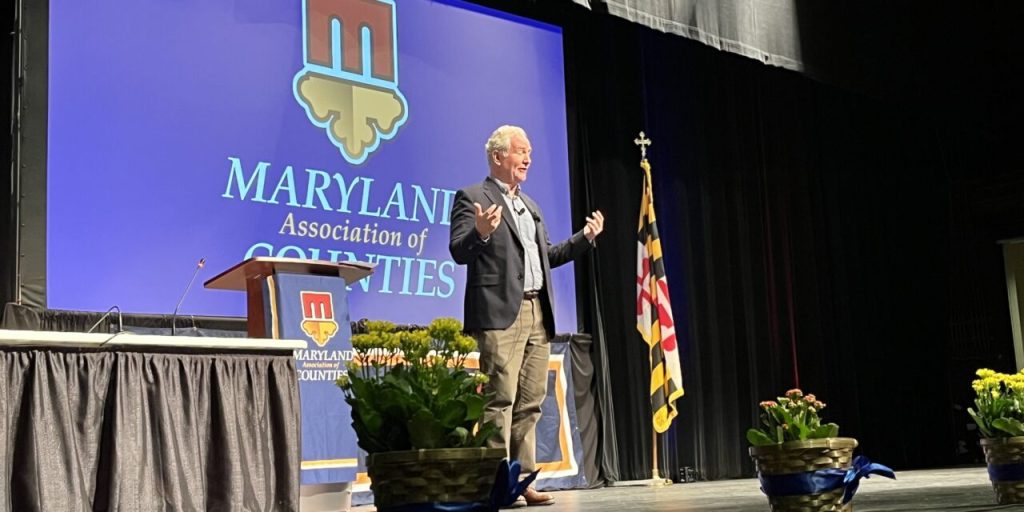
Representatives from Maryland’s 24 counties met in Ocean City at the annual conference of the Maryland Association of Counties (MACo) in mid-August, and the Blueprint for Maryland’s Future, the overhaul of education in the state developed by the Kirwan Commission in 2018, was a primary discussion topic, Len Lazarick reports for Maryland Reporter.com.

One of its big ideas for improving student achievement in Maryland and competing more effectively on a global stage was to make teaching in the state a more attractive profession, starting with increasing the minimum salary to $60,000. That has mostly happened, State Superintendent Carey Wright said in a panel discussion. And work to address the Blueprint’s focus on early learning continues to move forward in the state.
But the devil’s in the details when it comes to funding these huge initiatives. And we’re talking about quite a bit of detail.
Superintendent Jeffrey Lawson of rural Cecil County underscored the detail by casting a big spreadsheet on the stage’s screen. It showed all the spending categories for school funding — multilingual learners, special education, compensatory education (students in poverty), and so on — and the rising costs for each category over the next nine years.
“Here’s the problem with the Blueprint: you can make a strong case for every one of these rows,” the news site quoted him as telling the crowd. “I think we can all agree that the kids coming from poverty, they need more. They simply do. … We can all make a compelling case for each of these rows. In totality, the Blueprint comes across as a little overwhelming from a financial perspective, and that’s where the bulk of officials get stuck in this ditch. …
“Even your more experienced legislators oftentimes aren’t aware of this level of detail behind these numbers,” he continued, warning that lawmakers will eventually be forced to winnow those categories down.
Lawson’s concerns were echoed by other counties. Queen Anne’s County Commissioner Jack Wilson pointed to crippling budgetary volatility, citing an instance where a projected $6.3 million school request ballooned into a formal $13.9 million ask — a staggering spike for a $180 million county budget. Meanwhile, newly elected Howard County Council member Jessica Nichols noted that suburban districts face a different squeeze, bearing heavy mandate costs without receiving the poverty-weight differentials that offset expenses elsewhere.
State officials acknowledged the friction. Former Montgomery County Executive Ike Leggett, who now chairs the Blueprint Accountability and Implementation Board (AIB), conceded that the state may need to slow the rollout pace even as it pushes forward.
Yet the Ocean City gathering exposed the fundamental structural fracture at the heart of Maryland’s education system: a vast divide between state mandate and local control.
While global models like Singapore rely on unified, top-down governance, Maryland’s authority is heavily fragmented. Annapolis lawmakers and state oversight boards dictate sweeping educational mandates, but county governments are on the hook to fund nearly half the $10 billion bill. Locals are left with the fiscal burden, escalating local taxes, and virtually no say in how the money is spent.