

In our ongoing analysis of the Next Generation Science Standards, released to the public on Tuesday, we find the progression under “forces and interactions” from middle school to high school quite strong.
For example, performance expectation MS-PS2-4, found on page 40 of the storyline document, here, says middle school students should be able to
Construct and present arguments using evidence to support the claim that gravitational interactions are attractive and depend on the masses of interacting objects. [Clarification Statement: Examples of evidence for arguments could include data generated from simulations or digital tools; and charts displaying mass, strength of interaction, distance from the Sun, and orbital periods of objects within the solar system.] [Assessment Boundary: Assessment does not include Newton’s Law of Gravitation or Kepler’s Laws.]
When we look at the parallel expectation in high school, on page 63, we find the following description of what students ought to be able to do:
Use mathematical representations of Newton’s Law of Gravitation and Coulomb’s Law to describe and predict the gravitational and electrostatic forces between objects. [Clarification Statement: Emphasis is on both quantitative and conceptual descriptions of gravitational and electric fields.] [Assessment Boundary: Assessment is limited to systems with two objects.]
This progression shows the high school performance expectation building on that for middle school. Looking at the same data, middle school students should be able to construct a valid scientific argument describing the relationship between mass and gravitational force or between distance and gravitational force. They need not use Newton’s Law of Gravitation to justify their conclusions.
High school students, on the other hand, are required to support their argument more fully, using the underlying mathematics and physics in Newton’s Law of Gravitation. In addition, high school students are required to make predictions based on the evidence they have observed. In other words, high school students have to take their knowledge of gravity and extend it to systems beyond those of which they have direct knowledge. That’s critical thinking: analysis that goes beyond simple recall and comprehension.
A quick example from the solar system
Consider the following information, which shows each planet’s mass, distance from the sun, and the gravitational force between the planet and the sun (some values may be approximate):

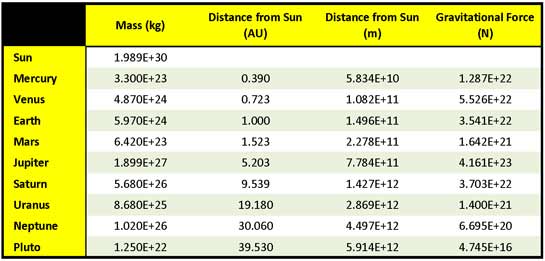
Middle school students might have to look at this data—or a graph of it—and construct an argument to support the conclusion that the gravitational attraction between a planet and the sun increases as the planet’s mass increases, even accounting for variations in distance.
[This paragraph demonstrates an error in the NGSS: Please see Demosthenes’s comment below.] Take a look at Mars and Jupiter, for example. Jupiter is farther away from the sun than Mars is, yet the sun exerts a much stronger gravitational force on Jupiter than it does on Mars. A conclusion might be something like, “The more massive a planet is, the greater the force of gravity the sun exerts on that planet.” Supporting that conclusion logically with data from Jupiter and Mars reflects critical thinking at the middle school level.
A high school student might be shown the above table with one of the gravitational forces missing. Then, he might have to predict a reasonable value for the gravitational force exerted on that planet by the sun and justify his prediction with Newton’s Law of Gravitation, which says that the gravitational attraction or force (F) between two bodies is given by the following formula:
where G is a constant equal to 6.6732 × 10⁻¹¹ N m2/kg2, the M’s are the masses of the two bodies, and R is the distance between the two bodies.
It’s this kind of progression in critical thinking that the Next Generation Science Standards were designed to encourage in our classrooms. Although they certainly could be revised, especially to remove misleading and incorrect statements with respect to science, the new learning standards, performance expectations, or whatever you want to call them, certainly deliver in terms of encouraging critical thinking.
One of the biggest problems I have with the NGSS performance expectations is that I’m not sure teachers will be able to provide both instruction and assessment that are aligned to the actual standards. Do you know middle school teachers? Ask them to construct a logical scientific argument, given the data in the table above, to support the conclusion that the gravitational attraction between the sun and a planet is proportional to the mass of the planet. Good luck.