

In our ongoing analysis of the Next Generation Science Standards, released to the public on Tuesday, we find the progression under “forces and interactions” from middle school to high school quite strong.
For example, performance expectation MS-PS2-4, found on page 40 of the storyline document, here, says middle school students should be able to
Construct and present arguments using evidence to support the claim that gravitational interactions are attractive and depend on the masses of interacting objects. [Clarification Statement: Examples of evidence for arguments could include data generated from simulations or digital tools; and charts displaying mass, strength of interaction, distance from the Sun, and orbital periods of objects within the solar system.] [Assessment Boundary: Assessment does not include Newton’s Law of Gravitation or Kepler’s Laws.]
When we look at the parallel expectation in high school, on page 63, we find the following description of what students ought to be able to do:
Use mathematical representations of Newton’s Law of Gravitation and Coulomb’s Law to describe and predict the gravitational and electrostatic forces between objects. [Clarification Statement: Emphasis is on both quantitative and conceptual descriptions of gravitational and electric fields.] [Assessment Boundary: Assessment is limited to systems with two objects.]
This progression shows the high school performance expectation building on that for middle school. Looking at the same data, middle school students should be able to construct a valid scientific argument describing the relationship between mass and gravitational force or between distance and gravitational force. They need not use Newton’s Law of Gravitation to justify their conclusions.
High school students, on the other hand, are required to support their argument more fully, using the underlying mathematics and physics in Newton’s Law of Gravitation. In addition, high school students are required to make predictions based on the evidence they have observed. In other words, high school students have to take their knowledge of gravity and extend it to systems beyond those of which they have direct knowledge. That’s critical thinking: analysis that goes beyond simple recall and comprehension.
A quick example from the solar system
Consider the following information, which shows each planet’s mass, distance from the sun, and the gravitational force between the planet and the sun (some values may be approximate):
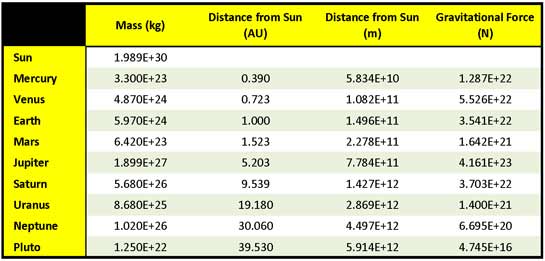
Middle school students might have to look at this data—or a graph of it—and construct an argument to support the conclusion that the gravitational attraction between a planet and the sun increases as the planet’s mass increases, even accounting for variations in distance.
[This paragraph demonstrates an error in the NGSS: Please see Demosthenes’s comment below.] Take a look at Mars and Jupiter, for example. Jupiter is farther away from the sun than Mars is, yet the sun exerts a much stronger gravitational force on Jupiter than it does on Mars. A conclusion might be something like, “The more massive a planet is, the greater the force of gravity the sun exerts on that planet.” Supporting that conclusion logically with data from Jupiter and Mars reflects critical thinking at the middle school level.
A high school student might be shown the above table with one of the gravitational forces missing. Then, he might have to predict a reasonable value for the gravitational force exerted on that planet by the sun and justify his prediction with Newton’s Law of Gravitation, which says that the gravitational attraction or force (F) between two bodies is given by the following formula:
where G is a constant equal to 6.6732 × 10⁻¹¹ N m2/kg2, the M’s are the masses of the two bodies, and R is the distance between the two bodies.
It’s this kind of progression in critical thinking that the Next Generation Science Standards were designed to encourage in our classrooms. Although they certainly could be revised, especially to remove misleading and incorrect statements with respect to science, the new learning standards, performance expectations, or whatever you want to call them, certainly deliver in terms of encouraging critical thinking.
One of the biggest problems I have with the NGSS performance expectations is that I’m not sure teachers will be able to provide both instruction and assessment that are aligned to the actual standards. Do you know middle school teachers? Ask them to construct a logical scientific argument, given the data in the table above, to support the conclusion that the gravitational attraction between the sun and a planet is proportional to the mass of the planet. Good luck.

What you’ve shown here actually demonstrates one of the errors in the NGSS. Is the G between the Sun and Jupiter greater than the attraction of every other planet to the Sun? Yes. But that’s about it. It only works for Jupiter…..for the others, the masses are small enough that the distance HAS to be accounted for. I wonder if you are looking at the same data that I’m seeing…..
Try graphing the data. You cannot find a mass/G relationship in our solar system. Not without figuring in distance.
What worries me is that you thought that this assessment item could be answered with this data.
The problem is that the author of the question didn’t know the science. That’s probably why they thought it was OK to cut Kepler and Newton’s Universal out of the assessment—because they don’t know that you can’t answer this question without them.
I wish this were the only instance in which the authors revealed that they don’t know physics. Sad. The question is, will you go check out your science? And when you find out that this NGSS assessment item doesn’t make any sense, will you blog about THAT?
Demosthenes: Thank you for your comment. It has brought to light three very important criticisms of the NGSS, and I hope I can do them justice in this post. In no particular order, the criticisms are basically these:
(1) Except, perhaps, for climatologists, scientists in different disciplines have expressed disappointment with the standards in their own field. That is, chemists are disappointed with the chemistry standards, physicists like you with the physics standards, and so on. I posted a while back how disappointed I was with the standards on natural selection, here.
(2) The standards began with a framework by the National Research Council, which was itself based on an atlas. In order to create standards for eighth grade, the high school standards were stripped; to create seventh-grade standards, the eighth-grade standards were stripped, and so on. Each time this stripping down was done in succession, in an effort to write with the target in sight, sort of, there was a greater chance of introducing an error. This has happened, as you showed, and this aspect of the standards must be ironed out either before or shortly after they are adopted by state boards.
(3) In the writing of the standards, inaccuracies remain, which are not likely to be corrected prior to adoption by state boards of education. After all, how can middle school students “construct and present arguments using evidence to support the claim that gravitational interactions are attractive and depend on the masses of interacting objects” when no such evidence exists without considering distance? Distance isn’t in the middle school standard, so if teachers or test writers see only the standard, we’re going to teach some bad science in middle school.
The inaccuracy in the physics standard above
What happens here is that in moving from the framework, which is perfectly good physics, writers of the standards had to water it down to high school and then to middle school. The high school solution involved using systems of no more than two objects. The middle school solution involved showing a relationship between only mass and the gravitational attraction, as well as excluding Newton/Kepler.
In a sense, the example recommended in the standard, I think, shows exactly what you say it shows: that the writers didn’t have a very good understanding of physics. They sacrificed good science in the interest of watering down the material. Of course distance has to be considered from a physics point of view. In fact, I would suggest that distance is much more important than mass in terms of its effect on the gravitational force: in Newton’s equation, the force decreases as the square of the distance.
But the other problem is that the people who will be developing tests to determine how well teachers are teaching this material in middle school and how well students are learning it know even less about physics than I do. Which is not very much.
This is why it was so important that the standards be accurate and unambiguous. If there are no planets in our solar system that can demonstrate the correlation between mass and gravitational force, then the standards shouldn’t suggest using such a system. One planet (Jupiter) doesn’t make a relationship.
Furthermore, the whole point of NGSS was to bring science into the real world, to show that science works by experimentation, seeing what works. If no system exists in the known universe where this principle can be demonstrated cleanly, then it should have stayed out of the middle school standards. Middle school teachers are going to make the same mistake I did—or even worse, as I hinted at the end of the original post. And if the standard is entirely theoretical in terms of having zero systems in the known universe where it occurs, there will be no way to check those standards or the test items that are written to assess them.
And then, we’ll be testing kids, firing teachers, closing schools, and whatever, based on science tests that are completely wrong, either by omission or commission.
All news is not bad
My original point in writing this post was to show that the standards had a logical progression, beginning in kindergarten and working through high school. Each year in school, students explore scientific concepts in greater depth than the year before. I wanted to look at this aspect of it, found one chain in the standards that seemed to fit the bill, and inadvertently stumbled upon a gaping hole in the standards.
It’s now clear that the way the writers accomplished this progression from year to year produced errors. State boards will have to consider this as they move forward.
Dear Paul,
Your response to this is surprising AND thoughtful AND well-written. My concerns are the same as yours. I’ve taught K-12 science for over twenty years, and this is just a disaster waiting to happen, on a grand scale.
Also, you should know that the NGSS that Acheive, Inc. posted as the Final NGSS, was not the Final NGSS. Around lunchtime on 5/16/2013, they silently posted an updated version. Note that your previous version says “April 2013” at the bottom, and the title of the file has the date “5/3/2013” in it. The new version says “May 2013” at the bottom of each page, and the date in the file is “5/15/2013.”
There was no announcement, they have not alerted the community. In the new version they made changes to the science stated in the DCI. Without telling anyone. Shady.
Keep up the good fight!