


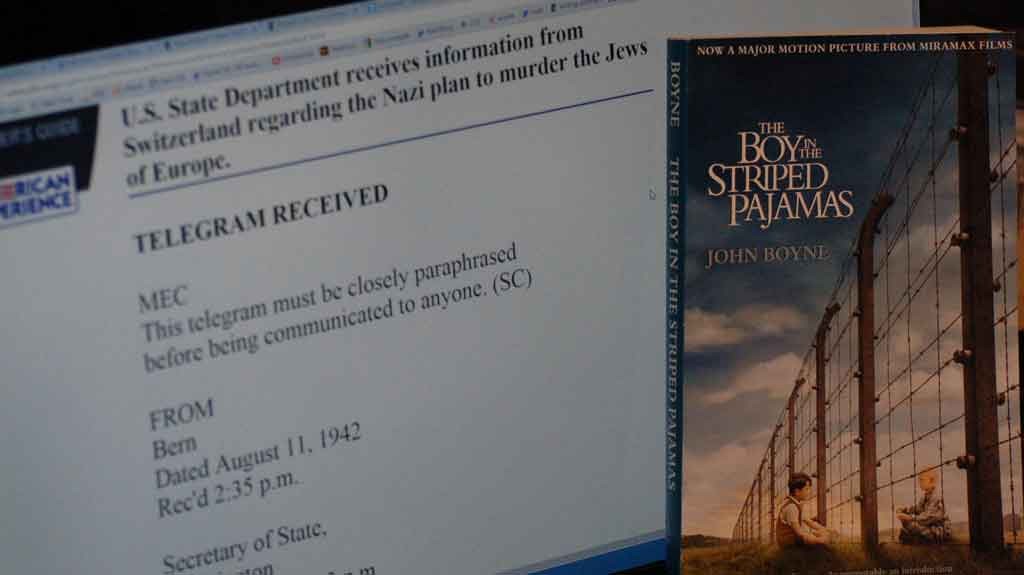
The requirement in the Common Core English language arts standards that students be able to read and understand informational text has led to some interesting lesson plans in literature classes where the standards have been adopted, the New York Times reports.


Under Common Core standards, the study of fiction like John Boyne’s The Boy in the Striped Pajamas might be supplemented by historical documents, like a memo from Switzerland to the US secretary of state. (Voxitatis)
What many literature teachers are doing, the paper reports, is having students read many of the same books they read under the old standards and incorporating informational texts like court opinions, research articles, or even newspaper op-ed pieces into the discussion. Sometimes kids have a great time debating laws or historical evidence while studying a work of fiction.
But sometimes it backfires. One eighth grader, an avid reader, told the Times that she appreciated how nonfiction could provide a historical context for a novel, but sometimes she got tired of the informational texts: “We do so much nonfiction. I just want to read my book,” she was quoted as saying.
Teachers at one school, though, Lower Manhattan Community Middle School, felt students were “more excited about a unit on women’s rights, focused on speeches by Shirley Chisholm and Sojourner Truth, and a 2006 letter by Venus Williams criticizing Wimbledon for paying female winners less than men.”
The nonfiction seems more relevant to kids’ lives, according to Eli Scherer, a special-education teacher. As a result, struggling readers were “more engaged by nonfiction,” he said.
Other examples of lesson units around works of fiction include:
- Shakespeare’s Romeo and Juliet with readings about teen suicide
- Mark Twain’s The Adventures of Tom Sawyer with an op-ed about teen unemployment
- J.D. Salinger’s The Catcher in the Rye with articles about bipolar disorder in adolescents
Unfortunately, the Common Core doesn’t really make any suggestions as to which informational texts should be paired with which works of literature. This has often left teachers to find informational texts that might not be the best fit for the novel or might not come from reputable sources.
It has also led to a reduction in the amount of fiction students read, because time has to be allowed for reading the informational texts and incorporating that material into class discussions. Sometimes, that’s a good thing, since what 12th grader really wants to read any more Beowulf than he has to, right? But sometimes it’s not so good.
“If you look at the standards and what they say, nowhere in there does it say, ‘Kill the love of reading,'” the Times quoted Kim Yaris, a literacy consultant, as saying.