


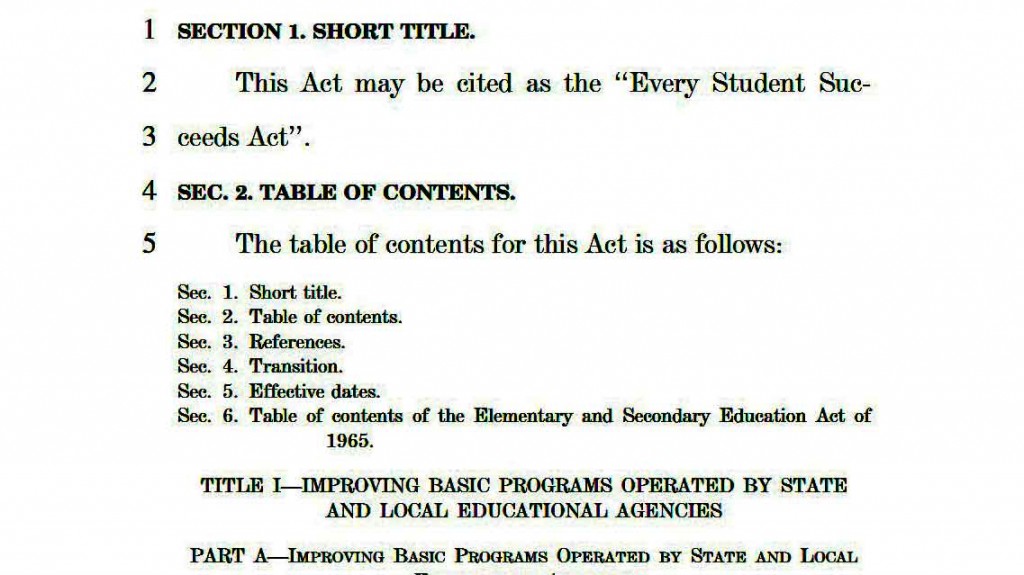
The “Every Student Succeeds Act” would scale back the federal footprint in education and, like its predecessor, the No Child Left Behind Act, require states to administer standardized tests in reading and math in grades 3 through 8 and once in high school. It would provide several key provisions for private schools and charter schools but make no drastic changes in Title I funding for disadvantaged students. It’s headed to the floor for a vote.
The bill, a compromise between the House and Senate versions, which passed earlier this year but differ in a few spots, is expected to come up for a vote this week. In committee, the compromise received strong bipartisan support, getting only one dissenting vote, that of Senator Rand Paul, Republican of Kentucky, who is running for president.
“This agreement, in my opinion, is the most significant step towards local control in 25 years,” Education Week quoted Senator Lamar Alexander, Republican of Tennessee, who chairs the Senate education committee, as saying.
The Council of Chief State School Officers, the National PTA, and both major teachers’ unions have endorsed the compromise.
The bill would protect the bottom 5 percent of schools in a state, a change to NCLB that took root as the US Education Department granted waivers over the last few years, but require states to work on schools with a high dropout rate or low-income and minority student populations. States will also have to continue the NCLB practice of providing special assistance if needed to students in special education and English learners.
For the majority of schools in a state, though, control lies with the state, a change that no doubt encouraged the National Governors Association, which rarely, if ever, endorses legislation, to get behind this compromise bill.
The bill’s support among politicians, however, is not completely mirrored in the education community. “Our schools can’t afford new mandates for high-stakes testing and opportunities for the private sector to profit off kids,” the Network for Public Education, a group of progressive education activists, said in an email message.
In the new version of the Elementary and Secondary Education Act of 1965, which is an infinitely better name for a school law, by the way, because it avoids absolutes like “no” and “every,” states essentially get to set their own academic goals, the Washington Post reports.
In practice that means while No Child Left Behind set a single goal for the whole nation at 100 percent proficiency in reading and math by 2014, under the new law each state would be able set individual academic goals. Furthermore, the bill would also leave the determination of how much weight to give test scores up to states.
The total accountability system for each state would have to include some measure of student progress, including test scores and graduation rates. But states could determine how much weight to give factors such as school climate, student engagement, and access to advanced courses in their accountability systems.
I wonder, Are we reverting back to a system where we send federal tax dollars to schools through states without requiring enough information that the money is being spent to make a difference for kids? I want to cut back the role of standardized testing, but I don’t want to allow states to lower the bar for their students while they still get my tax dollars.
Sandy Kress, a key architect of No Child Left Behind, apparently hopes we’re not biting off the nose of federal involvement to spite the face of educational opportunity for our students. “I don’t think this bill is going to fare well over time. I think it will be seen as one of the most serious policy mistakes in the whole history of education policy in the nation,” the Post quoted him as saying.
We’ll have a more complete analysis of the bill when it passes Congress.