


In a February 24 episode of the TV show Variety, actor Timothée Chalamet said he wouldn’t “want to be working in ballet or opera, or, you know, things where it’s like, ‘Hey, keep this thing alive,’ even though no one cares about this anymore … all respect to the ballet and opera people out there.”
The daytime TV show The View weighed in on his comments:

So did dancer and student reporter Iona Hersh at Van Nuys High School in California for an op-ed in the school’s student newspaper.
“I’m a dancer, and to say the least, I was horrified that someone who’s an actor themselves would hold such an unfavorable opinion of the arts,” she wrote. “Any area within the arts requires years of training to master and holds such immense value in the lives of many.”
The controversy has, ironically, ignited a global conversation that proves his “no one cares” assertion may be a significant miscalculation of the current cultural landscape. While the actor characterized these forms as being on “life support,” current data and international perspectives suggest that ballet and opera are not only surviving but are experiencing a robust, tech-driven resurgence.
The Global Renaissance: By the Numbers
Contrary to the “ethno-centric” view that these arts are a niche Western hobby, the most explosive growth in 2026 is occurring in the Asia-Pacific region.
In the Asia-Pacific region, attendance has increased by 29% since 2021, to 4.2 million annual attendees, driven mainly by massive government investment in China (Beijing National Opera) and a booming middle class in Japan and Korea.
The European market shows about 12 million annual attendees, representing an 18% increase in cross-border touring. Strong state funding in Germany and France and the integration of virtual and augmented reality into classical staging get most of the credit here.
The North American market has about 29 million annual dance attendees and an $11.16 billion opera market value. The primary drivers are the diverse programming (contemporary vs. classical) and “pay-what-you-can” accessibility programs.
Virtual Reality and Augmented Reality in Staging

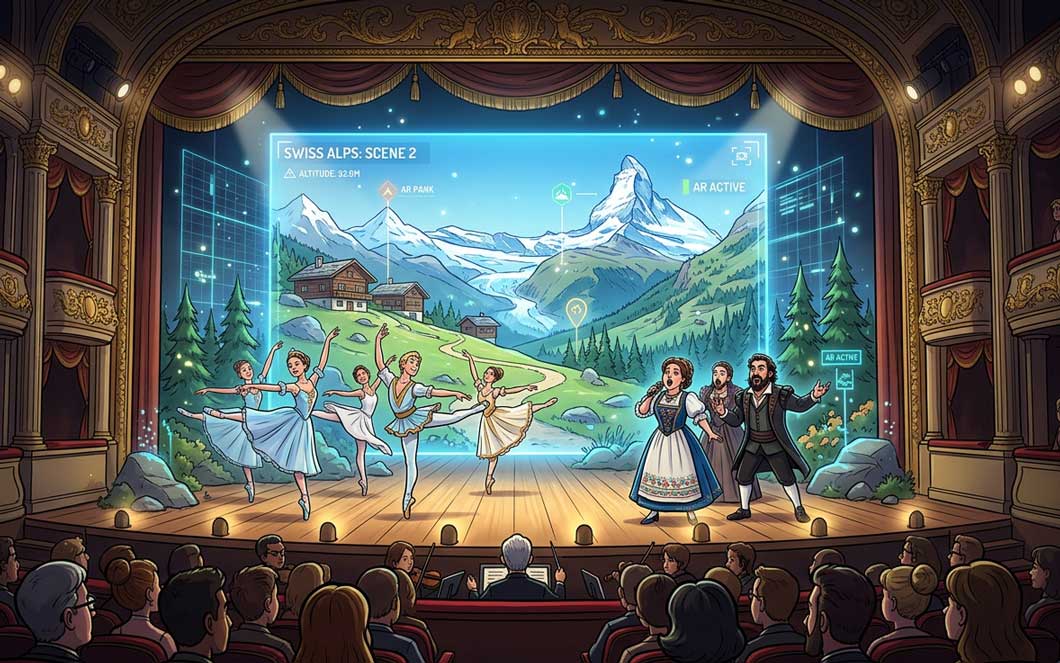
In the context of the 2026 performing arts season, virtual reality (VR) and augmented reality (AR) staging refers to the integration of digital, three-dimensional environments into live opera and ballet performances. Rather than relying solely on physical painted backdrops or heavy wooden sets, companies are using these technologies to create “immersive scenography” that can change instantaneously.
AR is used to overlay digital effects onto the physical stage that the audience sees in real time.
The “Smart Glass” Experience,” for example, in some premier houses, like the Paris Opera, now offers “AR glasses” for select seats. While watching the live dancers, the audience might see digital “embers” floating in the air during a fire scene or a spectral ghost appearing beside a singer that isn’t physically there.
Using a technique known as “Projection Mapping,” a more common form of AR where high-powered projectors “wrap” the entire stage and sometimes the theater walls in digital textures, some houses have made the walls grow and expand alongside stage props, such as the Christmas tree in a production of The Nutcracker.
VR is typically used to expand the reach of the art form beyond the physical building, or to create “hybrid” performances.
Example: Virtual Front-Row Seats: Many international companies now livestream performances in 360-degree VR. A student in Maryland or California can put on a headset and feel as though they are standing in the middle of the orchestra pit or sitting in the “Royal Box” at the Vienna State Opera.
Example: The “Digital Twin” Performance: In some experimental ballets, a live dancer’s movements are captured by sensors and projected as a “digital twin” or an avatar on a screen behind them. This allows a single dancer to appear as an entire “corps de ballet” or to interact with gravity-defying digital shapes.
These technologies are the primary tools used to bridge the gap between “traditional” arts and “Gen Z” audiences. Digital sets are significantly cheaper to “tour” than physical ones, allowing world-class companies to bring high-quality opera to smaller cities and schools that couldn’t previously afford the logistics.
By using the same engines that power popular video games (like Unreal Engine 5), opera and ballet are becoming “visual spectacles” that appeal to younger viewers accustomed to high-end digital media.
These Forms Still “Matter”
Advocates for the arts might point out that Chalamet’s critique ignores the “Olympic-level” athleticism and interdisciplinary nature of these crafts.
A professional ballet dancer typically trains 6 hours daily for over 10 years before their debut. This level of physical discipline is increasingly being highlighted at major events, such as Misty Copeland’s high-profile performance at the 2026 Oscars, which served as a direct rebuttal to the idea that ballet lacks “visibility.”
Opera is unique because it combines every major art form (music, theater, visual design, and dance) into a single experience. In 2026, many companies are using AI and immersive technology to create “scenic spectaculars” that rival Hollywood blockbusters in their visual scale.
It’s paying off with Gen Z, too. Survey data from early 2026 shows that the 18–34 demographic is the fastest-growing audience segment for ballet, now making up 28% of total attendees. This is driven, in part, by “pay-what-you-can” initiatives and cross-genre collaborations.
A Global Rebuttal to “No One Cares”
The response from international institutions has been both swift and witty, showcasing a “vibrant” rather than “dying” industry:
The Paris Opera responded to Chalamet with a clip of their current Nixon in China production, jokingly noting that “ping-pong also exists in opera.” The Wiener Staatsoper (Vienna) took to the streets to interview fans, proving that their upcoming runs are nearly sold out. And principal dancers Megan Fairchild and Sara Mearn from the New York City Ballet challenged the actor to “get in the studio” and experience the physical toll of the craft, reminding him that his own mother and sister were classically trained.