


Maryland doesn’t have too many schools potentially out of compliance with Title IX, the federal law that prohibits discrimination based on sex in school sports, but in Illinois, more than 1 in 4 schools may be out of compliance, according to a June 23 report from the National Women’s Law Center.


Florida’s Barron Collier Cougars play Virginia’s Flint Hill Huskies (Walter via Flickr Creative Commons)
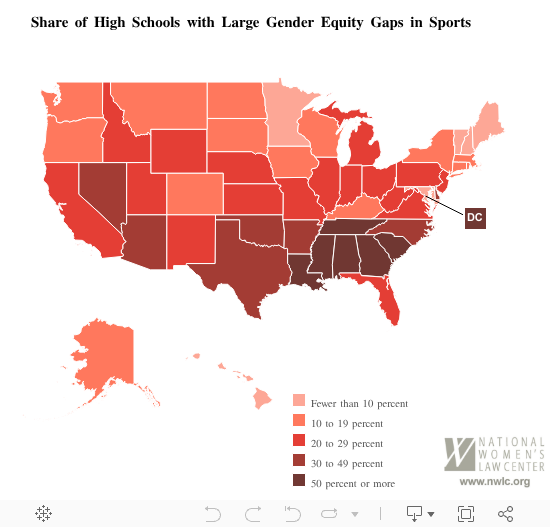
Fewer than 10 percent of the high schools in Maryland and only five other states—Vermont, Hawaii, Maine, Minnesota, and New Hampshire—have a percentage of girls on sports teams less than 10 percent away from the percentage of girls in the school, according to the report. That’s pretty good.
But in general, many “high schools across the country are not providing girls with their fair share of spots on sports teams,” the center writes. “Nationally, of the more than 16,000 high schools examined, nearly 4,500 schools—28 percent—have large gender equity gaps.”
The center has published a map via Tableau, embedded below, to show the percentage of schools in each state that have gender equity gaps of more than 10 percent. Percentages bands include states with percentages all the way to the start of the next band. That is, the 10–19 percent band, includes states that have 10 percent of schools with large gender equity gaps and states that have 19.99 percent of schools with large gender equity gaps.

Here’s how the center calculates the gender equity gap with respect to Title IX compliance: If 50 percent of the students at a school are girls and 35 percent of the student-athletes are girls, the gender gap is 15 percent (50–35).
In Maryland, 7.6 percent of the high schools have a large gender gap, defined as 10 percent or more. In Illinois, 26 percent of the high schools have a large gender gap in sports.
Having roughly equal proportions of spots on teams allocated to girls and girls in the student population is only one of the ways a school can demonstrate compliance with Title IX.
Let me demonstrate with an oversimplified example. Say a school has a girls’ volleyball team, a girls’ basketball team, a boys’ football team, a boys’ basketball team, and a boys’ wrestling team. If there are 50 spots on the football team for boys, 10 spots on the wrestling team for boys, and the other teams have 15 spots, the calculation would be as follows:
| Sport | Girls | Boys |
|---|---|---|
| Basketball | 15 | 15 |
| Volleyball | 15 | |
| Wrestling | 10 | |
| Football | 50 | |
| Total Proportion | 30 28.6% | 75 71.4% |
Then, say the school has the same number of boys as girls, 50 percent each. The gender equity gap at the school would be 21.4 percent, computed as the percentage of girls in the student population minus the percentage of spots on sports teams for girls.
A closer look at Title IX probably means that “gaps of 10 percentage points or more indicate that schools are likely not complying with the law,” the center writes.
Although the law itself doesn’t set an actual percentage for gender equity gaps, the US Department of Education’s Office for Civil Rights issued a clarification document in January 1996 spelling out a three-part test for Title IX compliance for schools that offered intercollegiate athletic competition.
Data for the study came from the US Department of Education and were for the 2011-12 school year, including all public co-educational high schools in the US that provide interscholastic athletic opportunities.