


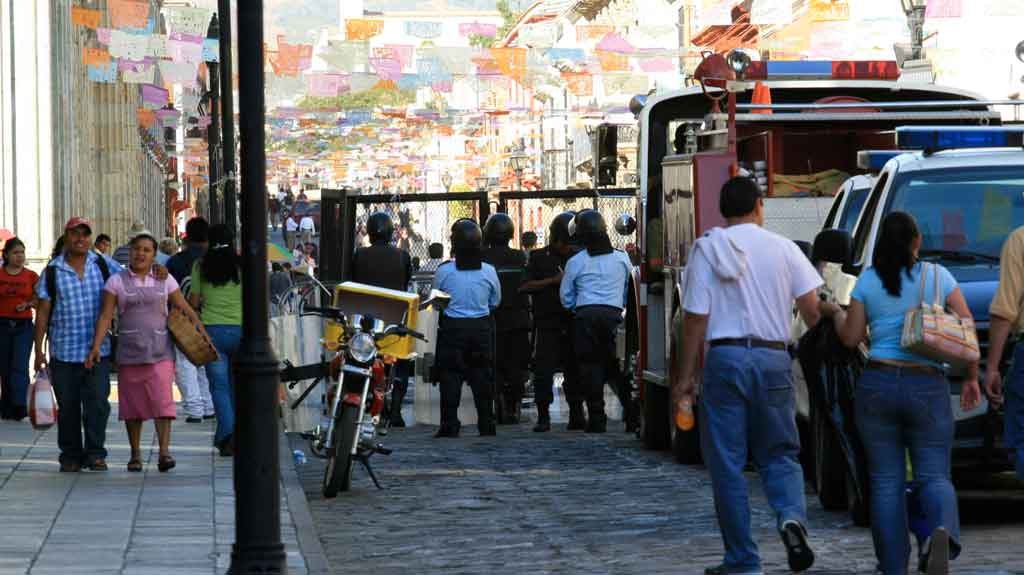
A labor protest led by a somewhat radical teachers’ union in Mexico’s second-poorest state escalated in mid-July, following a federal police response that began in June to remove protesters who had broken into or blockaded electoral offices, the Associated Press reports.


Protesters say education reforms, approved in 2013 by the Federal Congress, reveal a government that wants to make education a private service. By replacing long-term teachers with contract workers who have no union, they say, the government is essentially privatizing public education in every state in Mexico. The biggest resistance to the reforms has come from Mexico’s poorest communities, which languish in poverty but where kids have the same dreams, the same aspirations, as those in more affluent parts of the country.
Although Chiapas is still Mexico’s poorest state out of 32 regions, with a poverty rate rising to 76.2 percent last year, Oaxaca, which is also located on the southern Pacific coast, edged out Guerrero to become the second-poorest state, with a rate of 66.8 percent, the Reuters News Agency reported. Labor protests, especially those led by Section 22 of the national teachers’ union in this country’s poorest region, are nothing new.
In October 2006, thousands of protesters from Oaxaca marched to Mexico City to demand their state governor’s resignation. They said the man who was then governor of Oaxaca State had rigged elections and used brutal force to put down protests. Police force was indeed used to stop the protests, resulting in the death of at least five people that year at the hands of police. The demonstrations started as a demand by teachers for more pay, but the campaign soon extended to other areas of public policy, according to a report on the BBC.
The teachers’ union shines a light of public school privatization on this year’s protests, accusing the government of pushing reforms that will “stop offering free and public education,” the website Truth-Out quoted Dolores Villalobos, a teacher in Oaxaca who belongs to Section 22 of the National Organization of Education Workers (CNTE), as saying. “Before, the state had an obligation to provide public education. As part of the reform, that is changing. The concept is now just a ‘guarantee’ of education, and this means that there won’t be requirements, and it will be privatized. At the root of it, they want to reduce the number of education workers. With the reform, it will become a system of contracts for one or two years with no benefits.”
President Peña Nieto has shown support for Oaxaca’s governor, Gabino Cué Monteagudo, sending in federal police to take control of the State Institute of Public Education of Oaxaca, a building that was formerly in the hands of the CNTE. The federal government has also cancelled the union’s bank accounts, blocked their radio channel, and issued arrest warrants for union leaders, Truth-Out reported.
Although we generally oppose any government running the schools—because it does tend to lead to the takeover of schools by for-profit corporations—the situation with teachers’ unions in Mexico is very different from that in the US.
In Mexico, teachers are allowed to inherit their teaching positions from relatives and are sometimes illiterate or less than fully educated themselves. With the brute force of teachers’ unions, these bad teachers have become entrenched in many Mexican schools, a problem that doesn’t sit well with the government in many of Mexico’s poorest communities, where parents hope their children can break out of the poverty through education.
Despite the need for reforms, however, we are also opposed, on a more fundamental level, to often corrupt governments bringing in military or riot gear-brandishing police officers to put down peaceful protests. Breaking into the election offices or blockading the entrances so people can’t go to work or conduct elections is another matter though, even if protesters believe the elections to be rigged. Engaging in peaceful protests outside to inform the public of the wrong being inflicted on public schools would be more effective.
This is especially true since teachers everywhere vigorously oppose key parts of the 2013 overhaul in Mexico that required competitive testing for teachers. Those tests don’t measure teaching skills and are used simply as a tool to reduce the teaching workforce, which in a vicious cycle makes education quality much worse for students. The government in Mexico has suspended the use of those tests, mainly in response to informed pressure from teachers there, and we urge the teachers and others in Oaxaca to continue with peaceful protests in hopes of bringing about better reforms for the schools where they’re needed.