


Getting college-ready in America
The Council for American Private Education reported that high school graduates from private schools are more likely than their public school peers to be ready for college, based on ACT scores for the Class of 2015. Data show that 85 percent of graduates of religious and independent schools who took the ACT met or exceeded the test’s college-readiness benchmark score in English, versus 61 percent of public school grads. The share of students who met or surpassed the benchmark scores in other subjects was also higher in private schools in reading (66 percent compared to 44 percent), math (60 percent compared to 40 percent) and science (55 percent compared to 36 percent).
And speaking of standards, the Next Generation Science Standards (NGSS) were adopted by unanimous vote of the Connecticut State Board of Education on November 4. The NGSS Content Crosswalk Report shows content similarities and differences between NGSS and Connecticut’s current science standards. Information regarding transitioning curriculum, instruction and assessments will be forthcoming.
Selected links to NGSS resources:
- EQuIP Rubric for Evaluation NGSS Quality of Science Lessons and Units: The Educators Evaluating the Quality of Instructional Products (EQuIP) Rubric for science provides criteria by which to measure the alignment and overall quality of lessons and units with respect to the Next Generation Science Standards (NGSS).
- National Science Teachers Association NGSS Resources: web seminars, articles from peer-reviewed journals, NSTA Press books, short courses and face-to-face conference lectures and workshops, all designed to build an understanding of the NRC Framework and NGSS.
- NSTA Archived Webinars: NGSS Science and Engineering Practices
- NGSS Appendices: 13 essays detailing elements of the NGSS
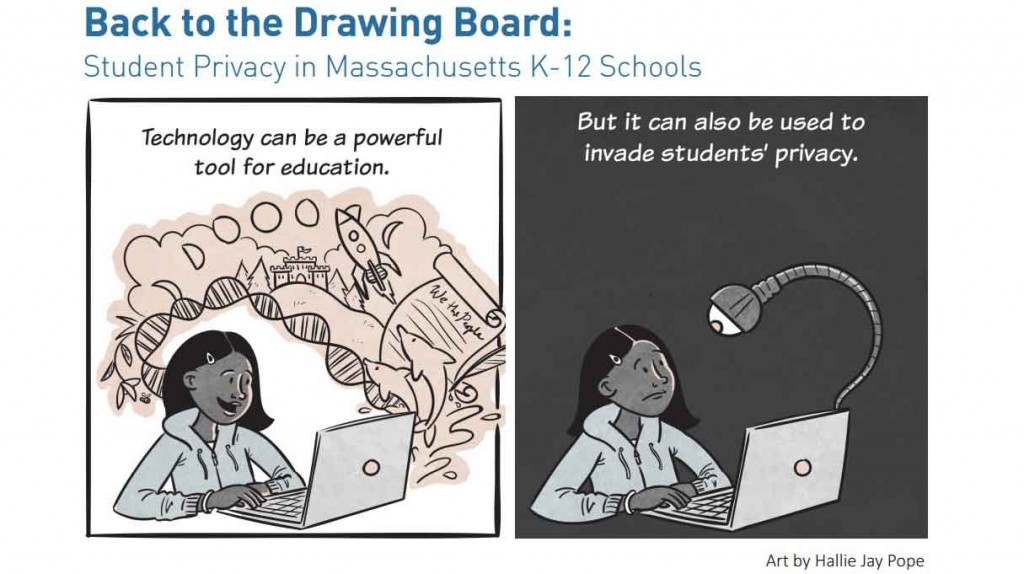
As we collect and report data on how college-ready our students are, the ACLU of Massachusetts has produced a report providing great detail on the status of student data privacy in K-12 schools. The Lower Merion School District in Pennsylvania, the report points out, at the start of the 2009-2010 school year, “gave students MacBooks loaded with spyware without telling the students or their parents. The school used this spyware to capture thousands webcam images, screenshots, and personal communications from at least two students.”
On the 2016 presidential campaign trail
Republican candidate and former Florida Governor Jeb Bush said questioned the value of college for liberal arts majors, Inside Higher Ed reports. “Universities ought to have skin in the game,” he was quoted as saying. “When a student shows up, they ought to say, ‘Hey, that psych major deal, that philosophy major thing, that’s great, it’s important to have liberal arts … but realize, you’re going to be working a Chick-fil-A.'”
Almost no students were allowed into the third Republican presidential debate, hosted at the University of Colorado. “The college framed [this debate] as a real chance for the students to have this meaningful political experience,” said CU-Boulder student Aaron Estevez-Miller, 21, in an interview with ThinkProgress. “In the months since then, the university and chancellor have really failed to deliver on this promise.” No matter: even though students will be voting in their first presidential election in 2016, the candidates didn’t really have much to say about education.
Senator Marco Rubio of Florida, who is running for president, introduced his “Investing in Student Success Act” again. This would allow students to fund their college education through private loans to be repaid through income-sharing agreements. Repayment would be based on the income for any individual or organization that agreed to help pay for their education for a predetermined period of time following graduation. The private financing option would serve as a voluntary alternative to student loans. “In the 21st century,” he said, “higher education is no longer an option for Americans, it has become a necessity. A complex and confusing student loan system makes it increasingly difficult for millions of people trying to meet the challenges of our economy.”
Election Day
Voters in Mississippi on November 3 defeated a proposal to change the state’s constitution with regard to school funding and, it was hoped, bring funding of schools into line with what is needed and erase some of the under-funding that has plagued schools in the state for about 18 years, the Clarion-Ledger reports. Initiative 42 would have changed the constitution to place the burden on the “state” (replacing the Legislature) for providing an “adequate and efficient system of public schools.” An alternative, known as Initiative 42A, may have split the vote on Initiative 42, and would have used the word “effective” to describe the public school systems the state would need to maintain. Neither initiative passed.
Plots against schools and a prank disguise
Two male students in Virginia have been arrested and accused of plotting an attack at their high school, law enforcement said, the Associated Press reports. They were planning to call in a bomb threat at Riverbend High School in Fredericksburg and then shoot at students and staff as they evacuated the building, said Captain Jeff Pearce of the Spotsylvania County Sheriff’s office. The 15- and 17-year-old students are charged with conspiracy to commit murder. “We were able to mitigate the danger, long before it presented any chance of coming to fruition and there was no immediate threat to the safety of the kids,” the Sheriff’s office said in a statement.
State Police in Connecticut arrested two Litchfield High School students on November 4 for allegedly disguising themselves as the Columbine killers and threatening bodily harm to other individuals, the New York Times reports. District Superintendent Lynn K McMullin said the students were sophomores who wore “very inappropriate and alarming disguises” on Saturday in a public area in town. However, she maintained in an email that, despite wearing trench coats, sunglasses, and baseball hats, “there was no credible threat and students were never in physical danger.”
Eating right
The US Department of Agriculture’s community eligibility provision, or CEP, jumped 20 percent this year, only the second year the option has been available nationwide, Education Week reports. By selecting this option, schools with at least 40 percent of students eligible for free or reduced-price meals can skip the paperwork for every individual student and just make all students in the school eligible. The school is reimbursed at about 60 percent of what it would receive for the meals if every individual student had become eligible by filing separate paperwork.
Technology update
According to a report from Wall Street Journal, Google is said to be working on taking out the OS used on Chrome, and its remaining programs will eventually be integrated on Android for mobile. Clearly, mobile computing is starting to dominate the computer world, and the Chrome OS is being phased out. This might be an issue for schools who have recently purchased thousands of Chromebooks as part of technology 1-to-1 programs.