


Why are great white sharks so rare?

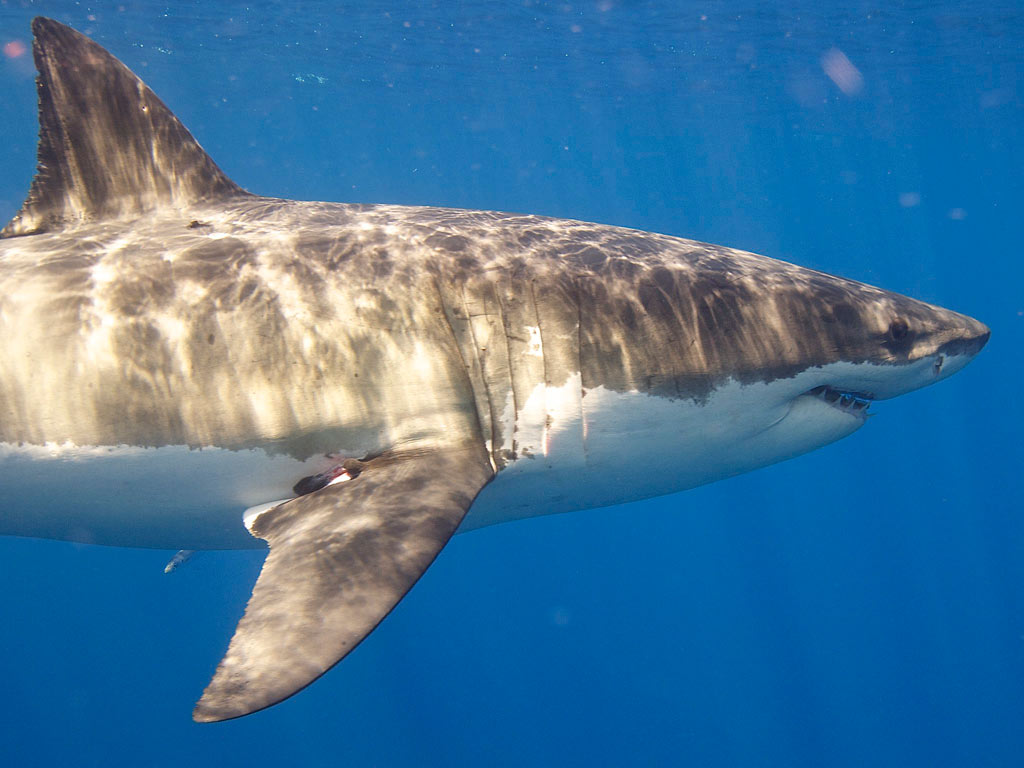
White sharks (Carcharodon carcharias), often called “great whites,” are among the ocean’s top predators. But their numbers are surprisingly small. Scientists estimate there are only about 20,000 white sharks worldwide — fewer than the number of fruit flies in a single city.
A Population Bottleneck
During the last Ice Age (about 25,000 years ago), glaciers trapped large amounts of water, lowering sea levels by about 40 meters (131 feet). This reduced ocean habitat led to a single population of white sharks in the southern Indo-Pacific Ocean.
As the climate warmed approximately 10,000 years ago, the ice melted, and sharks spread north again. Approximately 7,000 years ago, they began to form distinct populations. Today, there are three main populations:
- Southern Hemisphere — Australia & South Africa
- North Atlantic
- North Pacific
Two Types of DNA Tell Different Stories
Scientists use two kinds of DNA to study populations:
| Type of DNA | Inherited From | What It Shows | Pattern in Sharks |
|---|---|---|---|
| Nuclear DNA | Both parents | Overall genetic mixing | Nearly identical across the globe |
| Mitochondrial DNA (mtDNA) | Mother only | Maternal lineages | Very different between populations |
In 2001, researchers discovered a puzzle: white sharks had nearly the same nuclear DNA everywhere, but their mtDNA varied widely between groups.
A Mystery Without a Clear Answer
Scientists once thought this pattern could be explained by “philopatry” — females return to the same place to breed, while males roam and mix genes. But new research using one of the largest shark DNA datasets ever collected found that philopatry alone cannot explain the differences.
Other possible explanations include:
- Reproductive skew — only a few females reproduce each generation. (But tests show this is not the case.)
- Genetic drift — random changes in small populations. (But this should affect both nuclear and mitochondrial DNA, and it doesn’t.)
- Natural selection — perhaps only certain mtDNA sequences allow survival. (This seems unlikely in such small populations, unless the pressure is extremely strong.)
For now, scientists admit: The cause of the mismatch remains unknown.
Constructed-Response Writing Prompts
Explain why scientists study both nuclear DNA and mitochondrial DNA when investigating populations. Use the shark study to describe what each type of DNA revealed and why this created a scientific puzzle. (Analyzing DNA Evidence)
Scientists tested several possible explanations for the DNA mismatch in white sharks: philopatry, reproductive skew, genetic drift, and natural selection. Construct an argument explaining how the data does or does not support the hypothesis that natural selection (or choose another possible cause) contributed to this pattern. Support your reasoning with evidence from the passage and your knowledge of DNA. (Evaluating Scientific Explanations)
Propose additional research methods scientists could use to help solve the shark DNA mystery. Explain how your method would build on the current evidence. (Designing Future Research)