


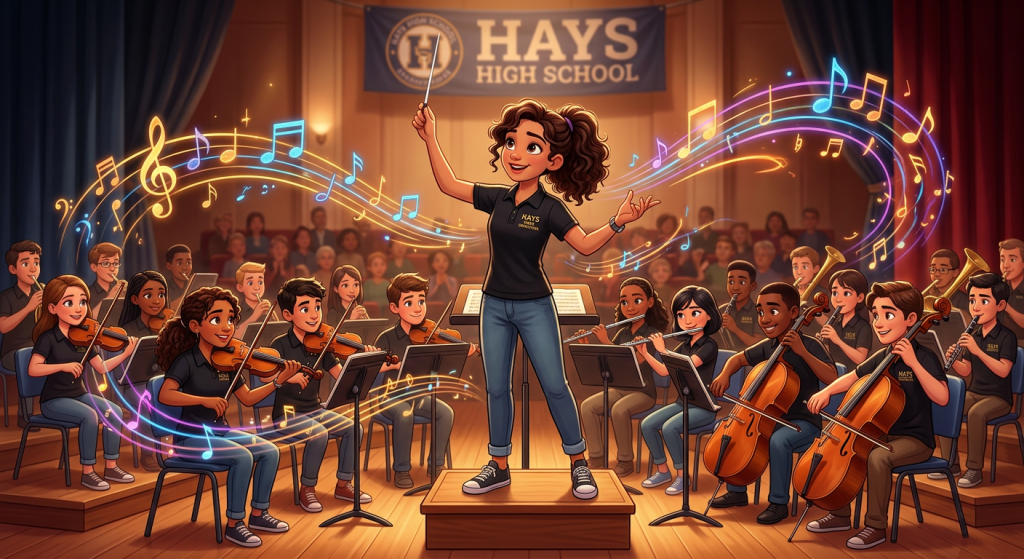
Putting a baton in a student’s hand is more than just a “neat” classroom activity; it’s a high-stakes pedagogical tool that shifts a musician from passive participation to active leadership.

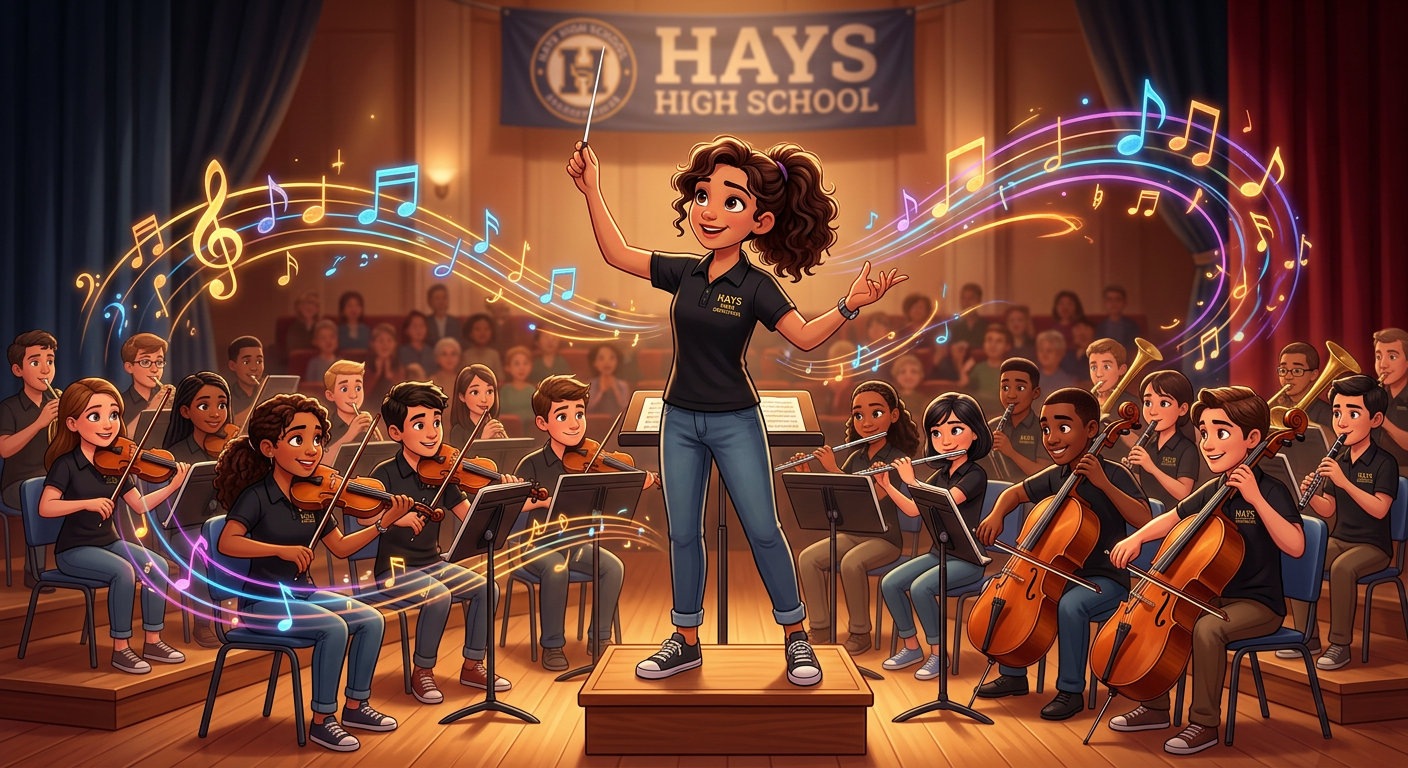
Brayden Smith noted, conducting forces a “holistic view,” Kennedi Fischer reported in the student newspaper at Hays High School in Kansas. Mr Smith is the orchestra director at the school, which hosted a concert last month at which students conducted every work.
But research suggests the benefits of conducting an orchestra go even deeper for students — into the realms of cognitive neuroplasticity, self-efficacy, and the development of a “growth mindset.”
In a traditional ensemble, students are responsible for their own notes and rhythm, and their focus is generally “linear.” However, a study published in Frontiers in Psychology (2024) indicates that active music-making, and specifically the sensorimotor integration required for conducting, engages the brain’s prefrontal cortex and parietal regions more intensely than passive listening or single-instrument play.
By conducting, students must process multiple “inputs” (the strings, the winds, the percussion) and synthesize them into a single “output” (the gesture). This builds critical thinking and self-awareness, as they have to instantly diagnose why a section is dragging or out of tune and fix it with a physical movement.
Growth Mindset on the Podium
The concept of a “growth mindset,” popularized by Carol Dweck, is perfectly embodied in works such as “Dance of Iscariot” or “Fantasy on a Japanese Folk Song.” These works, which appeared in the Hays program, are often categorized as “Grade 4” or “Grade 5” repertoire, meaning they contain complex rhythmic shifts and transparent textures where any error is exposed.
For a student like junior Issac Bloom or sophomore Leah Thomas, standing on the podium represents a massive “risk-taking” opportunity. Research from the National Association for Music Education (NAfME) suggests that when students take on these roles, they move from a “fixed” mindset, believing their leadership is a static trait, to a “growth” mindset, realizing that expressivity and cueing are skills that can be mastered through repetition and feedback.
The Benefits of “The Student Baton”
| Research Area | Key Benefit | Impact on Student |
|---|---|---|
| Neuroplasticity | Strengthens neural pathways between auditory and motor cortices. | Improved coordination and multi-tasking abilities. |
| Social-Emotional | Enhances “social relatedness” and empathy. | The student must “feel” the ensemble’s energy to lead it effectively. |
| Pedagogical | “Showing” vs. “Telling” builds clarity. | Students learn that clear communication (gestures) produces immediate results. |
| Self-Efficacy | Overcoming “Podium Anxiety.” | Builds a “protective factor” for mental well-being and confidence. |