


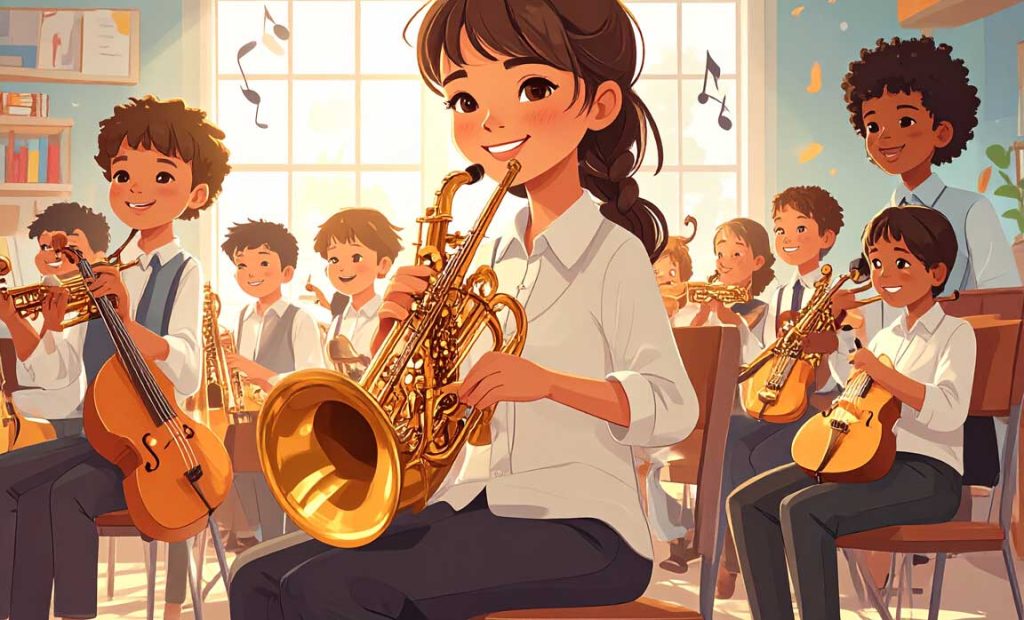
Music isn’t just about scales, rehearsals, and the occasional concert. For students who pick up an instrument, it often becomes a pathway to learning much more –about themselves, about perseverance, and about how growth comes from steady practice. At Hughson High School, the story of one trumpet player, told by Riley Vance in the student newspaper, shows just how far a “growth mindset” can travel beyond the band room.

Discovering Band, Discovering Himself
When John McKee first joined band in seventh grade, he wasn’t looking for a life-changing experience. He had just moved to Hughson a few years earlier, spent much of his time playing video games, and thought band sounded like something his friends were doing. Plus, his grandmother told him he’d make a good trumpet player. So he joined.
But what started as a casual decision soon turned into something bigger. “It’s just something fun to do,” John explained. “Like, learning something new, which is fun.” Over time, he realized that music wasn’t just fun; it was teaching him skills that extended into every part of his life.
His sense of rhythm sharpened. His ability to recognize patterns improved. And with every new piece of music mastered, he gained something even more important: confidence.
Growth Mindset in Action
If there’s one theme running through John’s journey, it’s a growth mindset: the belief that abilities can improve with effort, mistakes, and perseverance. That’s a lesson every band student learns quickly: no one picks up an instrument and plays perfectly the first time. Success comes only by facing wrong notes, missed rhythms, and hours of practice.
For John, that persistence has paid off. He’s played at jazz festivals, performed in the honors band, and even traveled with his group to Disneyland. Each experience reinforced the idea that effort leads to opportunity and that improvement is always possible.
Those lessons don’t stop at the band room door. Pattern recognition helps in math and science. Confidence helps in class discussions. And the patience to practice a difficult passage carries over to tackling essays, projects, or even everyday challenges.
A Parent’s Perspective
John’s father, David McKee, has watched this growth up close. Like many parents of student musicians, he’s had to buy performance outfits, juggle schedules to attend concerts, and encourage his son to keep practicing when the motivation ran low.
But for David, the rewards outweigh the sacrifices. “I’m proud to have a son who has dedicated his time to band,” he was quoted as saying. He’s seen John grow into a more confident young person — one who carries himself differently because of the discipline and pride that music instills.
His advice to his son reflects that perspective: “Keep at it, make your own music.” The message is as much about life as it is about trumpet practice.
The Teacher’s View: Music as a Life Teacher
Band director Kayte Maki has worked with John for three years, first in middle school and now at Hughson High. She’s watched his trumpet skills blossom, but she points to something deeper as well: his drive to hold himself to high standards.
“John has always held himself to very high standards,” she said. “Over the years, he has developed exceptional trumpet skills and improved as a musician.”
Maki also knows from personal experience how much music teaches about life. “I have learned about learning itself through regular practice, many mistakes, and perseverance,” she said. Music took her to places far and wide and introduced her to her closest friends and even her husband.
For her, the growth mindset isn’t just something she teaches; it’s something she has lived. The same patience and persistence that fuel progress on an instrument can also expand a person’s world, literally and figuratively.
Why Music Matters Beyond Music
John’s story is just one example, but it highlights something many band students experience: growth that extends well beyond playing an instrument. In music, you learn that every mistake is temporary, every challenge can be overcome, and every effort builds toward improvement.
This mindset helps in academics, where problem sets and essays require persistence. It helps in athletics, where training means repetition and resilience. And it helps in life, where confidence and adaptability open doors to friendships, jobs, and new experiences.
In other words, music isn’t just teaching students how to play songs. It’s teaching them how to grow.
At Hughson, band has been part of the school’s culture for decades, but its future depends on students who are willing to give it a try. For anyone on the fence, John’s journey and the voices of his dad and his teacher offer encouragement.
Band can mean late nights of practice, the pressure of concerts, and the occasional wrong note. But it can also mean discovering your strengths, learning how to overcome weaknesses, and gaining the confidence to take on challenges in every part of life.
Whether you’re like John, who first joined for fun, or like Ms Maki, who built a life shaped by music, one truth shines through: music is a training ground for growth.
So the real question isn’t just “Should I join band?” It’s this: What might you discover about yourself if you do?