


Blinding sun and crippling heat have forced Marquette High School in Chesterfield, Missouri, to alter its sports schedules, pushing Friday’s football game against St. Dominic back an hour to 7:30 pm and cutting girls’ tennis practices short.
“We can’t live up to our full expectations,” Siddharth Sawant quoted one tennis player as saying in the school’s student newspaper. “We have shorter practices, which gives us less time to improve.”
After meets Monday and Wednesday, she told Siddharth, “It was actually horrible. I almost passed out.”

Even in Rochester, Minnesota, several schools pushed football times back from 7:00 to 8 pm Friday, KAAL-TV (ABC affiliate) reported (video above).
In the southeast, the state of Florida has been under heat advisories 21 times this summer, Central Florida Public Media reported, causing adjustments to football times there as well amid the intense heat.
And the Dayton Daily News reported that several schools in west central Ohio also pushed their games back to avoid the hot sun. According to the National Weather Service, a heat advisory was in effect until 8 PM. While temps reached a high of 93°F during the afternoon, they settled down to 85°F by gametime — a little better.

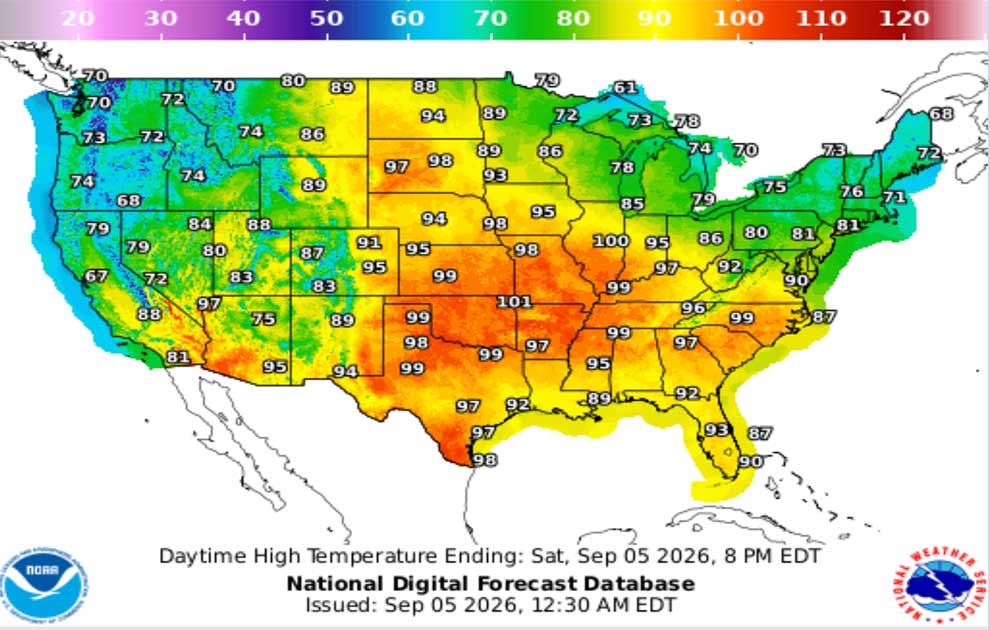
A Late Summer Heat Wave
The National Weather Service’s Weather Prediction Center said yesterday that an “unrelenting and intense” heat wave will continue from the central and southern Plains into the Mid- and Lower Mississippi Valley through the weekend and into next week. It’s expected to stay hot well beyond the Labor Day weekend.
In all, some 87.9 million people, representing about 26 percent of the population of the contiguous US, live in the areas expected to have dangerous levels of heat, according to The New York Times.
When it’s as hot as it is now, student-athletes often report lower energy levels. That’s because high heat and humidity trigger both muscular fatigue and central fatigue, which causes the brain to reduce effort to protect the body, leaving student-athletes feeling drained.
When temperatures climb, the body diverts a significant amount of blood flow away from the muscles and toward the skin to cool itself down. This drop in oxygen and nutrient flow to working muscles can cause physical performance to plunge by 20% to 30%, according to the Biomedical Research Institute at the Clínic Barcelona Research Foundation (IDIBAPS).