

INDIANAPOLIS (Nov. 14, 2009)—At the center of a perfect golden-ratio spiral, flanked by color guard members with long sticks in an × pattern that also points toward the center, sits a cellist with her instrument. The dancers take their sticks and rifles and start dancing around her, while other band members start to move as well.
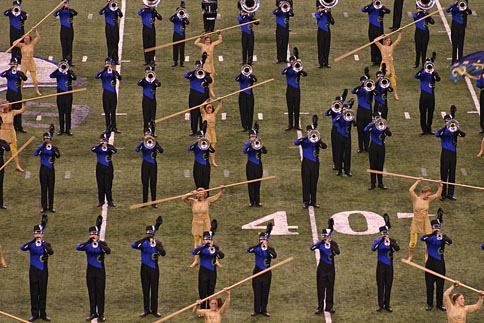
… And then — this:
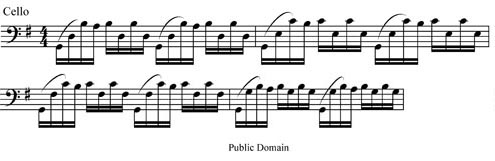
I apologize to those readers who can’t hear music from the score, but for these 10 seconds of music history, there are no words.
So opens the field show presented in semi-final and final competition at the Bands of America Grand National Championships by the marching band from Carmel High School in Carmel, Ind. The music is from the prelude to Johann Sebastian Bach’s Suite No. 1 for Unaccompanied Cello, G Major, BWV 1007.
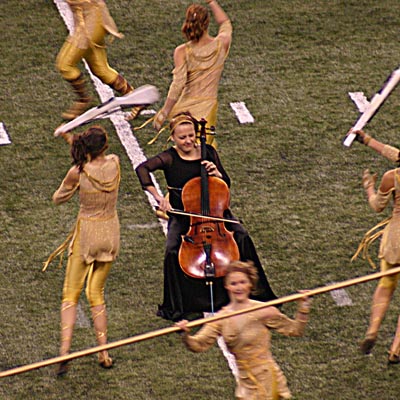
The band’s show is entitled “Virtue-OSITY” and includes four movements: Temperance, Justice, Prudence, and Fortitude. Bach’s cello suite fits nicely with the show’s theme in that although it appears to contain only one melodic line, the organist and composer actually wrote three.
It’s called implied polyphony: “implied” because the musician really only plays one note at a time, “polyphony” because our brain perceives several (“poly-“) parts going on at once. If I were to write out all the different parts, it might look something like this:

The melody in the middle voice goes sol-la-ti-do in the key of G Major. The upper voice accompanies it, sort of how a trumpet might provide a descant for a church choir. Then, the low G, which resonates as an open string when played on the cello, provides what we call a “pedal point,” keeping us as listeners constantly aware of where our tonal center is. An analogy for this might be a good friend who keeps us in line.
Any departure from the tonal center, as in the third measure with not only the dissonant major seventh but also the highly unstable tritone (F#, C), creates tension and forces a near-automatic resolution back to our center.
Thus virtuosity in the musical sense parallels virtue in our daily lives: we can’t stray very far from our own harmonic centers.
Yes, we multi-task, as Bach does, and some of those tasks do create a dissonance within us. But in the end, our voices resolve through acts of virtue, performed with virtuosity. Then, a neighbor picks up our chair and we exit off the field.
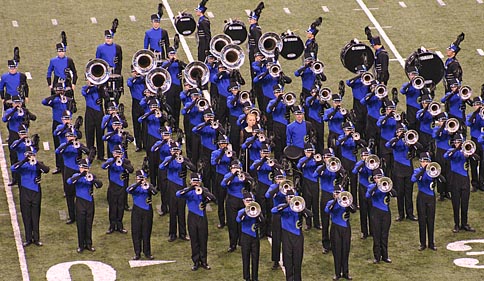
Another virtue portrayed in Carmel’s show is that of justice. For this we see a pianist sitting on a plank between the left 30- and 40-yard lines. The plank is really a see-saw, a clear reference to the scales of justice.
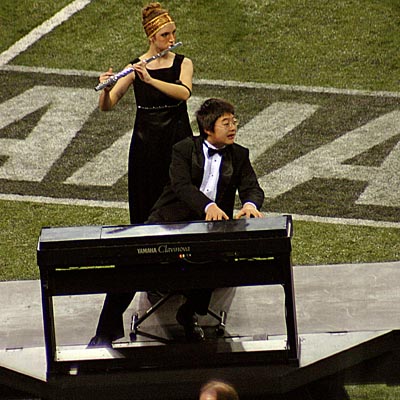
Notice, his bench has rubber feet. Those are necessary, because as he plays, dancers do cartwheels on the plank all around him, causing the see-saw to tilt, first to the left, then to the right, first the plaintiff, then the defendant, weighing both sides of every argument before resolutely pounding out the decision.
Prudence comes in the form of a flutist, rendering the opening segment of Claude Debussy’s Prelude to the Afternoon of a Fawn. She chooses her spot on the see-saw wisely, very near the fulcrum to allow minimal movement as she plays.
The final virtue in the eight-minute field show, fortitude, is clearly evident in many of the thundering concerto-like chords Carmel’s pianist hits at the conclusion.
Carmel High School, established in 1871, brings a marching band to the Bands of America Grand National Championships directed by Richard Saucedo and led on the field by drum majors Chris Wilner, Lexie Krohn, Teresa Mazzini, and Kristen Pileri. The band was named grand national champion in 2005.

Link to all semi-final bands:
2009/11/15/bands-of-america-semi-finalists