

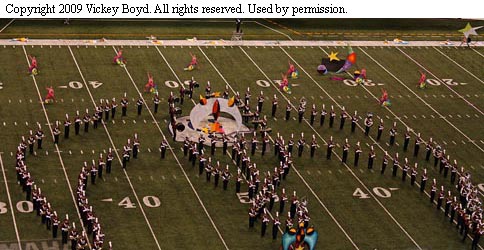
INDIANAPOLIS (Nov. 14, 2009)—The marching band from Wando High School in Mt. Pleasant, S.C., draws on music from the movie Contact for their field show, performed here at Lucas Oil Stadium for the Bands of America Grand National Championships. Although the band has a current streak of five state marching band championships going strong, they have never been to the Grand Nationals.
“We’re lying down at the beginning of our show, and we return to that formation at the end,” Rachel Ett, the band’s senior drum major, said in a phone interview. “It’s meant to convey out-of-this-world experiences and emotions, not like anything we experience on Earth.”
In the movie, an astrophysicist (Jodie Foster) is sent to a planet orbiting the star Vega, from which our radio telescopes have intercepted a signal. The message from space provides scientists with details on how to build a spaceship that will take us more than 26 light years to the home of another intelligent life form.
People on Earth think it would be best to send a scientist to document the technical details of intelligent life on other worlds, so Foster’s character is chosen. But when she gets there and opens her eyes to see a world with two suns, she declares, “They should have sent a poet.”
That’s Wando in a nutshell.
“Lots of bands focus on the technical elements, like rhythms, tuning, and so on,” Ms. Ett said. “But the main thing we strive for is the emotion portrayed on the field, on what the music is saying. Every time we have a successful run or something, we know it was because of the effort we put into the actual music making.”
Don’t misunderstand what this means: bands don’t make it to the semi-finals at Grand Nationals without ironing out technical details in their performance. Several hundred decisions are made every second as members of the band decide where to go, how to stand, etc., in the spaceship formation pictured above. A French horn quartet, later joined by a flute, out of this world in its own right, means musicians decide how much to crescendo and when, how to attack each and every note, and how to balance their individual parts.
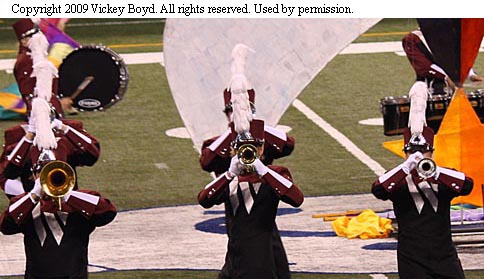
It’s just, she said, that their focus is in a different place.
Our recommendation to BOA
L. Scott McCormick, president and CEO of Music for All, which runs Bands of America, wrote that the organization’s annual budget is $6.2 million. Yet, errors in the program, which could be solved by spending a few hundred dollars on a proofreader, persist.
You might think these official printed programs are expendable, but I have talked with people who put things like this in an attic, drag them out to show their grandkids, and reminisce about what they did when they were in high school.
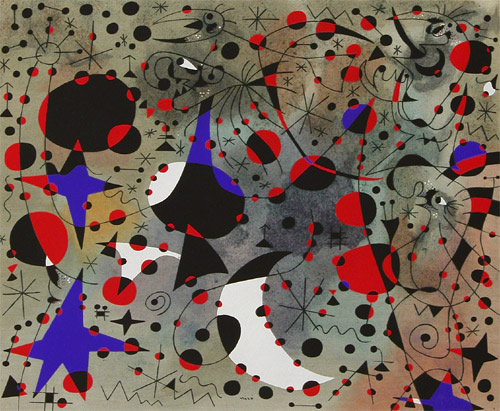
The program states that Wando’s show was “inspired by the paintings of Joan Muro.” The artist’s name is misspelled. It should be Miró.
He’s dead, so he probably won’t care, but when an organization’s raison d’être is to showcase the achievement of high school marching bands, the information about those bands and their programs should be as correct as possible, whatever the source of the error.
Inspiration and where it leads
In 1940-41, Miró painted a series, which he entitled “Constellations.” The connection to Wando’s show is apparent, even down to the detail of color guard dancers posing as pink stars. The image above is based on his painting The Nightingale’s Song at Midnight and the Morning Rain.
The Catalan artist gave an interview, very near his death in 1983, in which he said, “Don’t you think that the revolution of forms can be liberating? Unsettling people, forcing them to wake up.”
By “revolution,” he intended something far beyond a war or a coup d’état. After all, he had seen two world wars, a civil war in his Spanish homeland, as well as class repression, in his lifetime. The “waking up” he refers to, as we might also infer from Wando’s marching field artistry, is a different kind of revolution.
A different way of looking at band
At Wando, marching band is a completely extracurricular activity, but students who are enrolled in the curricular band class have to participate in marching band. Ms. Ett said there are pros and cons to setting it up like this.
“The good side is that it gives us a big sense of family—everybody feels like they belong,” she said. “But one of the cons would be that some kids don’t really want to be there.”
Band, then, is just a little different at Wando: extracurricular but mandatory, note-perfect but not technical. While many other bands master their shows in a technical, more science-like way, Wando sends a poet. In fact, they are the poets on the marching fields, artists on a green and white grid. And what they get for that is a family of lifelong friendships, borne of common experiences in hotel lobbies and in tremendous NFL stadiums.
Announcements and songs
Whether they want to be there or not, though, all 232 of them, minus the drum majors, wait back at the hotel after the semi-finals finish up, on their cellphones to parents who stayed at the stadium to hear the announcement of the 12 bands that were selected to appear in the finals.
The same thing happened Friday night at the end of the preliminary competition (a BOA announcer names the bands that advance to the next round in random order).
On Saturday, the names of the national finalists are announced, again (supposedly) in random order: “… Number 10, James Bowie High School … Number 11, Centerville High School …”
Wando has still not been called, and since they were named last of 34 bands after the prelims, they start to think they couldn’t be named last twice. Despite their worries, they remain in the hotel lobby, glued to their cellphones.
The odds of a band being named last in a list of 34 and then in a list of 12 are about 1 in 408. But when you’re standing in an Indianapolis hotel lobby and 11 out of 12 finalists have already been named, the suspense builds.
Then, patience pays off. “And the 12th finalist, Wando High School,” says the announcer.
More than 200 band members break out in a unison singing of the school’s alma mater, band parents reported on their Web site. These poets want nothing to do with mathematical odds; let’s make some music.
The Wando High School marching band is led on the field by Ms. Ett, who is also the first-chair clarinetist in the school’s symphonic band, and by fellow drum majors Jenna Pye and Adrian Champagne. The band is directed by Scott Rush. Their show is entitled “Beyond” and has six movements, including “Awakening,” “Becoming,” and “Being.”
Other notices for Wando
Wando High School has grown to become the largest high school in the state of South Carolina, principal Lucy Beckham said in an interview for the National Association of Secondary School Principals, which named her the 2010 Principal of the Year.
In an effort to ensure rigor and variety in the curriculum, Wando offers more than 250 courses in 37 majors, she noted.
“At Wando, we know we have a large school, but we want it to feel small to our students,” she said. “We want them to sense that they are very special and important to us, so we use a number of different strategies.”
One of those strategies is to divide the school into five smaller learning communities. The school has a ninth-grade academy and four career-related academies.
“We encourage students to pick a path that they think might be their long-term career interest,” she explained. “If you’re in the arts and humanities, you’re in classes with other kids in arts and humanities.”
In relation to Ms. Ett’s sense of band as a big family, Ms. Beckham acknowledged the same sense at Wando.
Other things the school does, she said, build “a lot of connections to school. We try to put kids through co-curricular [not entirely extracurricular] activities: sports, clubs, teams. Certain organizations at school create family senses of their own: band and ROTC would be examples of that.”
This national award is further evidence of the quality of teaching and learning happening at Wando.

Link to all semi-final bands:
2009/11/15/bands-of-america-semi-finalists
Ok, seriously?? I don’t see why they made finals, i appreciate that they worked hard all year, but what i dont appreciate is the fact that they pretty much stole Carolina Crown’s 2003 show and raped it with how awful they are, let me tell you, these are all the finalist bands who hate Wando: Avon, L.D. Bell, Marian Catholic, Marcus, Carmel, Broken Arrow, The Woodlands, Lawrence Central, Center Grove, James Bowie, and Centerville. They all hate this band and they NEVER want to see them at Grand Nationals EVER AGAIN