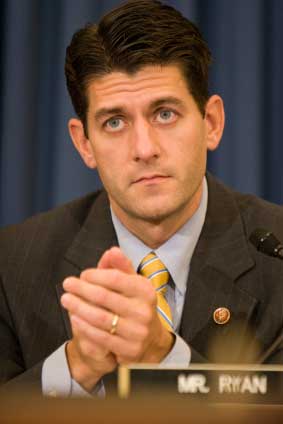
This weekend, Mitt Romney, the presumptive Republican nominee for president, chose Paul Ryan, a seven-term representative from Wisconsin, as his running mate.
Since Mr Ryan is now chair of the House of Representatives Budget Committee and has just been in Washington for so long, it’s not hard to find a very detailed record of votes and statements. Many people think he will add strength to the Republican ticket in the sense that critics of Romney say he has a weakness in putting together a budget strategy and Mr Ryan wrote a complete budget strategy, which he released in March.
The Chronicle of Higher Education reports on several issues related to colleges, here, including that budget proposal he released. His “plan would slash federal spending for nearly all non-defense-related programs, including many of concern to higher education,” the Chronicle reported.
Mr Ryan’s plan passed in the House, but many experts considered it more of a political statement than an actual budget that would ever be implemented.
He has sought cuts in federal student aid as well, including the stoppage of any in-school interest subsidy on undergraduate Stafford loans and the tightening of eligibility requirements for the Pell Grant program. He would completely cut off Pell eligibility for students attending college less than half-time, the Chronicle reported.
Perhaps the biggest issue in Ryan’s higher education record has been his support of for-profit colleges and universities. He has strongly opposed the US Education Department’s gainful employment provisions, which were designed to make sure non-degree programs at for-profit colleges were actually helping students find work that could justify the expense for a college program.
And, do you want to know what Paul Ryan was like in high school? The Los Angeles Times got a hold of his yearbooks and has some interesting revelations, here.
Finally, I suppose the hallmark position in Paul Ryan, at least when it comes to education, is his push for local control of schools by school boards. He did vote in favor of No Child Left Behind, but that was a decade ago, when everybody thought it would work better than it has. Now, he writes on his website:
The budget calls for reorganization and streamlining of K–12 programs and anticipates major reforms to the Elementary and Secondary Education Act [ESEA], which was last reauthorized as part of the No Child Left Behind Act [NCLB]. These reforms are necessary because the current structure for K–12 programs at the Department of Education is fragmented and ineffective. Many programs are highly restricted, serving only a small number of students, or duplicative, such as the 82 programs that are designed to improve teacher quality. Given budget constraints, Congress must focus resources on programs that truly help students and reduce programs that are failing to improve student achievement.
Much will be said during the campaign about education, and I will leave the debate for later, especially if Mitt Romney is elected president. Many positions taken by Mr Ryan through the years are those most seen as favorable to a privatization of public education, but time will tell. For now, I urge all Americans to get to know Paul Ryan, who could be, as they say, a heartbeat away from the presidency.
Photo: WASHINGTON (Sept. 24, 2008)—Rep. Paul Ryan (R-Wis.) questions Peter Orszag, director of the Congressional Budget Office, during a hearing on Capitol Hill about the impact of recent market turmoil on the federal budget on September 24, 2008 in Washington, D.C. Orszag reported that while the likely impact is currently unknown, it is likely to be substantially less than $700 billion. (Photo by Brendan Hoffman/Getty Images)
Probability questions about a Ryan presidency
When Mitt Romney introduced Paul Ryan this weekend, he misspoke, introducing him as the “next president” of the US. Everybody got a few laughs, and Romney corrected himself right away.
Anyway, you may be familiar with the “Five-Thirty-Eight” blog on the New York Times website. It’s written by Nate Silver, who’s always fascinating to read, especially for people who have an interest in math and politics.
In a recent post, he asks (and answers) the question, What is the probability that Paul Ryan will be the next president?
This is a combined probability problem, using the additive rule, since there are a few ways Ryan could become the 45th president and either one will work. First, Obama could win this November, and Ryan could seek the nomination in 2016, get it, and then win the election. This scenario, not so good for Romney, has a certain chance of happening, some of which is based on empirical data from past vice presidential candidates.
Second, the Republicans could, for some reason, nominate Paul Ryan to run for president this year, and he could win. Of course, the chances of this happening are much lower than scenario No. 1. But there’s a nonzero probability, which Nate Silver figures into the calculation.
And since Ryan could become the president after Obama in either of those two ways, you have to add the probability of scenario 1 to that for scenario 2 when figuring out the probability of the overall question.
Lots of historical data, lots of fun, good stuff to check out.
Comments are closed.