

We reported recently that the Illinois High School Association (IHSA) is expected to survey its 794 members schools in November regarding their interest in participating in an IHSA-sanctioned state championship tournament for marching band. We have launched our own informal, non-binding survey in order to collect votes and comments from directors, students, parents, and other interested people. It’s available here.
One of the questions on the survey is about the style of marching used by the marching band. Every respondent to date has answered “corps style,” which is because those directors who visit Illinois Marching Online, where the survey is being mentioned, use this style, typical in the Bands of America organization and, with a few different modifications in each case, at the vast majority of marching band festivals across America.
One style, however, often gets excluded from these festivals: show-style, which is the style made famous by the popular marching bands at historically black colleges and universities. This style of marching has been in the news lately, since HBO included a segment about the dangers and widespread occurrence of hazing in college marching bands at these colleges and universities. HBO did a segment about these bands several years ago but decided to revisit the theme after deaths were reported last year from the hazing activity.
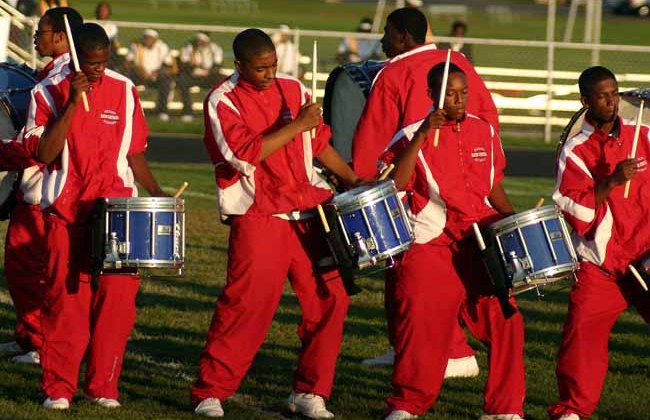
There is one notable show-style marching band festival/contest in the Chicago area each year, that being held at Rich Central High School in south-suburban Olympia Fields. You won’t find this festival listed on Illinois Marching Online, but for the record, it’s on October 13 this year, which is unfortunately the same date as the huge Illini Marching Festival at the University of Illinois in Champaign. Phillip Crews is the director of the program at Rich Central, and if you asked him, which I have, he would tell you, “Marching is marching,” meaning show-style bands should be on the same field, a level field, as corps-style bands. When I covered this show-style and drumline festival in 2008, I also had the opportunity to speak with some well-informed judges, including Ricky Burkhead, an assistant professor of percussion at the University of Mississippi.
These groups would probably show up at more large marching band festivals, like Bands of America, if it weren’t for a shortage of money in many of these schools. For example, many of them use popular music and simply can’t afford to track down the necessary copyright clearance. (Bands of America asks for a mechanical release so the shows can be included on a DVD and sold for a profit to band fans.)
I have also spoken with directors at other high schools in Chicago, where a show-style band can be found, including Mather, which has a band that numbers less than a dozen, and Morgan Park, which has a much larger band, both of which incorporate show-style elements.
Let’s say, just for argument’s sake, that high schools are trying to prepare at least some of their students for college. Some students from predominantly African-American high schools will attend historically black colleges, where the marching band uses the show style. We can hope the hazing has stopped by that point, since it is a horrible practice. And some of the students from these high schools will attend colleges where the marching band uses a corps style.
It’s a bit of an adjustment, as we learn from this comment thread on bandhead.org, but kids who march corps style in high school can and do adjust to life in a show-style band in college, and vice versa. Lots of students do it, especially in the South.
Are the musicians better in a corps-style band than a show-style band? Well, that depends on what you mean by “musician.” Corps-style bands do pay more attention to details in both music execution and in the precision of marching. They usually work up no more than half a dozen songs to play in the stands, have three or four sections, commonly called “movements,” in the one single show they prepare each year, and spend lots of time working on their drum cadences in front of large mirrors so they can perfect their body movement.
Show-style bands, on the other hand, pay less attention to each detail in the songs or in the movements and instead work up a whole bunch of songs to entertain the crowd from the stands.
Of course, there are corps-style groups that pay very little attention to detail, and there are show-style groups that work out the details in their shows to an excrutiating level. It’s just more typcial the other way.
But judging which style is “better” is not the point of any fine arts competition. The opportunity here is to learn. I will say that one thing show-style bands could learn from corps-style bands is to pay attention to detail. Music is in the details, folks. Bach knew it, Mozart knew it, Wynton Marsalis knows it, and the best education for band students would be that paying attention to the details is very important. That is, not only do you crescendo, but everybody in the ensemble needs to have a uniform crescendo when it happens. Loud music isn’t exciting, but music that “gets louder” is very entertaining.
And what could corps-style bands learn from show-style bands? Entertainment, crowd involvement, and so on. Heya! Many people, especially students, consider the corps style of marching outdated and not entertaining. Talk to fans at two football games if you don’t believe me. Fans at the game are much more likely to say, “We came to see the band,” if the band marches in a show style, whereas the only football fans at a school where the band uses a corps style who say anything remotely resembling that comment will be relatives and friends of kids in the band. Kids in show-style bands also love going to practice, whereas kids in corps-style bands don’t get excited about band practice quite as much.
Another thing show-style groups can learn from corps-style bands is that parents on the sidelines are a good thing, helping to move equipment onto and off of the field. Show-style groups don’t need quite as much of this help, because the kids are more motivated to chip in wherever needed to make the show, the whole show, an entertaining piece of art.
This is what schools are supposed to do: teach. Bands need to learn from each other. We need to take what is good about show-style bands into our corps-style groups and schools, and vice versa. Everybody will be better for it. I suppose one of the biggest challenges, as is now being tried at universities like USC, Michigan, and Ohio State, as well as the Madison Scouts of DCI fame, is to modify the corps style based on show-style entertainment, and put some swag to it.
