

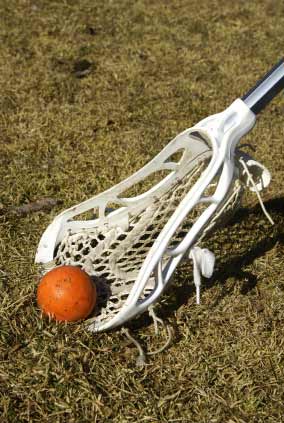
In high school girls’ lacrosse at the varsity level, most head injuries result from stick-to-head contact during aggressive play near the goal, a Feb. 20 report out of George Mason University has found. Most of these head injuries result from unintentional stick contact, which suggests that head injury in girls’ lacrosse may be an indirect consequence of play, in which players position themselves in hazardous situations either purposefully or inadvertently.
This study by Shane Caswell and colleagues may be the first that combines video analysis and injury data to report on the common injury mechanisms and game play characteristics that result in head injuries in scholastic girls’ lacrosse. They videotaped 529 varsity and junior varsity girls’ lacrosse games during the spring 2012 lacrosse seasons at 25 public high schools in Fairfax County, Va. A total of 14 head injuries were accurately captured on video, including 11 concussions and three contusions.
Penalties were called in only two of the 14 incidents, and the absence of penalty calls on most of these plays suggests a need to explore the extent to which current rules are enforced, as well as their effectiveness in preventing head injuries. But enforcement of the rules or modifications to them may only be part of an overall strategy to protect girls from traumatic brain injury, a strategy that research is yet to flush out.
“While these findings help us better understand the nature of head injuries and incidents in a sport that continues to grow in popularity throughout the world,” Dr Caswell said, “more research is needed to assess how prevalent these injuries are across all scholastic and collegiate women’s lacrosse and whether the game can be made safer by improved understanding of the rules by coaches and officials, better enforcement of existing rules, or the use of protective equipment.”
Can state laws help?
Maryland state Delegate Jon S Cardin said he has received correspondence from parents of girls who play lacrosse, asking him to find a way to ensure protection against the increasing number of concussions girls are suffering in the sport. “Their daughters … can no longer play the sport they love because one more concussion is too much for them to risk,” he said.
He seems to be taking at least two approaches to try to help. First, he has co-sponsored HB 1123, the Youth Girls’ Lacrosse Safety Bill, introduced by Delegate Dana Stein. The bill has been amended to mandate the wearing of helmets by all players—not just the goaltenders—in girls’ lacrosse. And second, he’s working with US Lacrosse and its director, Steve Stenersen, to get referees for public school lacrosse games certified by the organization to ensure they’re trained in how to enforce the rules of fair play and keep players safer.
Mr Cardin said that after “lengthy discussion with US Lacrosse and many in the lacrosse community, we were assured that the best practices standards being developed by US Lacrosse will be completed as soon as possible and will include recommendations for head protection in girls’ youth programs.”
But incluing helmets in a state law may be premature at this point. Even promises of forthcoming safety recommendations from US Lacrosse, which may include helmets for all players in girls’ lacrosse, should be supported by research before we enact laws that may make the injury situation worse.
Ann Kitt Carpenetti, managing director of game administration for US Lacrosse, told Newsday she hopes ongoing research at Brown University will establish a standard for helmet protection in girls’ and women’s lacrosse: “I would not say that helmet use is inevitable. I would say that what’s inevitable is that there will be a standard, hopefully by next year,” she said.
What about state agencies?
In action at its regular January meeting, the State Board of Education proposed amending the emergency policies put in place for the 2012-13 school year in order to make them permanent, but these policies don’t include any specific headgear or helmet recommendations for girls’ lacrosse. Recommendations may be forthcoming, however, as a task force created by the emergency policies moves forward with its work.
When finalized, the regulations will require refresher concussion training for coaches on a biennial basis, require concussion training for physical education teachers, and make certain that local school systems implement policies to ensure appropriate academic accommodations, documented oral and written notification to parents, and timely notification to athletic directors and school nurses of student-athletes who have sustained a suspected concussion.
Specific recommendations, however, might not come for a while, since Marylanders are taking a prudent stand, waiting for important research to finish. At a November symposium in Atlanta, for example, experts discussed the methodology used in testing various types of headgear more than any specific recommendations for a given sport.
The case for helmets
Current rules in girls’ lacrosse allow them to wear only soft, padded helmets. Boys, on the other hand, use hard shells. (Studies for some time—here, for example—have recommended specific helmet use for collegiate men’s lacrosse.)
For both boys and girls, though, there’s general agreement that it’s all but impossible to keep the ball and sticks off the heads, and when boys and girls play similar sports (soccer, basketball, baseball/softball), the rate of concussion is about double for girls. Brown University orthopedics professor Joseph “Trey” Crisco launched a study in late July to determine whether helmets help shield female lacrosse players from concussions caused by stick-to-head contact. He’s bringing live female lacrosse players to his lab and having them hit crash-test dummies in the head with lacrosse sticks.
“They’ll be whacking on the top of the ‘head’ and the side of the ‘head,'” Crisco was quoted as saying in New York’s Newsday shortly before his study began. “They’ll use the top, the shaft and the middle of the stick so we can determine the severity of stick checks.”
The case against helmet use
Some opponents of helmet rules for girls’ lacrosse say helmets will ruin the game, and others say their use may actually increase the number and severity of traumatic brain injuries by making the game more physical. In other collision sports, such as football, many experts hypothesize that the helmets and face masks promote a sort of recklessness or false sense of safety among players. Doctors are quick to remind athletes that helmets can’t prevent all concussions.
The American Medical Society for Sports Medicine issued a position statement in October entitled “Concussion in Sport,” available here. They seem to say the jury is still out on helmets in lacrosse:
Helmets, both hard (football, lacrosse, and hockey) and soft (soccer, rugby) are best suited to prevent impact injuries (fracture, bleeding, laceration, etc.) but have not been shown to reduce the incidence and severity of concussions.
Primary prevention of some injuries, including concussions, may be possible with some modification and enforcement of the rules of fair play if helmets are found to be ineffective. Secondary injury prevention may require referees and trainers to enforce return-to-play rules. And tertiary injuries, resulting from the lack of good follow-up medical care, may be best prevented off the field, the society has determined.
