

Although average global temperatures have leveled off over the last decade, the southwestern states of the US are a notable exception, climatologists say, according to this report in the New York Times.
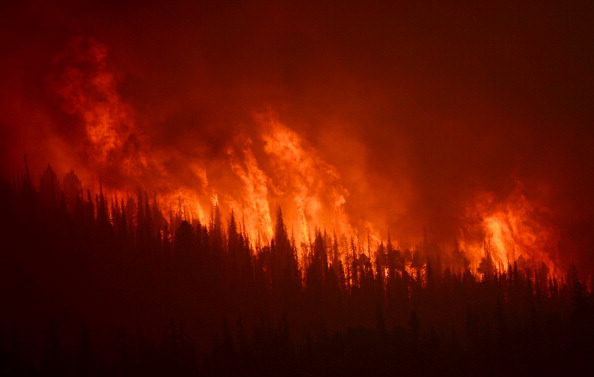
CREEDE, Colo. (June 27)—Fire burns out of control at the Papoose Fire in southwestern Colorado, which could still grow larger.
(Photo by RJ Sangosti/The Denver Post via Getty Images)
Furthermore, a report published today by the Potsdam Institute for Climate Impact Research in Germany, looking at regional impacts of warming around the globe, also reaches the conclusion that what today seems like an extreme in terms of temperature or the impact higher temperatures have on life may become the new normal.
We gained some insight into the impact of warming in the southwestern states this week as an Arizona wildfire killed 19 firefighters Monday and expanded to 10 times its size in a single day. It now covers close to 8,400 acres near the villages of Yarnell and Peeples Valley. Unlike many other places on the planet, average temperatures in Arizona continue to increase by about 0.72°F per decade, the Times reported, a rate faster than any other state.
Research from Potsdam, which considers not just temperature but the effects on crops, water supply, and economics of the people in the region, suggests that the Amazon region, the Mediterranean, and East Africa are the world’s brightest hot spots for impact from global climate change, but Arizona and the Southwest aren’t far behind: About two dozen wildfires are still uncontained in states from Idaho to New Mexico. The West Fork Complex fire, in the picture, covers about 96,000 acres in Colorado.
When winters are warmer in the Southwest, precipitation falls more commonly as rain, which quickly drains into streams instead of soaking into the ground, as snow would do during a colder winter. The ground is also drier due to drought conditions, and wildfires rage undamped.
“The fire season has lengthened substantially, by two months, over the last 30 years,” the Times quoted Craig D Allen, a research ecologist at the United States Geological Survey station at Bandelier National Monument in New Mexico, as saying. Sounds to me like a new “normal” is born.
Oddly enough, since Maryland just adopted the Next Generation Science Standards (NGSS), the word “fire” occurs only once in the entire document, and that is in the preschool standards, teaching students that hot objects like fire and the sun give off light.
The standard at play here is more likely HS-ESS3-5, a high school standard under “Weather and Climate.”
Analyze geoscience data and the results from global climate models to make an evidence-based forecast of the current rate of global or regional climate change and associated future impacts to Earth systems. [Clarification Statement: Examples of evidence, for both data and climate model outputs, are for climate changes (such as precipitation and temperature) and their associated impacts (such as on sea level, glacial ice volumes, or atmosphere and ocean composition).] [Assessment Boundary: Assessment is limited to one example of a climate change and its associated impacts.]
It’s a shame, really, that our own actions have led to conditions that raise the threat of wildfires for our own citizens. It’s not so bad, though still a shame, that our new standards don’t list wildfires as an example of the impact of regional climate change, since wildfires probably affect Americans more than ocean composition or many other impacts of regional climate change listed in the NGSS. The families of 19 firefighters, whom today we recognize as heroes, might have an issue with that particular judgment of the standard writers.
