

A two-month summer project for college math majors has them recording bird calls in the Tennessee woods and developing artificial intelligence algorithms so a computer can tell the difference between calls from different species, the Knoxville News Sentinel reports.
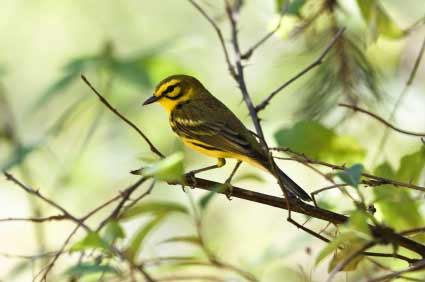
Prairie warbler
These top math students from across the US are visiting Knoxville to explore the “interface between math and biology,” the article stated. In this particular case, that interface touches, on the biology side, the response of different bird species to changes in their habitat caused by urban sprawl—there’s construction near the woods and helicopters flying overhead—and by climate change. On the mathematics side, it touches the encoding of digital sounds, stripping of extraneous noise to find the signal, and getting a computer program to understand how to identify the species from binary digits in the sound files.
“Two months is not a lot of time to develop a new artificial intelligence algorithm, but it’s possible,” the paper quoted Arik Kershenbaum, a research fellow with the National Institute for Mathematical and Biological Synthesis, as saying. Mr Kershenbaum specializes in the vocal communications of animals. His national organization, based on the University of Tennessee campus, promotes new and creative ways of applying the methods of mathematics to biological research.
The methods will be useful for researchers who want to know lots of information about field sparrows and prairie warblers, both of which tend to make overgrown fields near wooded areas their homes. Since scientists don’t have armies of people to go out and count how many of each species are in a certain area at a certain time, a good job by students this summer will allow researchers to simply place microphones in the field, which will do the work 24/7.
Microphones and the computer sound files are also more reliable than humans, Mr Kershenbaum said, especially in the “acoustically crowded” environment at the Forks of the River Wildlife Management Area, where students are working. “The level of hearing between people varies too much,” the paper quoted him as saying. “Sometimes, machines are better.”
But just because machines have the capability to hear more accurately than humans doesn’t mean they know what they’re hearing. Enter the math majors, who have to write programs to teach those machines what it is they’re hearing—which species of bird. It’s teamwork in action: man and machine, biologist and mathematician. Good stuff!
