

The athletic booster clubs from several high schools in Harford County, Md., have come together to protest a plan to charge “pay-to-play” fees of students who participate in extracurricular activities like sports, the Dagger Press reports.
“The overriding objection to pay-to-play is that public schools should be obligated to provide extracurricular activities free of charge as part of a free education,” the news website quoted a statement from North Harford High School boosters as saying. “As Maryland residents we already pay taxes to support public education.”
One of the problems in Harford County, unfortunately, is that funding for the schools has not met expectations of school officials or community members. Specifically, Harford County, which has increased its share of funding by 26 percent since 2006 despite a 2,500-student decline in enrollment since then, wasn’t able to come up with some extra money the district says it needs for 2013-14. The total operating budget for Harford County Public Schools is $424.7 million.
This led the board to approve fees of $50 per sport and $25 per extracurricular activity at its June meeting. The fees are expected to increase overall revenue by about half a million dollars and save teaching positions.
At a national level, about 61 percent of students aged 12-17 report having to pay fees to participate in sports or extracurricular activities. The average fee is around $93, but 21 percent of children faced a pay-to-play fee of $150 or more, according to a national survey last year from the University of Michigan, Ann Arbor.
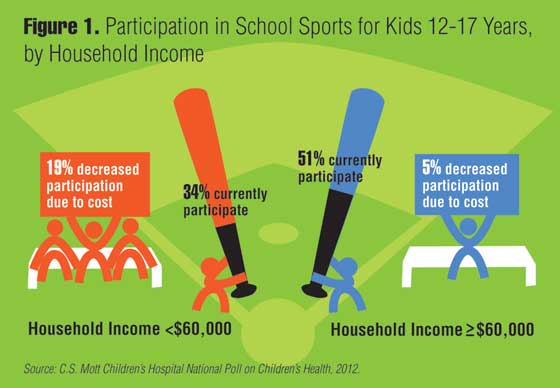
Since only about 6 percent of students qualify for a waiver on a national scale, based mostly on income, the same survey concluded that fees have the effect of preventing children from low-income families from participating in extracurricular activities.
Harford County Public Schools will waive the fee for students who qualify for free or reduced-price meals and for children of veterans, but no estimate was given as to the number of students this represents.
“We know that participating in school sports offers many benefits to children and teens: higher school achievement, lower dropout rates, improved health, reduced obesity and the development of skills like teamwork and problem-solving,” said Sarah Clark, MPH, associate director of the Child Health Evaluation and Research Unit at the University of Michigan. “There’s not an athletic director, school administrator or coach out there who doesn’t want every kid to have a chance to participate. But there are no easy answers, especially because budgets are expected to get tighter and tighter.”
In Hawaii, for example, four years ago, high school athletic association officials had collected more than $700,000 of a $1.2 million goal—most from private citizens writing $20 checks or from nonprofit foundations—to avoid forcing pay-to-play fees on students.
Even professional athletes chipped in. After the plea for money went out from the athletic association, Shane Victorino, then the Phillies’ All-Star center fielder who now plays for the Red Sox, told the association’s chairman, Keith Amemiya, he would send a check for $10,000, the New York Times reported.
The Times quoted the mayor of Honolulu, Mufi Hannemann, as saying in a telephone interview, “This is a need-to-have. Sports is not a nice-to-have, it’s a need-to-have. The importance of the issue is sky-high. People here get it about the value of sports.”

MSNBC reports:
Fees such as this are illegal in California but allowed in all other states. The ACLU says they’re illegal and warns that any collection action would inspire counter-suits. But fees are even being charged for full-day kindergarten, even at many districts in Illinois. The fees may violate the Illinois constitution, but this notion hasn’t been backed by any court decision at this point. In some cases, parents of kindergartners pay up to $3000 a year for the extra half day, MSNBC reported.
Furthermore, as we reported above, many education experts are warning that the fees promote inequity in terms of the educational opportunities public schools are providing for students.