

For many high school seniors, the start of the school year marks the start of the college application process, with application deadlines at some colleges coming as early as November.
If you’re one of those seniors this year, I hope you have, by now, heard about the Common Application—a single college application that requires some supporting documentation, such as letters from a teacher or a counselor, high school transcripts in an online format, and so on, but that allows you to fill out one application that is accepted at more than 500 colleges and universities in 47 states and seven foreign countries.
In total, more than 80 of the colleges are public schools, while the remaining ones on the list are private. In many cases, schools become members of the Common Application, which is a nonprofit association based in Virginia, in order to increase their visibility to potential applicants. High school guidance counselors may not have applications at the ready for many of the member schools.
For example, the University of Illinois at Urbana-Champaign isn’t a member, since high school guidance counselors in Illinois are likely to open a file drawer and find hundreds of blank applications to the U of I. The same holds true in Maryland for the University of Maryland at College Park. But the University of Illinois at Chicago is on the list, as is the University of Maryland, Baltimore County, as counselors in many parts of their respective states aren’t likely to have applications by the drawer-full.
Colleges on the list have all agreed to accept the Common Application and pay a $500 annual membership fee for the privilege. They also get charged for every application high school seniors send in, but you know how that works: colleges charge students $50 to apply and send $4 or so to the Common Application.
The terms of a “license agreement” between colleges and the Common Application also require the schools to accept “holistic” applications. That means students, first, have to write an essay, but second, that schools have to use several factors in determining a student’s acceptance, including the aforementioned recommendation letters, transcripts, and possibly SAT or ACT scores.
How the Common Application came into existence
The association wasn’t always so big, having started in the 1970s. The National Association of Secondary School Principals figured out one day that such a one-app-fits-all approach would streamline the college application process, especially for their students who wanted to attend colleges in other states or lesser known colleges in their home state. Thus the Common Application was born.
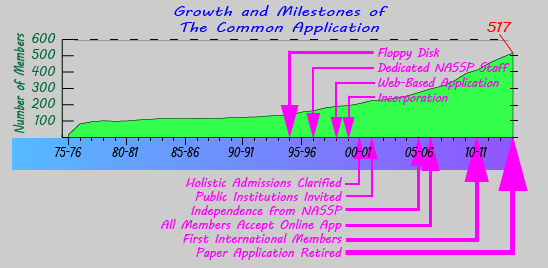
It started out with paper, of course, and then a floppy disk version of the Common Application was developed for the 1994-95 school year. Obviously that didn’t last very long, and the first Web-based version was launched in 1998-99. Since then, the software has gone through four generations of development, and this school year, the paper application has finally been retired.
Is the Common Application illegal for public colleges?
We decided to look into the Common Application because a glancing report in the Baltimore Sun said an assistant attorney general in Maryland had told one public college it was barred from entering into the agreement used by the Common Application.
If true, this would jeopardize membership for the four public colleges in the state that accept the Common Application: Towson and Salisbury universities, St. Mary’s College of Maryland, and the University of Maryland, Baltimore County. The use of the Common Application, for the record, has resulted in an increase in the number of applications received by these lesser known colleges, but it has generally not increased the number of students who enroll at the schools.
The statement made by Assistant Attorney General Elena Langrill during a Board of Regents meeting at Morgan State was “that state schools cannot legally enter the agreement. She pointed to one provision in particular, which says the schools may have to follow certain laws of Virginia, where the nonprofit Common Application is based,” the Sun reported.
If Maryland schools unwittingly broke the law in entering into this agreement, it would be news, for sure. But our investigation suggests that’s not likely.
First, we tried to reach someone at the attorney general’s office, Ms Langrill’s apparent section chief, in fact, but our email bounced from their server. The Sun reported that the AG’s office couldn’t comment on the finding anyway, so we took the next step: we contacted the Common Application folks and asked to see a copy of the license agreement Ms Langrill was getting so worked up about.
Here, we had some luck with a very responsive staff at the Common Application. Aba G Blankson, director of communications for the Common Application, pointed us to the agreement, which says, in part:
5.1 Law. This Agreement and all matters arising out of or relating to this Agreement will be governed by the internal laws of the Commonwealth of Virginia without giving effect to any choice of law rule except that in the case of a public institution member the governing law shall be that member’s state law if such law so mandates. … [Any] controversy, claim or dispute may be tried solely in a state or federal court for Fairfax County, Virginia, and the parties hereby irrevocably consent to the jurisdiction and venue of such courts except in the case of a public institution member whose state law prohibits it from providing such consent.
Hmm. To me, that sounds like public institutions that have a problem with accepting the jurisdiction of Virginia can get out of it. Furthermore, the license agreement features a standard severability clause, which means that if any part of the agreement is illegal or otherwise unenforceable, the rest of the agreement remains in effect.
We’re sure the AG’s office will figure it out, but in the meantime, if you start hearing that Maryland public colleges and universities can’t accept the Common Application, it’s just not so … we’re pretty sure … given the exact wording of the agreement.
The folks at the Common Application, both to me and to the Sun, maintain that they have never heard of this being a problem with any public institution, in or out of Maryland, ever. Sounds like a done deal to me, so get to it, seniors. That essay can be enlightening.

Correction:
An earlier version of this post identified the number of public institutions that are members of the Common Application as 91, and the post has been corrected to reflect an approximate number that is certain, “more than 80.”