

A new program enacted in North Carolina, which would give families of students who switch from a public school to a private school a $4,200 voucher to offset the private school tuition, has been put on hold by a state Superior Court judge, the Charlotte News & Observer reports.
At issue is the state constitution’s “public purpose” clause, which gives the state the authority to collect and appropriate tax money for public purposes only.
In the Feb 21 ruling, Judge Robert Hobgood put the brakes on the law before it could divert taxpayer money that the state would be unable to get back if the law were found unconstitutional. In most cases, judges only make orders like this if they see the plaintiff’s claims as meritorious, since the legislative and executive branches have already spoken by enacting the law.
The public purpose clause
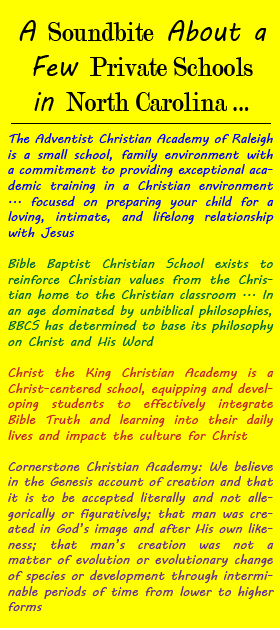
Education is a public purpose, some argue. “After generations of being denied a choice, parents finally can choose a school for their child, but now the … government is stepping in to prevent parents from exercising this right. Shame on them,” The New Orleans Times-Picayune quoted Gov Bobby Jindal as saying about a voucher law in Louisiana being challenged by the US Department of Justice. “Parents should have the ability to decide where to send their child to school.”
Others, including the federal government under George W Bush, disagree with Mr Jindal and assert that parents do have the right to choose where their children go to school. A user-friendly guide was published by the US Department of Education under Secretary Margaret Spellings, advising parents on how to choose the best school for their child. Included in the guide are religious schools and other nonpublic schools.
Even today, nobody can point to any parents who have been denied “the right to choose” to send their children to a religious or other private school. Although a parent’s rights are a matter of public concern, the choice itself is private and does not fall under the constitution’s “public purpose” clause. That’s absolutely the bottom line in North Carolina.
“Even if an activity involves a ‘reasonable connection’ with the unit of government, it does not necessarily mean that it serves a public purpose,” writes Kara Millonzi on a blog run by the University of North Carolina School of Law.
“The activity also must ‘primarily benefit the public and not a private party.’ According to the North Carolina Supreme Court, it is not necessary, in order that a use may be regarded as public, that it should be for the use and benefit of every citizen in the community. It may be for the inhabitants of a restricted locality, but the use and benefit must be in common, and not for particular persons, interests, or estates.” she writes, with references and internal quotes removed.
Since the state’s highest court ruled that the use of tax dollars cannot benefit “particular persons,” it’s clear, to me anyway, that the voucher law will be struck down as soon as all arguments can be heard. Vouchers will only benefit people who switch from public schools to a private school and the folks at that private school. That violates the strict wording of the state’s constitution.
Constitutions can be changed, of course, so some people are calling this a temporary setback. “The school choice train is not stopping,” they yell from the peanut gallery. But this train has already left the station, since parents already have this right. Voucher proponents are simply asking the rest of us to pay the fare for a ride we didn’t knowingly request.
The public purpose of making public schools better
Many people, including the highest representatives of both political parties, think a voucher system will create competition and cause improvements in public schools. If this were true, the voucher program does serve a public purpose in that it will drive improvements in the public schools.
As University of Illinois researchers Christopher A and Sarah Theule Lubienski write in their new book The Public School Advantage: Why Public Schools Outperform Private Schools, “Both major American political parties have continuously embraced [choice-oriented reforms], differing not in principle on the issue but only in the extent to which the idea would be advanced through specific programs (ironically, giving voters little choice on the question of school choice).
“Policymakers accept the idea that choice and competition in education will lead to greater innovation and better outcomes,” they write.
Voucher programs are indeed alive and well in about two dozen states.
“Our goal is to have a system in which every family in the US will be able to choose for itself the school to which its children go,” Nobel laureate Milton Friedman said in a 2003 CNBC interview. “We are far from that ultimate result. If we had that—a system of free choice—we would also have a system of competition, innovation, which would change the character of education.”
I mean no disrespect to the Nobel committee in economics, but the data simply don’t support the conclusion Mr Friedman and many politicians reach about vouchers causing competition and innovation, especially since public schools already perform better, on average, than private schools when data are corrected for student demographics.
The two longest-running voucher programs in the country, Milwaukee and Cleveland, have poor track records. In both instances, the public school students outperform students who receive vouchers and attend private schools. Looking at national data, the Lubienskis write:
We found that once we account for the fact that private schools serve families with more advantages associated with academic success—things like money and highly-educated parents—we find that public elementary schools are, on average, simply more effective at teaching mathematics. Indeed, demographic differences more than explain any apparent edge in the raw scores of private school students, and by the time they reach middle school, public school students score ahead of their demographically similar, private school peers, with differences ranging from a few weeks to a full grade level, depending on the type of private school.
It’s illogical to assert, as Mr Friedman does, that schools that do worse by students—those religious schools in North Carolina that would receive the bulk of the voucher money—would drive innovation in schools that already perform better. It would be more logical to assume the exact opposite would happen and the public schools would stop trying so hard. This will directly cause the quality of the public schools to decrease, and the decline in quality would only be compounded by the loss of funding based on the vouchers. Witness the annihilation of the public schools in North Carolina—at the apocalypse of this sequence of events.
Therefore, without a constitutional amendment approving vouchers, which I have serious doubts would ever pass in North Carolina, I read the public purpose clause in the constitution as precluding private vouchers funded by public money.
In terms of education, the voucher program as passed provides the public with no accountability for the funds, no safeguards against discrimination, and no requirement that schools use state-certified teachers or align their curricula to a state-approved set of standards.
Editorial
I strongly support alternative private schools, as several posts on these pages show by praising the caliber of students who choose to attend private schools. The parents of these kids have budgeted and prioritized to send their children to those private schools. Taxpayers did not bear the burden of those personal choices.
I’m not suggesting public education is perfect. Rather, my purpose here is simply to point out that a specific use of taxpayer dollars is unconstitutional. Competition may very well cause public schools to institute better reforms than a new curriculum from the Common Core or new tests from a multi-state consortium. Our communities will just have to find another way to encourage that competition: voucher programs violate the constitutions of many states, including North Carolina.
One argument in favor of vouchers that I haven’t mentioned is that people who don’t send their kids to public schools shouldn’t have to pay for public schools. I didn’t mention it, because it is jaw-dropping and wrong in many ways:
- People who don’t have any children still pay taxes, which support the public schools. The voucher law would not apply to them, and that would be by no choice of their own.
- Elected officials, not just people who have children, get to decide where to send tax dollars, in accordance with laws passed by previously elected officials. It’s called democracy.
- Durham residents’ tax dollars help pay for state roads in Greensboro, even though they don’t live in Greensboro and have never even been to Greensboro.
- If other voucher programs are any indication, students may end up back in public schools anyway, as the private schools close abruptly and leave town with the money from the vouchers.
The last case was brought to our attention by the Milwaukee Journal-Sentinel. It involved a Wisconsin school that promised “school choice” for parents there but closed one day in December, without warning parents. The school kept the $200,000 it had received in taxpayer funds, and the parents of 66 special-needs students scrambled to find alternatives.
Although the Wisconsin school was not a private religious school but a special-needs voucher school, created under Wisconsin law, the story drives home how little the argument over school choice is about education and how much it’s about money. Parents already have the choice of how to educate their children, but the only question is, Who will pay for their choice?
