

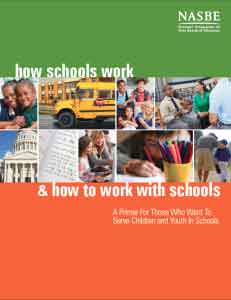
The Center for Safe and Healthy Schools, part of the National Association of State Boards of Education, in partnership with the Centers for Disease Control and Prevention, has created a new report that aims to explain how public schools in the US actually work and how people and organizations can team up with schools to promote learning, safety, and health for all students.
Across the country, millions of children attend public school every year. Their parents likely went to public school too, as do the vast majority of Americans. But attending public school, or even working in education, isn’t the same as knowing how public schools—and our nation’s education system—actually work.
How Schools Work and How to Work with Schools (May 2014) demystifies public education for policymakers, government officials, community members, business leaders, and others interested in partnering with schools to improve the health, safety, and well-being of all students and ensure they are successful in their academic pursuits.
- Explanation of public education governance at the federal, state, local, and school levels and how national organizations influence education policymaking.
- Ways to meaningfully and positively engage with the education sector, including examples of successful school-community partnerships and best practices.
- Guiding principles for working with schools and practical steps for more successful collaboration with them.
- Answers to the most frequently asked questions about public education. For example: What is Title I and how does it support low-income students? And, how are public schools funded?
- Reliable data sources and resources for additional information on crossover issues in education, from school crime and safety, to school nutrition and health policies and practices.
- A glossary of common education terms, acronyms, and important federal education programs.
How Schools Work and How to Work with Schools is funded by the Centers for Disease Control and Prevention (CDC). NASBE thanks the CDC for its support and acknowledges that views expressed in the report are those of the authors alone and do not necessarily represent the official views of the CDC.
