

Perhaps one of the greatest weaknesses of our school band program is that, for the majority of the students, active participation ceases upon the day of graduation from our high schools.
—Band director William D Revelli (1937)
“The school band movement.” Music Educators Journal 23: 32-34.
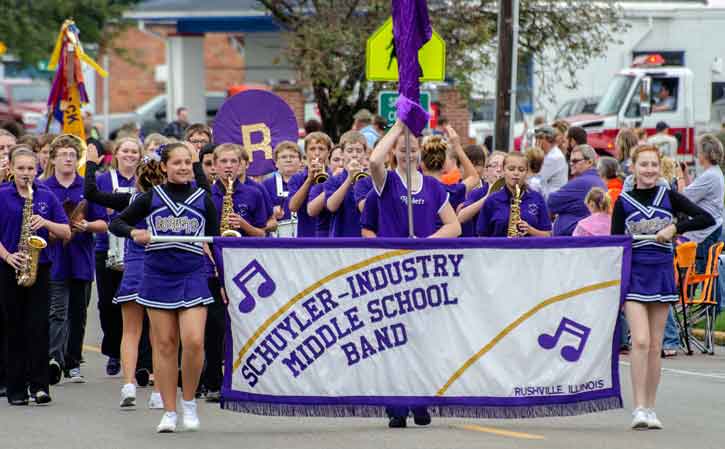
Schuyler-Industry Middle School Band, Rushville Smiles Day Parade, Sept 2013 (Macomb Paynes / Flickr)
At Central Middle School in Tinley Park, Ill., band director Jason Freeland has a way of reducing the chances that his band students will stop playing their instruments when they get to high school or even after they graduate from high school. In fact, in recent years, he’s had a perfect record in terms of students going on to play in their high school bands.
“I’m proud to say that almost every year—almost, not every year, but almost every year—I have 100 percent continue in high school,” he said in a telephone interview. “I think four years ago, I had one or maybe two students that didn’t continue.”
Recently a former student, Tanner Jackson, was the subject of a brief write-up in the Chicago Tribune, here. Tanner started playing trombone in fifth grade in Central’s beginning band, and Mr Freeland said he could remember Tanner being fascinated with some of the lower parts that give the trombone a prominent place among the sounds coming from concert bands. “I can remember thinking, ‘Yeah, you were born to be a bass trombone player,'” he said about his student, who will start his college career at the Eastman School of Music next month.
Resounding with the pride only teachers feel in their students’ accomplishments, Mr Freeland said, “One of the really cool things for me is just to have students come back and to hear about what they’re doing now and how far music is taking them.”
Convincing students to stay in band in college after leaving high school is understandably harder than getting them to join their high school band after middle school. Friends from middle school often attend the same high school, but a near-perfect record, even at the middle school-to-high school transition, is a strong sign that Central is doing a few things right.
Why is persistence in band such a big deal?
For musicians like Tanner, who will most likely pursue a career in music, continuing to work in large ensembles like symphony orchestras and concert bands is an absolute requirement.
Former Boston Symphony Orchestra bass trombonist Douglas Yeo writes, “Do you want to become part of something so much bigger than yourself: working as a team to recreate great works of music, to continue to improve on that re-creative process in a sometimes difficult and misunderstood profession, and bringing edification, joy, and delight to hundreds of thousands of people in the hopes that they will cherish music as you do and continue their own daily discovery and re-discovery of one of God’s greatest gifts to humanity?”
But even for the majority of Central’s band students, who won’t major in music or pursue it as a profession, persistence in large ensembles, at least through high school, has a lot to offer. To encourage continued success, Mr Freeland takes steps during rehearsals. One of the rehearsals last week had four mini-rehearsals, or sectionals as musicians call them, inside it. These sectionals are opportunities for small groups of students, often those who play the same instrument, to work on just their part, without worrying about issues on other instruments. Each sectional at Central is run by a student leader.
“We did some like instruments, and we did some cross instruments,” Mr Freeland explained. “My job in the last two weeks of our summer band was really just to monitor. If they fell down, I’d help them up, but other than that, I wanted them to run it on their own.”
- They have fun with their friends—and they’re all friends, according to Mr Freeland—developing those friendships and the associated camaraderie. That’s important for their growth.
- They’re learning the music. If you’re, say, a cornet player and you can get up in front of other cornet players and run a sectional, you’re gaining a tremendous amount of leadership skills and confidence.
“I think that’s wonderful for kids,” he said.
Greg Bimm, director of bands at Marian Catholic High School in Chicago Heights, once had Mr Freeland as a student teacher. Because he also believes large ensemble rehearsals and performances are fun for kids, Mr Bimm makes the short trip to Tinley Park every year to guest conduct at Central’s Music-a-thon.
He said he enjoys having the chance to stay in Illinois and work with “a very fine band.” (Many of his guest-conducting appearances take him to other states. Last year he was in Florida, and this year, he’s expected to guest conduct in Georgia and Nevada.) “I am always inspired when I spend time with them,” he said, referring to Central’s band.
How does Central get kids to stay in band?
District 146, Central’s K-8 district, has three bands: a beginning band, which is mostly for fifth graders, a concert band, and then a symphonic band, which is the top group. Placement in the bands is by audition, as is determination of which students will serve as section leaders.
“I don’t necessarily put numbers on my band,” Mr Freeland said. “Instrumentation is important, but it’s more about who achieves the standards set for each band. There are specific qualifications to be in concert band, and then there are obviously more qualifications to be in symphonic band.”
Twice a year, once in September and once in January, kids sweat it out, competing not only for spots in the symphonic band but as section leaders. “They’re informed about it well in advance so they always know what’s coming,” Mr Freeland explained.
Competition is an idea that doesn’t get high marks from very many music directors. Students seem to be charged up by competing against each other, though, as long as it’s a friendly competition and a good teacher keeps them from setting unrealistic goals that only lead to disappointment and discouragement.
In its pure form, however, competition can be one of the best ways for students to learn, and many of them rise to the occasion and strive toward performance excellence. “Kids will want to ramp it up,” Mr Freeland said. “They’ll keep getting better, and the program is driven around competition—healthy competition, because sometimes competition can squash things, too.”
In rehearsals, kids often create or imagine game-like scenarios: “Hey, can the flutes do better than the clarinets? Let’s see what we can do. We can make some games, and now we’re having fun. And we’re learning.”
So just because some directors cringe at the mention of the word doesn’t mean competition isn’t in the front of kids’ minds. In a research study entitled “Keeping Instruments Out of the Attic: The Concert Band: Experiences of the Non-Music Major,” 39 of 61 non-music college students who were participating in campus bands listed among their most “memorable in-school” experiences at least one that involved being adjudicated or winning competitions.
“My high school band scored an outstanding rating for the first time in five years, and our school won best overall,” the study’s authors, Dan Isbell of Ithaca College and Ann Marie Stanley of the University of Rochester, quoted one survey respondent as saying. “Winning state champions with my marching band my junior year of high school,” another said.
While the authors freely admit that the “most memorable” experience may not be the “most positive” experience or the one most conducive to learning, it is clear that kids make decisions—here, to stay in band at the next level or not—based on experiences that they remember.
The intrinsic reward of music for its own sake
University of California, Berkeley, Professor David L Kirp wrote in Sunday’s New York Times, “Every successful educational initiative of which I’m aware aims at strengthening personal bonds by building strong systems of support in the schools.” He gave an example of preschools, the best of which “create intimate worlds where students become explorers and attentive adults are close at hand.”
But although competition may drive the band program at Central, student leaders, like Tanner Jackson, become explorers with the music. Competition may be the motor, but the vehicle is very much the music, and it’s steered by a director who’s not afraid to let students take the wheel on occasion and learn from whatever mistakes they make.
The strategy has paid off: The band placed first at the super-state festival last spring and will return this year as the honor band. They played “His Honor,” a march by Henry Fillmore, “On an American Spiritual” by David Holsinger, and a relatively new piece, “Choreography,” by Robert Sheldon. Recordings of excerpts of these works can be found on the band’s website, here.
In addition to a concert for families before the winter break and one in May, the band will perform at about a dozen events in and around Tinley Park during the 2014-15 school year, including three parades for the marching band next month.
“I feel strongly about supporting our community,” Mr Freeland said. “I think it’s really important that young kids are taught to support their community, so any occasion that I can get out in our community and perform, I do it.”
And why is this so important? According to Beth Cummings, senior coordinator for music for the Polk County School District in Florida, kids gain much more than the knowledge of music or playing an instrument.
“What we see is that the students become more self-assured,” The Ledger quoted her as saying. “Band students are problem-solvers. They understand a sense of community and working together, and these are all the skills employers are looking for. They get that sense of being a part of something. Our kids today don’t have that any other place.”
Central’s director would seem to agree. “It’s not, OK, we accomplished this Sousa march,” he said. “That may be some of the nuts and bolts: you learned ‘Stars and Stripes,’ you learned ‘His Honor.’ But it’s more about, How did we approach this march? What are the steps we took? So that you can become independent with your life, so you can do this on your own.
“How did you reason through this? What are the problem-solving skills that we learned from this so that you can grow to become a better problem solver? Because you may own a company someday, or you may be a lawyer someday. And you know, what it says in the book about how you’re supposed to go about it—X, Y, and Z—may not work. So how could you problem-solve to get it to work?”
As for the Music-a-thon that takes place every year at the school, guest conducted by Greg Bimm on a regular basis, the Marian Catholic director says he hopes kids find in him a different perspective from a “new set of ears” and perhaps a few different ideas on how to continue to progress.
“Also, I hope they have fun and enjoy the morning,” he said. “Having fun and seeing how practicing and rehearsing can be exciting is a great thing to help kids (of all ages) be inspired to continue to play and perform.”
