

August 2014 will be entered into the books as the hottest August on Earth since at least 1880, and the three months of summer—June, July, and August—set a record for being the hottest ever, the Washington Post reports.
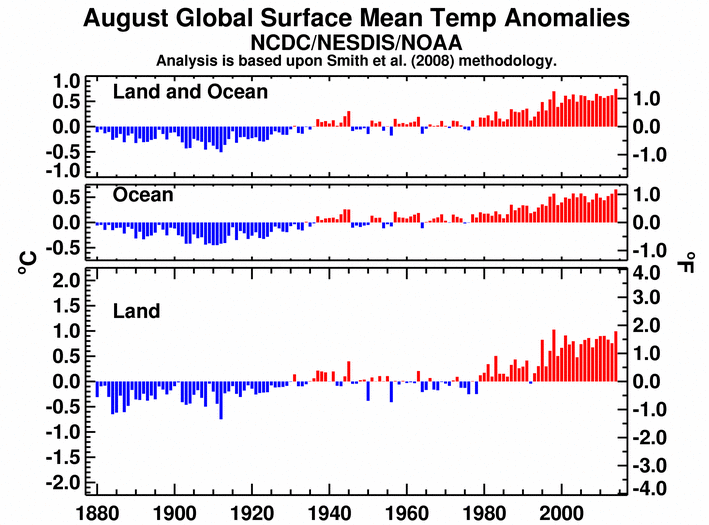
The Post cited a routine global analysis from the National Oceanic and Atmospheric Administration’s National Climatic Data Center, here, which said, “The combined average temperature across global land and ocean surfaces for August 2014 was record high for the month, at 0.75°C (1.35°F) above the 20th century average of 15.6°C (60.1°F), topping the previous record set in 1998.”
In addition, other climatic anomalies also increased, including drought over 32 percent of the US, the wettest summer in France since 1959, and the wettest August in Japan since 1946. Two typhoons bumped up the rainfall total in Japan, but tropical storms generally strengthened in the Pacific. Hurricane Iselle made landfall on Hawaii’s Big Island as a tropical storm on Aug 7, the first tropical storm to do so since 1992. It had, at one point, maximum winds of 220 km/h (137 mph).

The period between January and August was also the third warmest on record, the news site phys.org added from the report, which was released on Sept 18.
“If we continue a consistent departure from average for the rest of 2014, we will edge out 2010 for the warmest year on record,” the site quoted Jake Crouch, a NOAA climate scientist, as saying. “Another way to think of that, if the next four months—September through December—if each of those months rank among the five warmest on record, 2014 will be the warmest year on record for the globe.”
Explain why changes in environmental conditions may cause the local population of some plants and animals to increase, the population of others to decrease, and even brand new species to develop. See Next Generation Science Standard HS-LS4-5 and the research article here for more information.
In the research, Steven G Kuntz and Michael B Eisen recently discovered that fly embryos develop at different rates at different temperatures. Such an effect of temperature on development rates could have a positive or negative impact on different populations of flies, depending upon where they are in the world.
