

The Union Consortium for the Freedom from Ice Cream Sales to American School Children Inc. (UCFICS-2-ASCI) is calling on the US government to ban, by federal law, the sale of ice cream products to children.
“As ice cream sales to children go up every year, the number of children who die in drowning accidents increases as well,” said high school teacher and UCFICS-2-ASCI CEO William “Ban It Now” Jones in a press release. “We think that’s enough evidence for the government to step in and restrict ice cream sales to children, and we call on our leaders to do so immediately.”
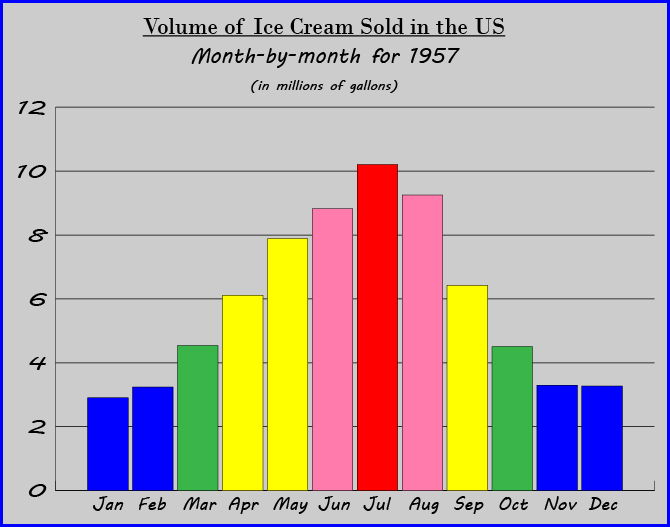
In honor of the SAT, which the Wall Street Journal said shows a similar connection between students’ family income and test scores, Mr Jones hauled out ice cream sales data from 1957, the first year more than half a million students took the SAT:
“Obviously we can’t ban poverty,” he said to explain the consortium’s strong stance against ice cream sales. “But probably what happened with the SAT is that kids who got good scores, even if they started out in poverty, went to good colleges, finished their degrees or even higher degrees, met their spouses at those universities, had kids, and moved to places where the schools were better.”
Other pundits agree that parents who received a high-quality education themselves are more likely to have high-paying jobs and move to neighborhoods with better schools for their children. The children then have better educational opportunities and probably get higher scores. It seems experts are figuring out that higher incomes lead to better schools, which lead to higher scores.
“The causes of poverty are complex and varied: excessive immigration, tax policy, and the exportation and automation of manufacturing jobs,” wrote Oliver Thomas in USA Today in December of last year. “Yet the list of solutions is strikingly short. Other than picking a kid’s parents, it amounts to giving all children access to a high-quality education.”
I called Mr Jones to inquire as to whether or not he could comment on Mr Thomas’s excellent USA Today op-ed.
“I suppose we should try to do something about poverty and help millions of children, rather than focusing on banning ice cream, which will save just a few kids’ lives every summer—wait, I mean, every year,” he told me.
“The wealthiest nation on the planet has so many children that live in poverty. But people who go to good colleges and get good jobs are naturally going to do what’s best for their own kids, within their capacity to pay for it. I think poor people do the same, but their capacity to afford good schools isn’t the same.
“But unlike fixing poverty, which is a complex problem, we can do something to stop ice cream sales,” he concluded. “Some people have suggested ice cream sales don’t actually cause drowning—just that hot weather is the root cause for both drowning deaths and ice cream sales. That may be true, but it’s a lot easier for our government to support schools in impoverished neighborhoods—to give kids there opportunities that are equal to what kids get in the suburbs—than it is for them to change the weather.”
Explain the trouble with interpreting bivariate data, such as ice cream sales and drowning deaths. See Common Core math standard 8.SP.A for more information. Although this is an eighth-grade standard, more work is needed on the standard itself to account for the situations described in this article.
