

Ever since I snapped a picture of a sign in the parking lot of a Japanese steak house in Jacksonville, Fla., that read, “Parking only for steak house … All others we be towed,” I’ve been on a campaign about using at least adequate writing skills in communicating with the public.
See, if someone’s car actually got towed away in the above situation, he or she could make the case that the towing was never posted, since the sentence, as written on the metal signs in the parking lot, is complete gibberish.
This morning, I found the sign below on a bus in Baltimore:
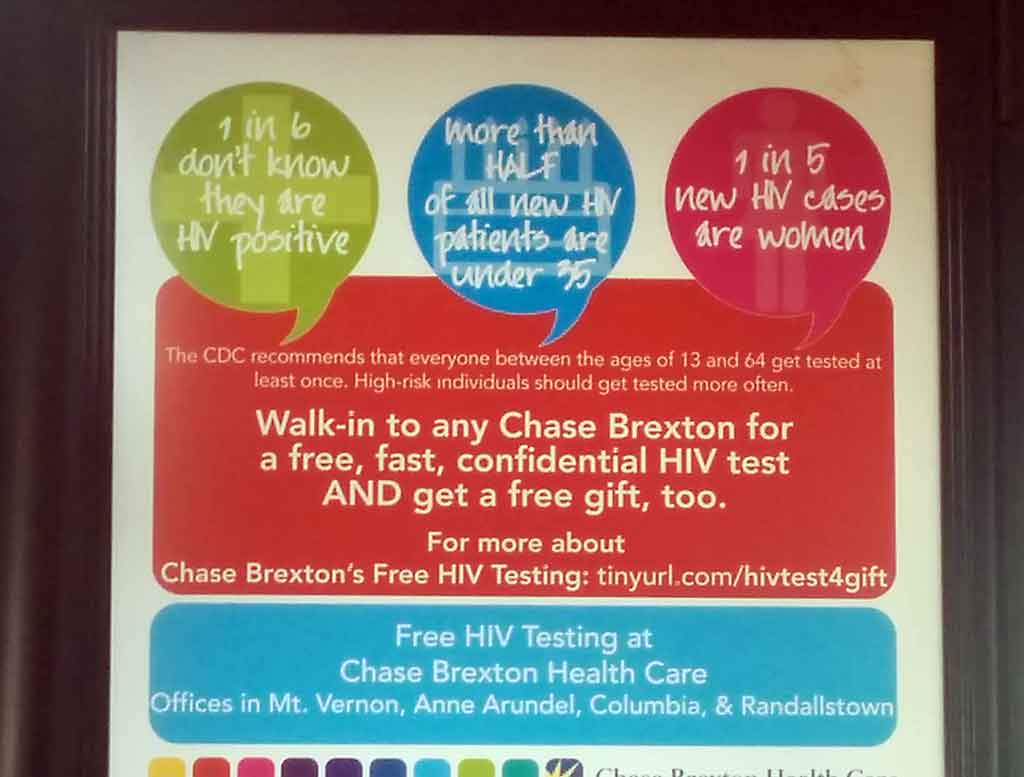
Let’s start at the top. Expressions like “1 in 6” mean a ratio to native speakers of English, and it may be obvious what the denominator is. But to accommodate better understanding, especially by nonnative speakers, who have to translate what they read into other languages, this expression has to include what the big group is. As it stands, it would probably be understood to mean “1 in 6 people in the whole world,” which is clearly not what’s intended, since that many people don’t even have HIV. The “6” is obviously referring to only people who are HIV-positive. Of those people, about 17 percent don’t know they have HIV.
The group is explicitly mentioned in the little bubble quote on the right: new HIV patients. Actually, it says “cases,” but I won’t quibble over that. It’s just sloppy, because “cases” might be misunderstood by nonnative speakers. The word has many, many meanings.
Now let’s look at subject-verb agreement. The subject of the left and right bubble quotes is “1.” Everything else before the plural verb is the object of a preposition, but many speakers would use a plural verb here, thinking that “1 in 5” is an adjectival phrase that describes “new HIV cases,” which is plural and the real subject of the sentence.
When I’m editing sentences like this, if I can’t figure out another way to say it, such as changing it to a percentage, I usually leave it the way it was originally written, since even I’m not sure about the rule here. The Chicago Manual of Style is silent on this question, and the Longman Grammar of Spoken and Written English says plural agreement has dominated our usage over the last century. The Cambridge Grammar of English Usage quotes this finding and adds, “For most writers the choice depends on whether you’re thinking of a single case or a general principle.”
But if the sentence is recast, the verb usually agrees with the word after “of” when referring to the proportion as a percentage. That construction is safe, so if possible, I usually change “1 in 5” to “20 percent of.” An example would be changing “He said 1 in 2 voters think voting is a waste of time,” which is certainly acceptable except for 17th-century purists, to “He said 50 percent of the electorate thinks voting is a waste of time.”
I won’t harp on subject-verb agreement here, since the problem doesn’t make the text misunderstood, but failing to specify what the “6” refers to is a real problem.
But what caught my eye and forced me to get out my cellphone to snap a picture was the big headline. Clearly, “walk-in” is not an imperative verb, because using the hyphen turns it into a noun describing a person walking into an establishment or an adjective describing something related to people who walk into an establishment, such as a walk-in ATM or walk-in customers. So, the ad here will really mess with nonnative speakers’ minds, although the sound is the same as what would be the correct way to write it.
We also need to say a little about “in to” vs “into” here. Usually, using “into” is correct: if the verb doesn’t need “in” as part of a verbal phrase, then it’s best to change “in to” to “into.” An exception would be something like “log in to our server.” Here, the verb “log” needs “in” because “log in” is a verbal phrase that changes the meaning of the word “log.” In other words, when I say “log in to our server,” the “in” is an adverb modifying “log” and the “to” is a preposition. So, if this is written in title case, it would be “Log In to Our Server.”
On the ad, though, the word “in” doesn’t change the meaning of the word “walk” at all, and the words “in to” should therefore be combined to “into.” As I said, though, it sounds the same, so it’s unlikely to trip anybody up when it comes to understanding the message.
As for the message, we have another writing problem. Should “all” 13-year-olds get tested? Is that really what the Centers for Disease Control and Prevention—which is what I assume “CDC” means, but which isn’t specified anywhere in the ad—would recommend? Let’s check.
The site AIDS.gov says, “Research indicates that a significant percentage of teens are sexually active, which automatically puts them at risk for contracting STDs, including HIV. Routine HIV screening also allows many teens to get tested for HIV, without having to disclose their sexual activity to their parents. (For current information on teen sexual risk behavior, see CDC’s Department of Adolescent and School Health.)”
In other words, yes, all 13-year-olds should get an HIV test, but one reason is that “routine” testing of all 13-year-olds means no individuals will have to disclose their sexual activity to their parents, according to AIDS.gov, our government.
So, this is an important message, if you believe “a significant percentage of teens are sexually active.” It should be written according to the rules of standard written English before companies spend our premium money to advertise it to the general public.
