

It may sound like a strange idea, but paying students to eat a fruit or vegetable is less expensive than just serving it, and paying them directly also reduces waste and increases the chances they’ll eat the fruit or vegetable you serve.
A new federal rule has prompted the nation’s schools to serve an extra $5.4 million worth of fruits and vegetables each day. However, the nation’s children throw about $3.8 million of that in the garbage.
Researchers from Brigham Young University and Cornell observed three schools adjust to new school lunch standards that require a serving of fruits or vegetables on every student’s tray—whether the child intends to eat it or not. As they report in the December issue of Public Health Nutrition, students discarded 70 percent of the extra fruits and veggies.
“We saw a minor increase in kids eating the items, but there are other ways to achieve the same goal that are much, much cheaper,” said BYU economics professor Joe Price.
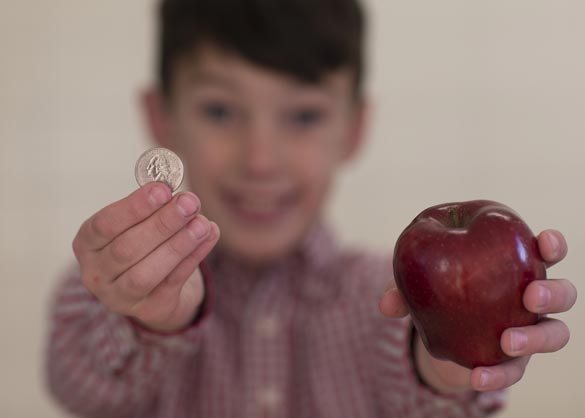
With Cornell’s David Just, Dr Price conducted a second study to measure the effect of small rewards in the lunchroom. The week-long experiments took on different twists in the 15 different schools—some could earn a nickel, others a quarter, and others a raffle ticket for a larger prize. But the results were generally the same. Offering small rewards increased the fruit and vegetable consumption by 80 percent, and the amount of wasted food declined by 33 percent.
“Parents are often misguided about incentives,” Dr Price said. “We feel a sense of dirtiness about a bribe. But rewards can be really powerful if the activity creates a new skill or changes preferences.”
The case against using bribes in parenting is perhaps best articulated in Alfie Kohn’s 1999 book Punished by Rewards. In many scenarios, the use of rewards can crush internal motivation. With healthy eating, for example, some fear that prizes will prevent children from developing their own motivation to eat things that are good for them. Another danger, known as a boomerang effect, is the possibility that some children would eat less fruits and vegetables when the rewards disappeared.
That’s why this research team measured fruit and vegetable consumption before and after the week-long experiments. When the week of prizes ended, students went back to the same level of fruit and vegetable consumption as before—no lasting improvement, but no boomerang effect either.
Now the researchers are studying whether extending the experiments over three to five weeks might yield lasting change. So far things look promising.
“I don’t think we should give incentives such a bad rap,” Dr Price said. “They should be considered part of a set of tools we can use.”
