

About 62 seconds of surreptitious video, not unlike the video from inside the Supreme Court that surfaced recently, has been posted on YouTube, a video that purports to show part of a professional development lecture for teachers in the Chicago Public Schools.
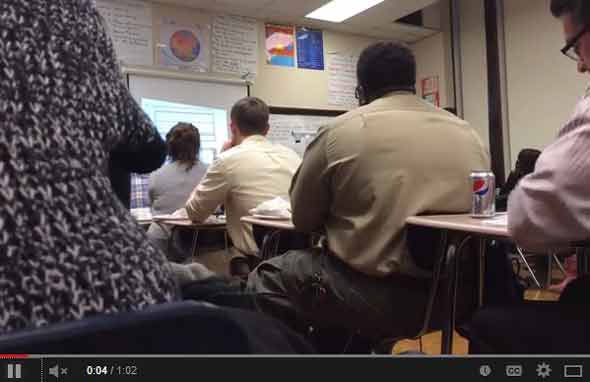
On YouTube
The out-of-context training session reminds me of direct instruction, an idea that sounds good when you first hear about it but sort of loses you after the first 10 or 20 seconds.
According to Wikipedia, a specific direct instruction technique was first developed in 1964 at the University of Illinois by Siegfried Engelmann. It is, however, “a general term for the explicit teaching of a skill-set using lectures or demonstrations of the material, rather than exploratory models such as inquiry-based learning.
“This method is often contrasted with tutorials, participatory laboratory classes, discussion, recitation, seminars, workshops, observation, active learning, practica or internships.”
It usually goes something like this:
Teacher: OK, class, whatever question I ask you, you say 1492. Do you understand?
Class (in chorus): Yes.
Teacher: What are you going to say?
Class (in chorus): 1492.
Teacher: Good. What year did Columbus discover America?
Class (in chorus): 1492.
Teacher (to Johnny): Johnny, what happened in 1492?
Johnny: Columbus discovered America.
On occasion, Johnny might answer “1492,” but for direct instruction aficionados, this is simply a teachable moment.
It’s not a bad way to teach vocabulary, and after all, that’s what we’re doing with teachers, isn’t it? We’re providing them with a new vocabulary, published in the Common Core. If we had wanted inquiry- or project-based learning, direct instruction styles would have been completely out of place. However, the Common Core is clearly not being implemented with an eye on inquiry- or project-based learning, at least not in Chicago, and I suspect in other school districts.
But for teaching kids a trick or two, as this third-grade teacher in Seattle demonstrates on the Teaching Channel, it might work for a while. When it starts to fade out, teachers can always turn to a contrived “turn and talk” or “pair share” so that every child gets to participate in the discussion, at least with one other student, not necessarily ever with an adult.
Let me give you an example of the echo chamber in the Chicago presentation:
Presenter: By Choosing
Teachers: By Choosing
Presenter: Flexibly
Teachers: Flexibly
Presenter: From a range of strategies
Teachers: From a range of strategies
So much time. So little information.
The presenter could have at least been a little more flexible by varying the length of the repeat-after-me phrase instead of using one or two words each time! I found this insulting. I mean, it works if we have to memorize a corporate slogan or mission statement, but with professionals who should choose from a range of strategies but still have to memorize by rote only one strategy, as dictated to them, it’s going to run out of steam quickly.
Many teachers also found the video insulting. One said in the comments, “Although the presenter may be attempting to demonstrate a ‘new’ teaching method, I can’t help but think using any similar method would be creating a society of mindless drones. I may only teach grade 2 students, but even they would be insulted at this type of instruction. My heart breaks for any teacher believing that this is effective instruction.”
So file this one in the “Walk a mile in their shoes” category, and empathize with teachers who tell you so much of what they have to do during their day has absolutely nothing to do with teaching. We’re talking about Domain Four in the Danielson Framework here. Professional development is important, of course, as Danielson recognized, but this does not count.
