In the production of the musical Grease at Cuyahoga Falls High School in Ohio, Kenickie walked onto the stage carrying a pizza box from a local pizza parlor, rather than a sack lunch, as the script calls for, the Wall Street Journal reports. The owner of Guys Pizza had donated $500 to the school’s production in exchange for this “product placement” on the high school stage.
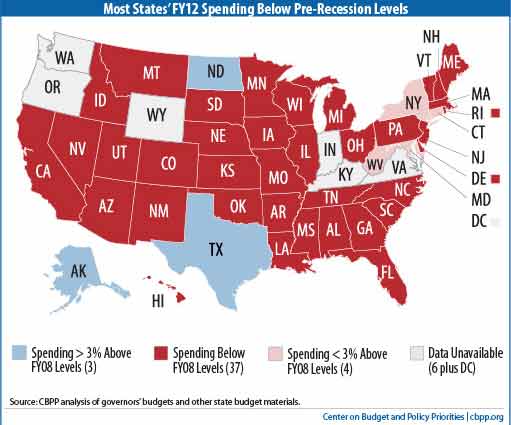
Overall state spending is down since the recession.
The trend is gaining in popularity across the country, since licensing agreements that provide royalties for authors often protect the words characters speak much more than the visual elements of the production.
Why drama clubs need to raise money
Drama clubs find themselves needing money more often these days. According to data from the Educational Theatre Association, which represents theater teachers, about one-third of school theater departments received substantial funding from their districts in 2012, compared to about one-half in 1991.
In addition, high school drama coaches have felt under pressure to produce slicker and slicker shows to keep the audience numbers up. This trend is nothing new, as high school productions, which double as educational activities allowing students to explore talents they may have, often involve many more students and parents than professional theater productions.
“The Bethlehem Catholic production [in Pennsylvania] had 68 kids in the cast, 18 middle and elementary school kids, and a technical crew of 30,” the Morning Call quoted one professional theater director as saying in 2004. “Northwestern Lehigh had 75 kids and a backstage crew of 15. There are more people working on one of these shows than in some Broadway musicals.”
So clearly, musicals involve a large number of students at high schools—more than certain sports at many high schools. And it serves the mission of the schools quite well. An October 2009 report by the Center for Arts Education in New York concluded, “In several national studies over the past decade, students at risk of dropping out cite participation in the arts as their reason for staying in school.”
The cost of being fabulous
Newer, more spectacular musicals have sky high licensing fees, the Journal reported. The new Shrek the Musical, for example, can cost a school up to $10,000 per production, depending on the amount of money the school expects to make, which is some function of the size of the theater and the number of shows performed.
According to Samuel French Inc, a licensing company, “The concept when assessing licensing fees is that the amount of the fee directly relates to the income potential of the box office, no matter how large or small. In instances of higher venue seating or increased ticket prices in the amateur market, a formula is used to calculate the appropriate fees considering factors of ticket price and seating capacity.”
All this means drama clubs have to come up with more and more money on their own. The Department of Education in New York reported that “outside arts funding included: Parent-Teacher or Parent Associations, private foundations, local businesses, state, local, and county arts agencies, education associations, federal, and state grants, City Council, in-kind donations from cultural organizations and business partners.”
The story here is about business partners, but it is by no means the only source of external funds. But grants tend to decrease every year and funding received from many school districts has also decreased over the last two decades, despite the higher costs associated with drama productions. For example, the Eyes on Iowa project at Drake University reported in 2010 that when the Des Moines Area School District needed to cut $11 million from its budget and did it across the board, “art and music departments were hit the hardest.”
The recession also made things worse, as the Washington Post reports, saying that about 95 percent of US schoolchildren attend schools that have cut their funding for arts programs since the recession.
While state law prevented Maryland from cutting funding to the schools—Maryland made up budget deficits by increasing the alcohol tax, increasing motor vehicle fees, cutting funding to Medicaid programs, and making public employees contribute more to their pensions—Illinois made significant cuts of about 11 percent to school funding after the recession.
Creativity often gives rise to more creativity
The decreased funding from school districts for drama productions, however, has led to some creativity in the marketing classes, as Cuyahoga Falls High School, located in a working-class community north of Akron, demonstrates. Ohio’s K-12 cuts in 2012 weren’t as severe as Illinois’s were—the state cut funding to the schools by 7.5 percent—but as one door closes, another one often opens.
“When I was in high school, we did a lot of boring things like bake pies and wash cars to make money” for activities, the Wall Street Journal quoted Paul Vincent, a lawyer and co-owner of Guys Pizza restaurant, as saying. He even had a walk-on role as a burger joint worker in Grease.
The product placement idea this year at Cuyahoga Falls began as a project in the college-prep marketing classes. Emily Knight, the school’s marketing teacher, said kids pitched the sponsorship idea door-to-door in the community and came back with a few ideas that made the musical’s director cringe.
The effort paid off, though. Cuyahoga Falls raised about $15,000 from the three-night production in their 1,500-seat auditorium, compared to about $5,000 from last year’s musical, without the product placement.