

Whenever parents ask their kids about math, whether it’s about money, or anything like that, it helps the kid, according to a third-grade math and science teacher at Bob Sikes Elementary School in Crestview, Fla., the News Bulletin reports.
A math coach, who works at several schools, was quoted as saying, “The Florida standards and the Common Core have increased the rigors over the past few years.” This makes students “learn to think for themselves,” said Jennifer Ferrell.
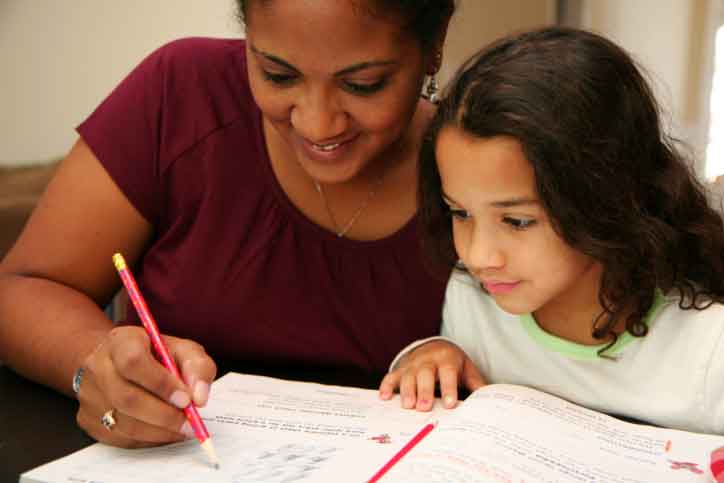
It helps, of course, if parents understand the math, science, literature, or whatever behind the homework assignment. But really, it may be just as important for them to be there, by their kids’ side, to listen and show an interest in what their children are learning at school.
Now, no one is suggesting that parents do the homework. Rather, they often serve more as monitors than as tutors.
Some busy parents who have a lot of money, in fact, hire professional homework helpers for their sons or daughters who can’t remain focused long enough to complete a homework assignment.
“I think it really came about as a result of very, very busy parents who needed some additional care given for their children after school and saw the opportunity to meld that with some academic support,” the New York Times quoted Robert Lauder, principal of Friends Seminary, a Manhattan private school, as saying. But, he said, “with any kind of support, there is the possibility of it becoming a crutch.”
As a general rule, tutors work better when a student is experiencing trouble learning French grammar or trigonometry. When the problem is one of focusing on homework, though, homework helpers can hone time-management or organizational skills or just sit there until a student completes the assignment.
So, at Bob Sikes parent night, several teachers had math problems ready for students to work on with parents by their side, showing once again that it can be necessary to educate parents as much as students. This parent education takes place not so much in school subjects as on being good homework helpers.
“One big thing we are focusing on this year is (having students) explain what they did and why,” the News Bulletin quoted one teacher as saying about math curricula, which have changed under the Common Core. If students are going to develop their explaining skills, an attentive, caring ear is a prerequisite.
Explain how to determine the difference between a low temperature of –8°F and a high temperature of 14°F on a very cold day. See the introduction to the Grade 7 math standards in the Common Core for more information.
