

Maryland School Assessment scores, given to third through eighth graders in math and reading as part of the accountability requirements outlined in No Child Left Behind and subsequent state and federal laws, took a slight step back in 2013, as state classrooms moved forward with new learning standards, according to data released today by the Maryland State Department of Education.
The percentage of elementary students scoring at the proficient levels in reading fell slightly from 88.2 percent in 2012 to 86.4 percent this year, while the percentage of elementary students scoring in the proficient levels in mathematics dropped from 87.7 to 83.9 percent. The percentage of middle school students scoring at proficient levels in reading improved from 82.1 percent in 2012 to 83.4 percent this year, while mathematics scores in the proficient range fell from 76.2 to 72.2 percent.
The results speak directly to the important changes that have been taking place in Maryland public school classrooms and across the country. Similar decreases in performance levels have been recorded in other states this year.
“We are in a transition period, both in Maryland and throughout the nation,” said State Superintendent of Schools Lillian M. Lowery. “Maryland schools have been implementing the Common Core State Standards in reading and mathematics, but new assessments aligned to the curriculum will not be ready for use until the 2014-15 school year. This misalignment will certainly affect our scores this year and next.”
Moving to the Common Core and PARCC
Maryland teachers and principals began implementing the Common Core State Standards to a large degree last school year, and the transition will be complete in the 2013-14 school year. In addition, schools this coming year will be field testing the new Partnership for Assessment of Readiness for College and Careers (PARCC) assessments that are aligned to the Common Core. The new tests purport to measure the critical content and skills embedded in the new standards.
“The Common Core is designed to prepare students for life beyond high school, and the difficulty of the assessments will rise accordingly,” Dr Lowery noted. “Results from the new assessments will provide students, parents, and teachers with much more information about where the students are, and reveal a clearer path to their futures. The Governor, the General Assembly, and MSDE will continue to make certain Maryland teachers and students have the support necessary to successfully make this transition.”
The PARCC assessments are being built to measure a full continuum of student abilities, including the performance of high- and low-performing students. The assessments [are being designed to] test writing skills at every grade level, as well as critical thinking and problem solving skills in an in-depth manner. In addition, the PARCC exams are computer-based, which will allow for timely snapshots of student knowledge that provide parents and students with richer information about performance, and give educators the opportunity to adjust instruction to better support learning.
Plans are for the new exams to be field-tested in every Maryland school in 2013-14, although only in certain grades. Other students will take the MSA one more time. Federal law requires that all students in grades 3-8 be tested each year in reading and mathematics, but Maryland intends to make certain that no student takes both assessments.
Once the new assessments are ready for full implementation in 2014-15, initial scores are expected to be lower than those on the MSA. The Common Core State Standards increase student rigor, which will make attaining a proficient score more difficult.
Other causes of the lower scores
Also affecting this year’s MSA scores is the end of the Modified Maryland School Assessment for special education students. More than 6,000 special education students took the general assessment for the first time in 2013, nearly 2 percent of the testing population.
The changes in curriculum and student population directly affected the 2013 results. Student subgroups in both race and special services categories showed moderate declines for 2013. The table below shows the percentage of Maryland students who scored proficient or better on the MSA, along with the change in the percentage from the 2012 results, in elementary and middle school grade levels for reading and math, separated first by the student’s race and then by the student’s special services category.
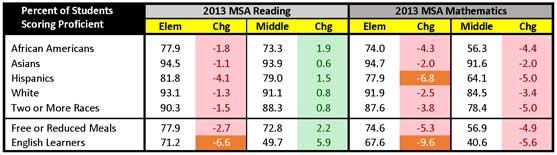
With the changes in the assessed student population, score differentials are most noticeable for students receiving special education services, with a modified version of the Maryland School Assessment no longer available. The percentage of special education students scoring in the proficient range in reading fell 6.5 points at the elementary level to 63.2 and fell 3.9 points at the middle school level to 47.1. In mathematics the percentage of students scoring in the proficient range fell 9.9 points at the elementary level to 51.8 and 10.6 points in middle school to 33.2.
Strong history of improvement
The Maryland School Assessment program replaced the Maryland School Performance Assessment Program (MSPAP) in 2003 in order to meet the requirements of the federal No Child Left Behind Act. That change in assessment program also caused school and system-level scores to drop.
Despite this year’s score moderation, results on the Maryland School Assessment have improved dramatically over the past decade. Strong improvements have been made across all racial and special service subgroup categories over the past decade, and the gaps in performance between student subgroups have diminished.
Since 2003, there has been:
- A 24.4 percentage point gain in elementary reading—from 62 to 86.4 percent proficient
- A 23.9 percentage point gain in elementary mathematics—from 60 to 83.9
- A 23.5 percentage point gain in middle school reading—from 59.9 to 83.4
- A 32.6 percentage point gain in middle school mathematics—from 39.6 to 72.2
Achievement gap reductions have been dramatic. For example, the gap between the percentage of White and African American students scoring at proficient levels in grade three reading stood at 30.8 points in 2003, and between White and Hispanic students at 33.1 points. By 2012, those percentages had been cut significantly—to 17.8 points between White and African American and 13.8 points between White and Hispanic students. (It should be noted that racial subgroup definitions changed in 2011, so comparisons are approximate.)
Moreover, the percentage of students scoring at the upper-level “advanced” range has increased significantly over the past decade. In 2013, 41 percent of the total proficient scores in elementary reading reached the advanced level, while 40 percent of elementary mathematics and 38 percent of middle school mathematics students scored advanced. More than 55 percent of all scores in the proficient range in middle school reading were at the advanced level.
More results on the way
Scheduled for release in the coming months are the 2013 MSA science scores at the elementary and middle school levels, High School Assessment scores, graduation rates, and attendance figures. Also coming are the School Progress Index (SPI) results, Maryland’s school accountability plan.
Statewide, system, and local school MSA data was scheduled to be available at noon today on the Maryland State Department of Education’s updated report card website, here.
