Two recent studies suggest that education might hold some power still to lift poor people into the middle class, regardless of how the middle class is shrinking in America, giving way to people who find themselves living in poverty or in affluent lifestyles.
First, what exactly do people mean by a “shrinking middle class” whenever they use that term? One way to think of it is visually. Imagine that at some point in the past, 10 percent of the population was living below the poverty line, which is based on household income and the number of people who depend on that income. For example, the 2013 “poverty line” for a family of four in the 48 contiguous states is $23,550. Four-person households that make less than that amount in 2013 are said to be living below the poverty line.
Also, consider that at that time, 10 percent of the population lived in households with annual incomes of, say, more than five times the federal poverty line. This scenario is demonstrated at the left of the graph below, which considers “Poor People” to be those living below the poverty line.
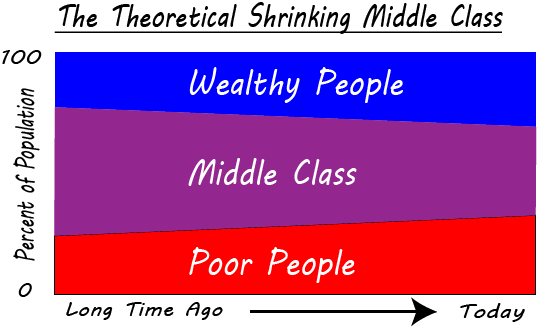
But as time went on, families that were once living above the poverty line started making less and less, either because family members lost their jobs, took a cut in pay, or had to fall back on part-time work. Because of the reduction in income, they now fall below the poverty line. At the same time, people who were closer to the top of he income distribution, making, say, four times the poverty limit, now have a greater effective income as a result of tax breaks, stock investments, or increases in other income sources. This scenario is represented at the right of the graph above.
That’s essentially what people mean when they talk about the “shrinking middle class.” People near the bottom fall below the poverty line, and those near the top make more. The rich get richer, and the poor get poorer, but there’s a net movement of people away from the middle of the income distribution when viewed against the poverty line.
The other way to look at a “shrinking” of the middle class is by the attitudes of people who are in the middle class. As stated above, many have seen their incomes reduced because of one factor or another, as PBS reported here in a series of eight graphs. According to the article, “the middle class has struggled to keep pace with smaller paychecks, mounting debt and shrinking opportunities for steady work.”
Educators often talk about trends in the opposite directions from those described above: they say education can help lift people out of poverty and propel them into the middle class. And that is what happens, to a certain extent, but some people have a higher probability of busting into the middle class from below the poverty line than others, according to a recent study by Raj Chetty, a Harvard economist, and a few other people.
- Larger tax credits for the poor and higher taxes on the affluent improved mobility only slightly
- Little or no correlation between mobility and the number of local colleges and their tuition rates
- Little or no correlation between mobility and the amount of extreme wealth in a region
- Size and dispersion of the local middle class affect mobility greatly: All else being equal, upward mobility tended to be higher in metropolitan areas where poor families were more dispersed among mixed-income neighborhoods.
- Mobility is higher in areas with more two-parent households, better elementary schools and high schools, and more civic engagement, including membership in religious and community groups
In an apparent partnership with researchers, the New York Times has published an interactive feature that will allow you to click on the area of the country in which you live and see the chances that a child whose parents earned an income in the 10th percentile of all earners will move up in the world. The report can be found here.
The original report emphasizes that no causation is implied in the study, just a strong correlation between upward mobility and the factors identified above: the local middle class areas being peppered with lower-income families, the quality of the elementary and high schools, and the level of civic engagement.
Another interesting corollary of the study is that the factors affect middle- and low-income children much more than they affect high-income children. That is, poor children can get a substantial boost from improvements made to the factors, but reductions in the quality of those factors is not likely to change the mobility of wealthy students very much.