A Maryland bill that would raise the maximum speed limit on interstate highways and other limited-access roads, H.B. 555, passed in the House of Delegates, 133-0, on Feb 20, following a vote of 22-0 in the Environmental Matters Committee last week, the Carroll County Times reports.
The bill now heads to the Senate Judicial Proceedings Committee, where a similar bill died last year after a unanimous approval in the House.
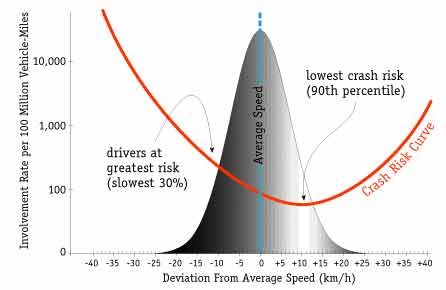
Contrary to popular belief, slower drivers are at greater risk (B.C.-SENSE)
If the bill becomes law as it’s written now, the maximum speed limit would increase to 70 mph. According to the Fiscal and Policy Note attached to the bill, the move would put Maryland with 22 other states where the maximum speed limit is 70 mph. According to the note:
- One state has a maximum speed limit of each 60 mph, 80 mph, and 85 mph.
- 11 states, including Maryland, have a maximum limit of 65 mph.
- 22 states set the maximum limit at 70 mph, the most common speed.
- 14 states have a maximum limit of 75 mph.
The full list of states, along with some special conditions for urban areas in some states and other special considerations, is available from the Insurance Institute for Highway Safety, here.
A report from the Institute of Transportation Engineers says, “Drivers traveling significantly faster or slower than the 85th percentile speed (the speed below which 85 percent of cars travel when not impeded by traffic or the presence of law enforcement) are at a greater risk of being in a crash.”
We reported in December that there was a loud call on the Illinois Tollway Administration to increase the maximum speed limit on tollways around Chicago from 55 mph to 70 mph as a result of a study that found the 85th percentile speed on the roads was 72 mph.
The change on Maryland’s roads won’t be as much as the Illinois Tollway is considering, but the primary people affected by speed limits that are too far below the 85th percentile speed are kids. They are taught in their driver’s ed classes to stay within the speed limit. We’re actually instructing them to drive unsafely, and it’s not right.
The setting of the maximum allowable speed limit wouldn’t affect any roads right away; it just allows the possibility of a higher speed limit. The actual speed limit on each road, under this bill, would be be set by the state on a case-by-case basis.
Other resources on the Internet
- An article in Copenhagenize.com that argues that any study that computes the 85th percentile speed needs to consider pedestrians and cyclists. Well, pedestrians and bicyclists aren’t allowed on interstate or other limited-access roads in Maryland, so it’s a moot point, but it’s a well written article with a few nice graphs for the math geeks among us.
- An annotated bibliography posted by SENSE, the society for Safety by Education Not Speed Enforcement in British Columbia. They say the graph for risk reaches a minimum at about the 90th percentile speed. Be sure to explore the links in the menu bar at the top of the page.
- An informational report from the Federal Highway Administration describing methodologies used in establishing speed limits (engineering approach, expert systems, optimization, and injury minimization). It also reviews the basic legalities of speed limits and presents several case studies for setting speed limits on a variety of roads.