

The Intergovernmental Panel on Climate Change, a United Nations group that occasionally summarizes climate science, says in a new report that the effects of climate change, formerly known as global warming, will get worse unless we do something to bring greenhouse gas emissions under control, the New York Times reports. A few effects have had an impact on every continent:
- Ice caps are melting and sea ice is collapsing in the Arctic
- Water supplies are coming under stress
- Heat waves and heavy rains are intensifying
- Fish and other creatures are migrating toward the poles
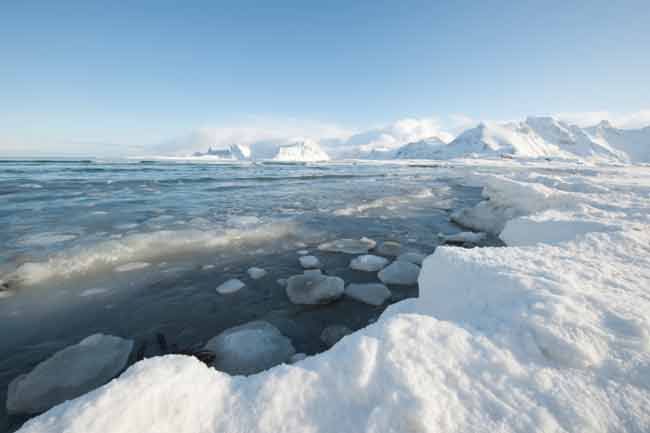
A glacier on the island of Moskensoy in Norway
Some frequently asked questions about climate change might be helpful to schools or other concerned citizens. The document answers the question, “Are we seeing impacts of recent climate change?” with the following:
Yes, there is strong evidence of impacts of recent observed climate change on physical, biological, and human systems. Many regions have experienced warming trends and more frequent high-temperature extremes. Rising temperatures are associated with decreased snowpack, and many ecosystems are experiencing climate-induced shifts in the activity, range, or abundance of the species that inhabit them.
Oceans are also displaying changes in physical and chemical properties that, in turn, are affecting coastal and marine ecosystems such as coral reefs, and other oceanic organisms such as mollusks, crustaceans, fishes, and zooplankton.
Crop production and fishery stocks are sensitive to changes in temperature. Climate change impacts are leading to shifts in crop yields, decreasing yields overall and sometimes increasing them in temperate and higher latitudes, and catch potential of fisheries is increasing in some regions but decreasing in others. Some indigenous communities are changing seasonal migration and hunting patterns to adapt to changes in temperature.
The report has more than 30 chapters, so it clearly can’t be summarized in a blog post. However, one of the most interesting aspects of the report, as I read it, was the social and economic effect climate change is having on our culture—not so much because of the hot temperatures or heavy precipitation, which causes enough problems, but because of the adjustments we have to make to live in a world where climate change is happening at the rate it is.
Good thing humans are one of the most adaptable species on Earth, unless you count the cockroaches.
Via press release, March 31, out of Yokohama, Japan
The Intergovernmental Panel on Climate Change (IPCC) issued a report today that says the effects of climate change are already occurring on all continents and across the oceans. The world, in many cases, is ill-prepared for risks from a changing climate. The report also concludes that there are opportunities to respond to such risks, though the risks will be difficult to manage with high levels of warming.
The report, titled Climate Change 2014: Impacts, Adaptation, and Vulnerability, from Working Group II of the IPCC, details the impacts of climate change to date, the future risks from a changing climate, and the opportunities for effective action to reduce risks. A total of 309 coordinating lead authors, lead authors, and review editors, drawn from 70 countries, were selected to produce the report. They enlisted the help of 436 contributing authors, and a total of 1,729 expert and government reviewers.
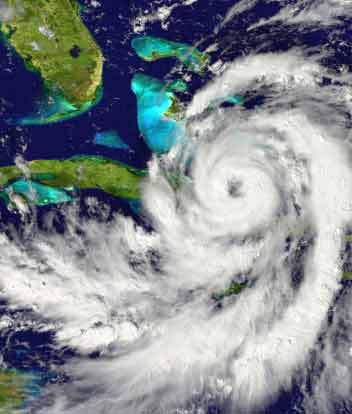
Above: A hurricane over Cuba. From the report: The impacts of extreme weather events depend on the frequency and intensity of the events, as well as exposure and vulnerability of society and assets. The last several decades have seen changes in the frequency and intensity of extreme weather events including extreme temperature, droughts, heavy rainfall, and tropical and extratropical cyclones with low to very high confidence, depending on the type of extreme event. However, the impacts of extreme weather events also depend on the vulnerability and exposure of systems. It is possible that climate change can affect vulnerability and exposure, but typically both are primarily influenced by non-climate confounders, most notably economic development.
The report concludes that responding to climate change involves making choices about risks in a changing world. The nature of the risks of climate change is increasingly clear, though climate change will also continue to produce surprises. The report identifies vulnerable people, industries, and ecosystems around the world. It finds that risk from a changing climate comes from vulnerability (lack of preparedness) and exposure (people or assets in harm’s way) overlapping with hazards (triggering climate events or trends). Each of these three components can be a target for smart actions to decrease risk.
“We live in an era of man-made climate change,” said Vicente Barros, Co-Chair of Working Group II. “In many cases, we are not prepared for the climate-related risks that we already face. Investments in better preparation can pay dividends both for the present and for the future.”
Adaptation to reduce the risks from a changing climate is now starting to occur, but with a stronger focus on reacting to past events than on preparing for a changing future, according to Chris Field, Co-Chair of Working Group II.
“Climate-change adaptation is not an exotic agenda that has never been tried. Governments, firms, and communities around the world are building experience with adaptation,” Field said. “This experience forms a starting point for bolder, more ambitious adaptations that will be important as climate and society continue to change.”
Future risks from a changing climate depend strongly on the amount of future climate change. Increasing magnitudes of warming increase the likelihood of severe and pervasive impacts that may be surprising or irreversible.
“With high levels of warming that result from continued growth in greenhouse gas emissions, risks will be challenging to manage, and even serious, sustained investments in adaptation will face limits,” said Field.
Observed impacts of climate change have already affected agriculture, human health, ecosystems on land and in the oceans, water supplies, and some people’s livelihoods. The striking feature of observed impacts is that they are occurring from the tropics to the poles, from small islands to large continents, and from the wealthiest countries to the poorest.
“The report concludes that people, societies, and ecosystems are vulnerable around the world, but with different vulnerability in different places. Climate change often interacts with other stresses to increase risk,” Field said.
Adaptation can play a key role in decreasing these risks, Barros noted. “Part of the reason adaptation is so important is that the world faces a host of risks from climate change already baked into the climate system, due to past emissions and existing infrastructure,” said Barros.
Field added: “Understanding that climate change is a challenge in managing risk opens a wide range of opportunities for integrating adaptation with economic and social development and with initiatives to limit future warming. We definitely face challenges, but understanding those challenges and tackling them creatively can make climate-change adaptation an important way to help build a more vibrant world in the near-term and beyond.”
Rajendra Pachauri, Chair of the IPCC, said: “The Working Group II report is another important step forward in our understanding of how to reduce and manage the risks of climate change. Along with the reports from Working Group I and Working Group III, it provides a conceptual map of not only the essential features of the climate challenge but the options for solutions.”
The Working Group I report was released in September 2013, and the Working Group III report will be released in April 2014. The IPCC Fifth Assessment Report cycle concludes with the publication of its Synthesis Report in October 2014.
“None of this would be possible without the dedication of the Co-Chairs of Working Group II and the hundreds of scientists and experts who volunteered their time to produce this report, as well as the more than 1,700 expert reviewers worldwide who contributed their invaluable oversight,” Pachauri said.
